Alphabell.
Updated daily

Daily radar

New work where AI improves AI, picked each day from public sources by our editor pipeline. Every item states its loop and links to the original.

What today's radar picked, by part of the AI stack
Agents and harness 5Compute stack 1Data and training signal 2

Last run 2 Oct 2026, 20:29 UTC · 31 of 31 sources checked · 56 candidates scored · 8 published · RSS · Sources · How it works

2 Oct 2026

8 picked
PaperarXiv·29 Sep 2026·Training data

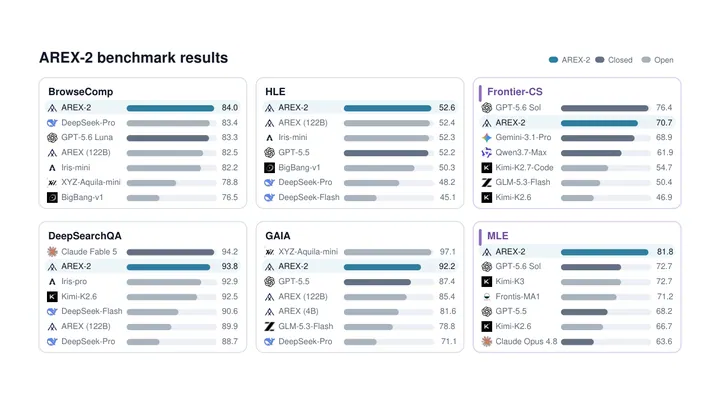
AREX-2: Advancing Self-Improving Agents through Long-Horizon Reflective Tasks

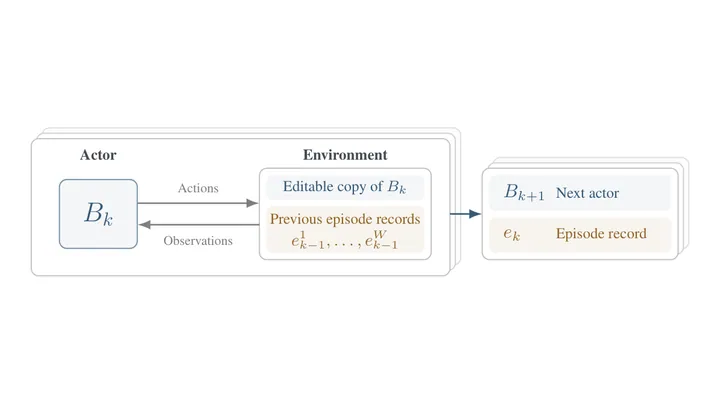
The loop: The AREX-2 agent synthesizes long-horizon improvement trajectories from ML engineering tasks and uses them to train its successor for better performance on MLE-bench.

AREX-2 trains an agent on synthesized long-horizon improvement trajectories from ML and programming tasks to advance its self-improving capabilities.
loop fit 9/10Hongjin Qian, Chaofan Li, Kun Luo et al.via arXiv
AREX-2: Advancing Self-Improving Agents through Long-Horizon Reflective Tasks
PaperarXiv·29 Sep 2026·Self-modifying agents

SelfSearch: Reward-Free Search for Self-Improving Agents

The loop: An LLM agent modifies its own instructions and tools using records of its own previous attempts, improving its success rate on future tasks.

SelfSearch enables agents to improve their own instructions and tools using records of past self-modification attempts without needing downstream reward signals.

loop fit 9/10Jungwoo Yang, Injin Kong, Yohan Jovia arXiv
SelfSearch: Reward-Free Search for Self-Improving Agents
PaperarXiv·29 Sep 2026·Self-reward and self-play

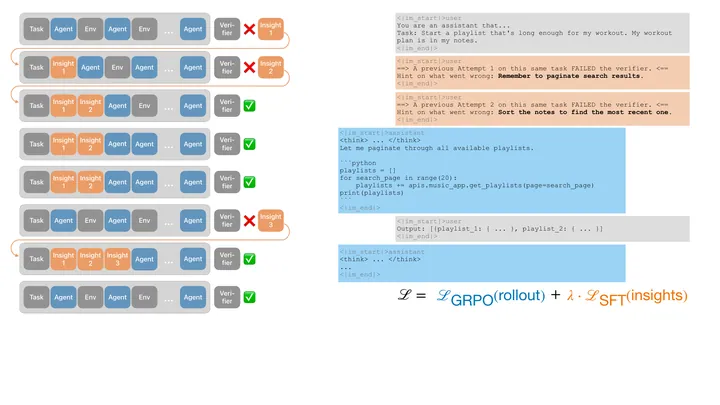
RLTL;DR: Self-improvement by Internalizing Self-generated Feedback

The loop: A policy model generates its own feedback insights from failed attempts and internalizes them through training, improving its success rate on future rollouts.

RLTL;DR allows a policy to write and internalize its own feedback insights from failed attempts, breaking through learning barriers on difficult tasks.

loop fit 9/10Michael Kirchhof, Eleonora Gualdoni, Andrew Szot et al.via arXiv
RLTL;DR: Self-improvement by Internalizing Self-generated Feedback
PaperarXiv·29 Sep 2026·Tools and harness

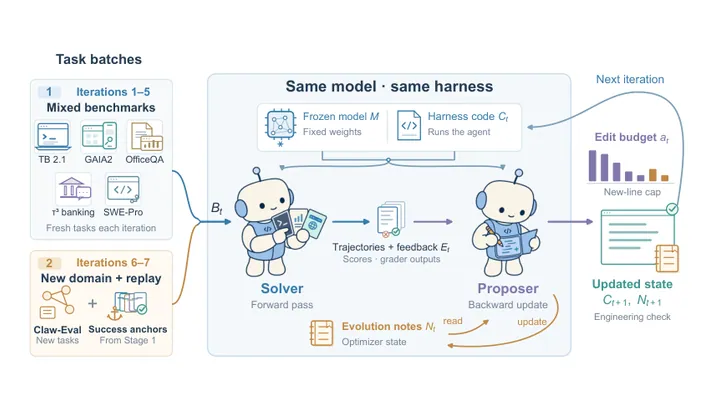
Self-Evolving Harness on Multiple Tasks with the Agent as Its Own Optimizer

The loop: A frozen model acts as a solver to generate run records and then as a proposer to edit its own harness, improving its performance on subsequent tasks.

A framework where a frozen model first solves tasks and then edits its own harness based on run records to improve performance across diverse domains.

loop fit 9/10Qiankai Xuvia arXiv
Self-Evolving Harness on Multiple Tasks with the Agent as Its Own Optimizer
ProjectGitHub·17 Apr 2026·Self-modifying agents

ModernOps888/the-forge

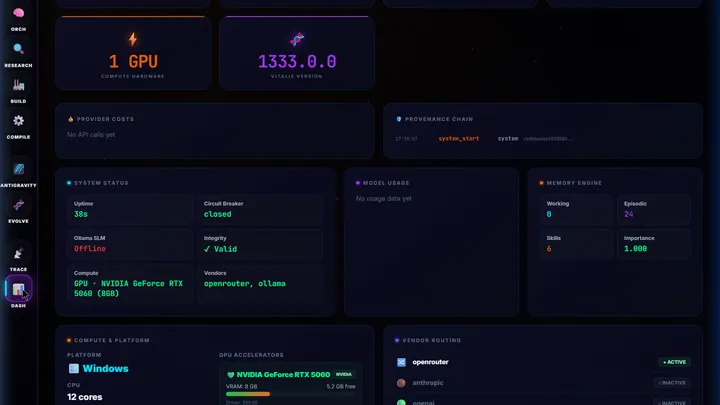
The loop: Four LLMs compete to evolve and breed code through a JIT compiler judge, creating a closed loop of code improvement that enhances their own capabilities.

A multi-agent platform where four LLMs compete and evolve code using a JIT compiler as a judge.

loop fit 9/10ModernOps888via GitHub
ModernOps888/the-forge
ReleaseGitHub·28 Sep 2026·Self-modifying agents

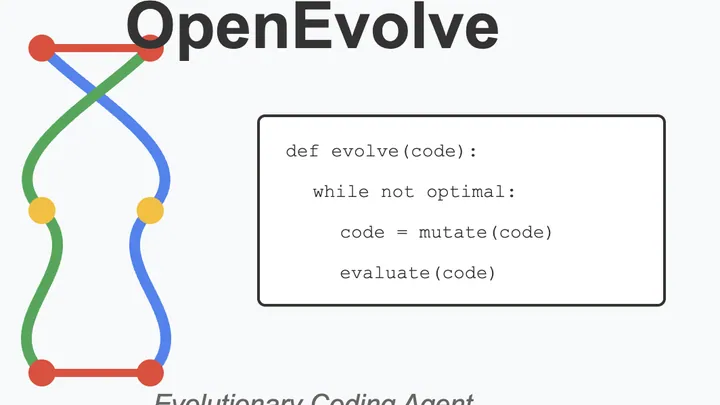
algorithmicsuperintelligence/openevolve: v0.4.0

The loop: The OpenEvolve system uses pluggable selection strategies and program validation to evolve code, capturing token usage and enforcing evolution blocks for its own mutations.

A release of OpenEvolve introducing pluggable island selection, token tracking, and evolution block enforcement for self-modifying code.

loop fit 8/10codelionvia GitHub releases
algorithmicsuperintelligence/openevolve: v0.4.0
ProjectGitHub·13 Aug 2026·Tools and harness

ZK-Andy/dsh-continual-evolve

The loop: A continual self-evolution plugin refines the DeepSeek Harness state based on session trajectories, using a benchmark-driven loop to validate and improve its own harness.

A plugin for DeepSeek Harness that enables versioned, rollback-safe continual self-evolution from session trajectories.

loop fit 8/10ZK-Andyvia GitHub
ZK-Andy/dsh-continual-evolve
Blog postPyTorch·2 Oct 2026·Kernels and compilers

Building a High-Performance and Portable vLLM Linear Backend with Helion

The loop: The Helion autotuner uses a DSL to generate high-performance kernels for vLLM, which then runs LLM inference more efficiently for future tasks.

Helion is integrated into vLLM's linear backend to autotune high-level kernel DSLs, improving LLM inference performance.

loop fit 7/10Sean Chen (Red Hat) and Shangdi Yu (PyTorch, Meta Platforms)via PyTorch
Building a High-Performance and Portable vLLM Linear Backend with Helion