Alphabell.
Daily edition

Radar, 3 Nov 2026

Today's edition highlights systems that optimize their own operational environments, from runtime harness editing to meta-controlling experience retrieval.

PaperarXiv·1 Nov 2026·Tools and harness

Exo: An Architecture for Self-Improving Systems at Runtime

The loop: The Exo agent autonomously edits its own harness code and strategies during task execution. These inspectable code changes are preserved and activated to reduce costs and improve performance on subsequent tasks.

An agent runtime architecture that collapses the optimization loop into task execution by allowing agents to revise their own harness and strategies on the fly.
loop fit 9/10Chaoyun Zhang, Bingxuan Li, Pinxue Guo et al.via arXiv
Exo: An Architecture for Self-Improving Systems at Runtime
PaperarXiv·2 Nov 2026·Tools and harness

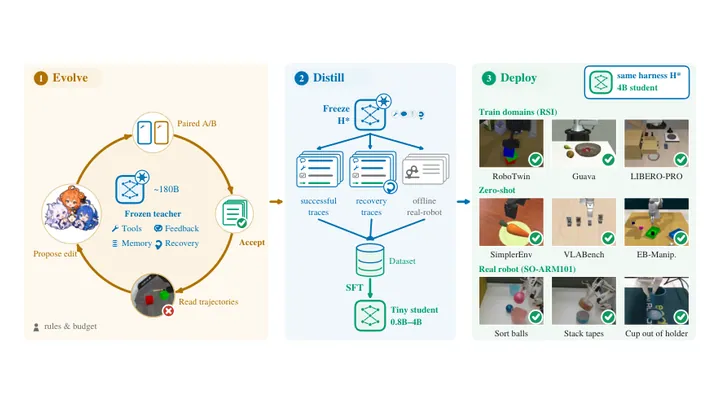
TinyAstral: Transferring Self-Evolving Harnesses to Tiny Generalist Manipulation Agents

The loop: Frontier agents propose and statistically validate edits to a teacher model's harness. The improved harness is then used to collect successful trajectories to distill a compact student agent that operates in that same evolved harness.

A two-stage approach that uses frontier models to evolve a teacher's harness before distilling a compact student agent to run in it.

loop fit 9/10Yanbei Jiang, Chao Lei, Rena Gao et al.via arXiv
TinyAstral: Transferring Self-Evolving Harnesses to Tiny Generalist Manipulation Agents
PaperarXiv·30 Oct 2026·Self-reward and self-play

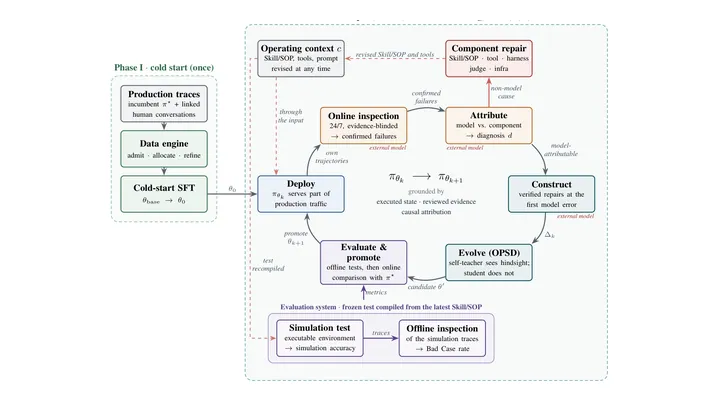
CARE: Grounded Recursive Self-Improvement for Production Customer-Service Agents

The loop: The CARE agent identifies its own production failures and pairs them with independently verified repairs. It then uses on-policy self-distillation to update its own weights, improving its performance on future customer service traffic.

A customer service agent framework that learns continuously in production by diagnosing its own errors and distilling the repaired trajectories.

loop fit 9/10Kehong Gong, Xiaoxu Zheng, Guanli Hou et al.via Hugging Face Papers
CARE: Grounded Recursive Self-Improvement for Production Customer-Service Agents
PaperarXiv·30 Oct 2026·Self-modifying agents

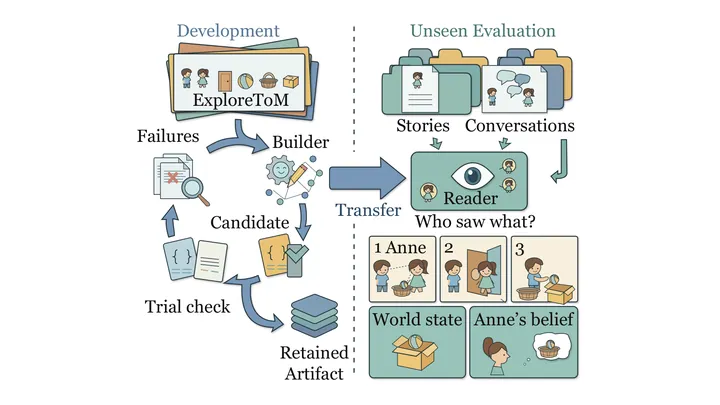
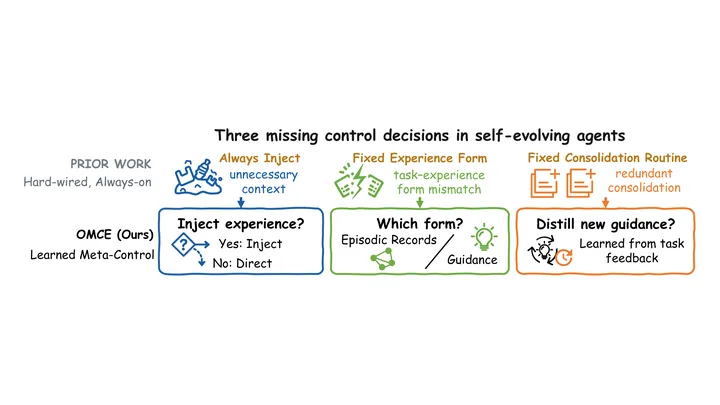
Evolving Memory, Learning to Meta-Control: Test-Time Adaptation for Experience-augmented LLM Agents

The loop: The OMCE meta-controller uses task feedback to update its memory bank and refine its own routing policy via contextual bandit updates. This improves how the agent retrieves and utilizes experience in future tasks.

A framework that allows self-evolving agents to learn a meta-control policy from task feedback to better manage and deploy their accumulated experience.

loop fit 9/10Jun He, Canmiao Fu, Ying Zhang et al.via arXiv
Evolving Memory, Learning to Meta-Control: Test-Time Adaptation for Experience-augmented LLM Agents
PaperarXiv·31 Oct 2026·Research automation

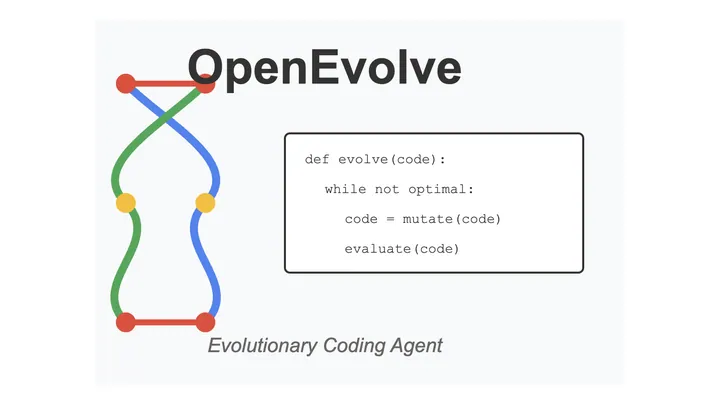
algorithmicsuperintelligence/openevolve: v0.4.1

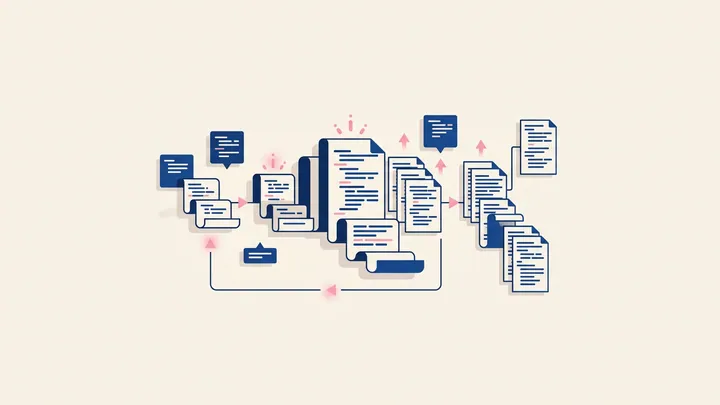
The loop: The OpenEvolve framework uses mixed evolution modes and competitive checkpoints to iteratively refine programs. It records the mode used on each program in an evolution trace to improve the evolution process.

A new release of an open source evolution framework that adds mixed evolution modes and interoperability with AlphaEvolve.

loop fit 8/10Yandan zheng, Haoran Luo, Xinliang Zhou et al.via arXiv
algorithmicsuperintelligence/openevolve: v0.4.1
PaperarXiv·30 Oct 2026·AI R&D evals

More Rules, Longer Lists? Benchmarking Self-Evolving Agents on a Hidden-Rule Curriculum

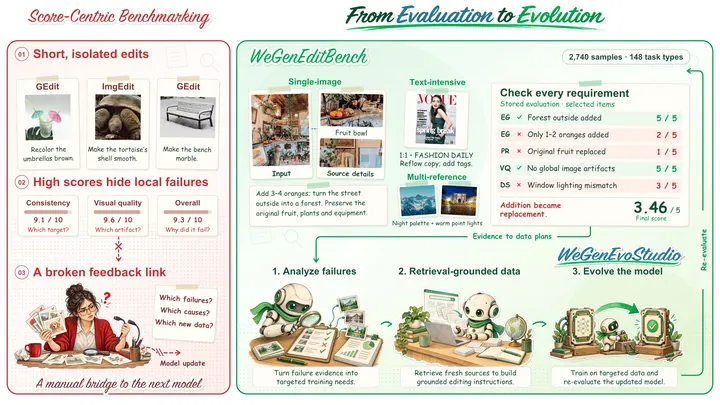
The loop: Self-evolving agents rewrite their persistent state from feedback to learn latent rules. CLR-Bench measures this ability, providing a metric to evaluate and improve self-improvement capabilities.

A benchmark that tests whether self-evolving agents can learn hidden rules by rewriting their persistent state from feedback.

loop fit 8/10Alexander Krentsel, Sylvia Ratnasamy, Ion Stoica et al.via arXiv
More Rules, Longer Lists? Benchmarking Self-Evolving Agents on a Hidden-Rule Curriculum
PaperarXiv·1 Nov 2026·Training data

When Requirements Interact: Scaling Long-Horizon Coding via Interdependent Specifications

The loop: A synthesis agent iteratively develops coupled task requirements and executable tests. These synthesized tasks are used to train more capable coding agents for long horizon software development.

A framework where a synthesis agent iteratively develops coupled task requirements and executable tests to train coding agents on long horizon tasks.

loop fit 8/10Zeyuan Zhao, Yuanyuan Shi, Peng Yu et al.via arXiv
When Requirements Interact: Scaling Long-Horizon Coding via Interdependent Specifications
ReleaseGitHub·2 Nov 2026·Interpretability and oversight

Training activation classifiers for safety and alignment

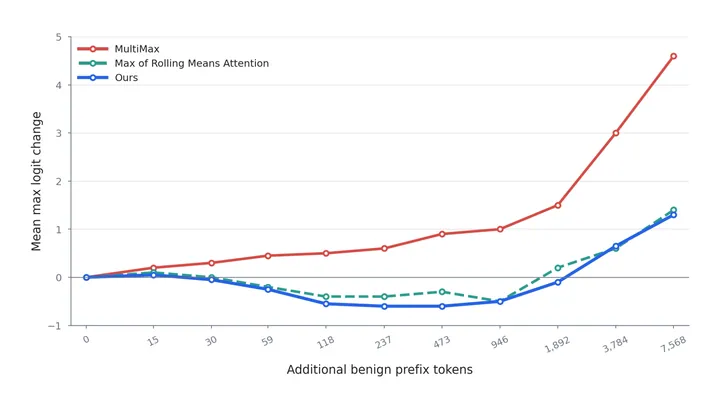
The loop: Activation classifiers monitor a model's internal activity to detect policy violations. This improves the safety and alignment of the model, making it safer to deploy and use for further development.

A method for training efficient monitors that use a model's internal activity to detect and interrupt policy violating behavior in real time.

loop fit 7/10codelionvia GitHub releases
Training activation classifiers for safety and alignment
Blog postOpenAI·2 Nov 2026·Interpretability and oversight

Training activation classifiers for safety and alignment

The loop: Activation classifiers monitor a model's internal activity to detect policy violations, which improves the safety and alignment of the model, which makes the model safer to deploy and use for further development.

We show how we train and deploy efficient monitors that use a model’s internal activity to help detect and interrupt policy-violating behavior in real time.

loop fit 7/10Alex Makelov, Xiaojun Xu, Sundaram Ananthanarayanan, Ethan Mcdonald, Tom Dupre...via OpenAI Alignment
Training activation classifiers for safety and alignment
Blog postOpenAI·2 Nov 2026·Tools and harness

Scaling Git at OpenAI

The loop: Codex generates code at a scale that necessitates a new Git backend, which improves the development infrastructure for OpenAI models, which makes the development of Codex and its successors more efficient.

How OpenAI built Pando, a Git-compatible backend designed for the scale of development that Codex makes possible.

loop fit 6/10via OpenAI
Scaling Git at OpenAI
Blog postNVIDIA·2 Nov 2026·Tools and harness

Keep Distributed Training Running with Automated Workload Recovery

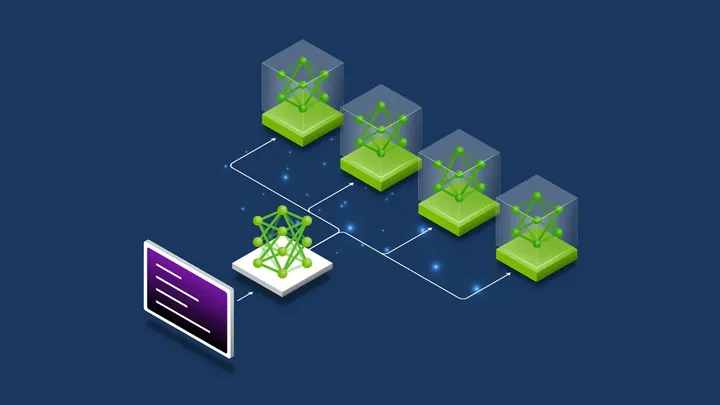
The loop: Automated Workload Recovery detects and recovers from hardware and software failures during training, which improves the efficiency of distributed training runs, which makes the development of large models faster.

As distributed AI training scales, failures across hardware and software dependencies increasingly disrupt training progress, making fast, reliable recovery...

loop fit 6/10Elizabeth Goodmanvia NVIDIA Technical Blog
Keep Distributed Training Running with Automated Workload Recovery

← 2 Nov 2026 Latest