Alphabell.
Daily edition

Radar, 16 Nov 2026

Today's radar highlights systems that rewrite their own operational boundaries, from agents evolving their reinforcement learning harnesses to models directly programming the weights of other networks.

PaperarXiv·16 Nov 2026·Tools and harness

ModHarness-RL: Recasting Harnesses as Learnable and Evolving Programs for Agentic RL

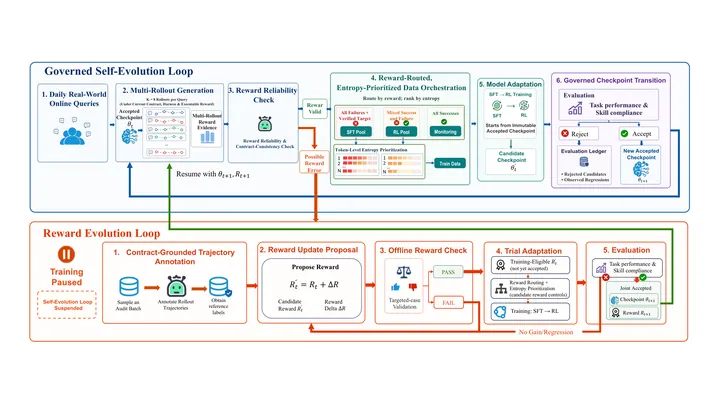
The loop: The agentic reinforcement learning system proposes and verifies new harness programs based on its recent trajectories. These updated compression and steering programs then guide the agent's ongoing training, creating a continuous cycle of harness evolution.

An agentic reinforcement learning framework that continuously evolves its own execution harness by learning compression and steering programs from its training trajectories.

loop fit 9/10Siqi Guo, Ming Lin, Tianbao Yangvia arXiv
ModHarness-RL: Recasting Harnesses as Learnable and Evolving Programs for Agentic RL
PaperarXiv·16 Nov 2026·AI R&D evals

WeightBench: Evaluating Language Models as Weight-Space Programmers

The loop: Large language models are evaluated on their ability to read, fix, and write the weights of other neural networks without gradient descent. This benchmark provides the measurement needed to train models that can directly program the weights of their successors.

A benchmark of 42 tasks that evaluates how well frontier language models can directly read, edit, and write the weights of other neural networks.

loop fit 9/10Yuechun Yu, Wenzheng Kong, Xiaofeng Mao, Jin Zhangvia arXiv
WeightBench: Evaluating Language Models as Weight-Space Programmers
PaperarXiv·13 Nov 2026·Self-modifying agents

Evidence-Governed Adoption of Self-Generated Updates in Autonomous AI Agents

The loop: An autonomous agent generates candidate modifications to its own prompts, tools, and workflows based on its interaction history. A governance framework then evaluates these candidates against fresh audits and adopts the successful ones, permanently upgrading the agent's capabilities.

A framework that rigorously evaluates and filters self-generated modifications to an autonomous agent's prompts and tools before permanently adopting them.

loop fit 9/10Hoang Tran Vuong, Linh Ngo Van, Dang Nguyen et al.via arXiv
Evidence-Governed Adoption of Self-Generated Updates in Autonomous AI Agents
PaperarXiv·16 Nov 2026·Kernels and compilers

DRTriton: Large-Scale Synthetic Data Driven Reinforcement Learning for Triton Kernel Generation

The loop: A large language model is trained via reinforcement learning to convert PyTorch programs into optimized Triton kernels. These kernels are then compiled to CUDA to accelerate the execution of the model itself.

A scalable learning framework that uses reinforcement learning to train large language models to generate highly optimized Triton kernels from PyTorch reference implementations.

loop fit 9/10Zelin He, Siyu Zhu, Jacob Helwig, Yujian Liu, Li An, Rohit Jain, Shiyu Chang,...via arXiv
DRTriton: Large-Scale Synthetic Data Driven Reinforcement Learning for Triton Kernel Generation
PaperarXiv·12 Nov 2026·Research automation

A step toward defining the Standard Model on a lattice

The loop: GPT-6 Astra assists researchers in generating a detailed proof for a nonperturbative lattice definition of the Standard Model. This successful application of AI to advanced theoretical physics generates high-quality reasoning trajectories that serve as training data for future models.

OpenAI details how GPT-6 Astra helped researchers turn a candidate definition of the Standard Model into a detailed mathematical proof.

loop fit 6/10Subodh Lonkarvia Hugging Face Papers
A step toward defining the Standard Model on a lattice
Blog postOpenAI·15 Nov 2026·Research automation

A step toward defining the Standard Model on a lattice

The loop: GPT-6 Astra assists in generating a detailed proof for the Standard Model, producing high quality reasoning data for its successors.

Explore a candidate nonperturbative lattice definition of the Standard Model and how GPT-6 Astra helped turn the idea into a detailed proof.

loop fit 6/10via OpenAI
A step toward defining the Standard Model on a lattice

← 15 Nov 2026 Latest