Alphabell.
Daily edition

Radar, 10 Nov 2026

Today's radar highlights systems that extract lasting value from their own runtime, from test-time libraries to evolutionary memory pools for Linux schedulers.

PaperarXiv·9 Nov 2026·Research automation

Where is all the AI safety research uplift?

The loop: Frontier AI models perform research and engineering tasks to accelerate capability progress. This increased development velocity directly speeds up the creation of successor models, which are in turn more capable at research and engineering.

An analysis estimating that Anthropic is achieving a significant acceleration in AI capability progress by using its own models to speed up research.

loop fit 9/10Yifan Zhang, Hengxuan Lou, Xinkui Zhao, Rengrong Xiong, Naibo Wang, Chang Liu,...via arXiv
Where is all the AI safety research uplift?
PaperarXiv·9 Nov 2026·Kernels and compilers

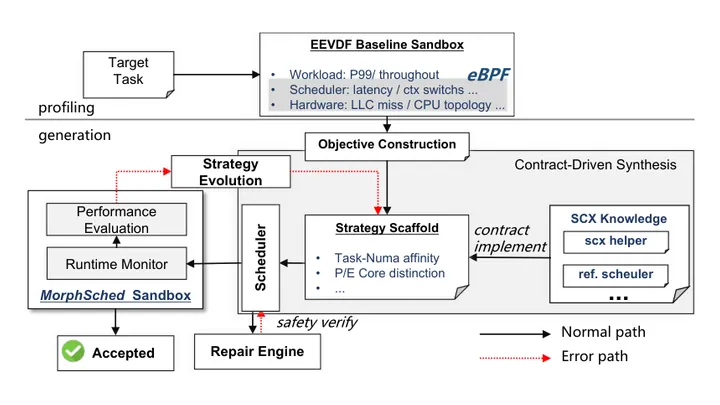
MorphSched: Workload-Aware Adaptive Scheduler Generation for Linux

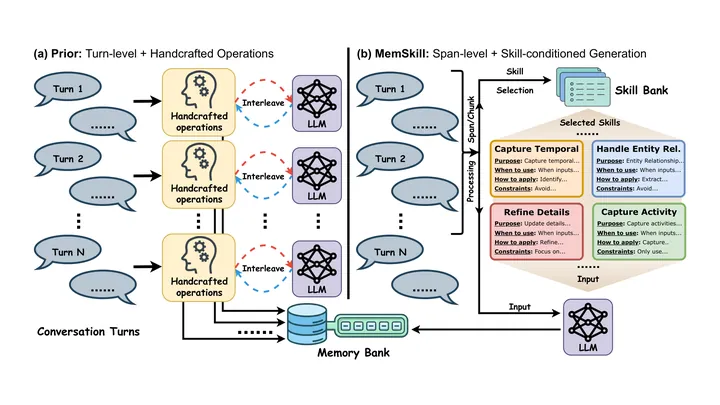
The loop: An LLM synthesizes custom Linux schedulers and profiles their performance on target workloads. The system accumulates this performance feedback in an evolutionary memory pool to refine its own generation strategy for future schedulers.

An LLM-driven system that synthesizes Rust and BPF Linux schedulers and uses runtime performance feedback to evolve its generation strategy.

loop fit 9/10Shervin Shahidi, James Poon, Hang Xie, Kenneth O. Xu, Robin H{\aa}kanson,...via arXiv
MorphSched: Workload-Aware Adaptive Scheduler Generation for Linux
PaperarXiv·9 Nov 2026·Self-reward and self-play

AutoRefine: Auto-Calibrating Code Judges from Workflow Outcomes

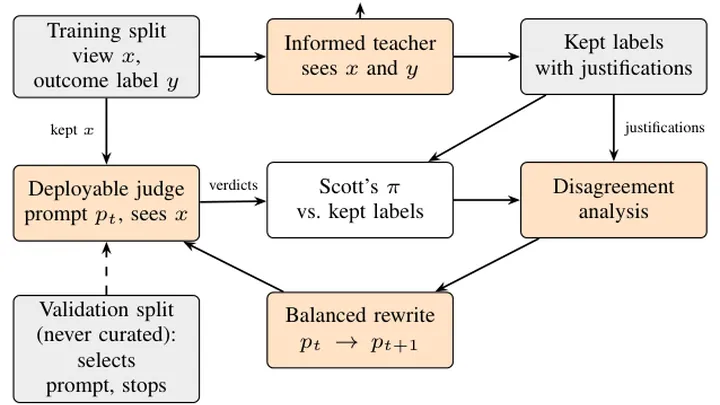
The loop: A teacher model observes noisy workflow outcomes like test failures and rewrites the prompt of a deployable code judge to reproduce those labels. This auto-calibration improves the judge's accuracy in evaluating future code changes.

A loop that uses free but noisy development workflow outcomes to automatically recalibrate the prompts of LLM code judges.

loop fit 9/10Weijia Xu, Alessandro Sordoni, Chandan Singh, Zelalem Gero, Michel Galley,...via arXiv
AutoRefine: Auto-Calibrating Code Judges from Workflow Outcomes
NewsAlignment Forum·9 Nov 2026·Self-modifying agents

Test-Time Learning with an Evolving Library

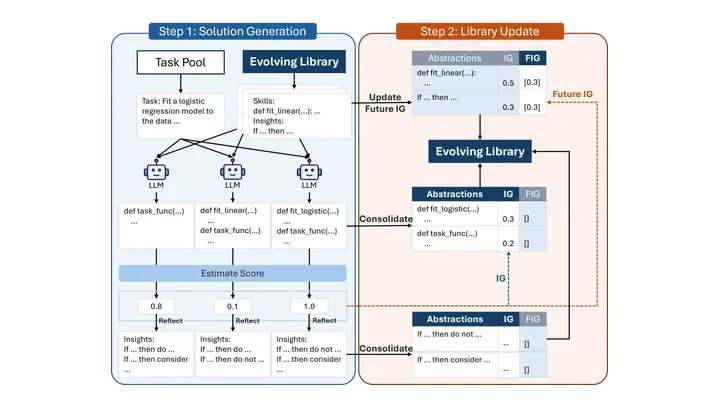
The loop: A language model extracts modular skills and reflective insights from its own inference trajectories to build a shared library. It then reuses and evolves these knowledge abstractions to improve its performance on subsequent problem instances without parameter updates.

A test-time learning framework where a model accumulates and evolves a library of knowledge abstractions from its own successful inferences.

loop fit 9/10Buckvia Alignment Forum
Test-Time Learning with an Evolving Library
PaperarXiv·8 Nov 2026·Tools and harness

Review the Episodes, Refine the Lessons: Simple Memory Evolution for Embodied Agents

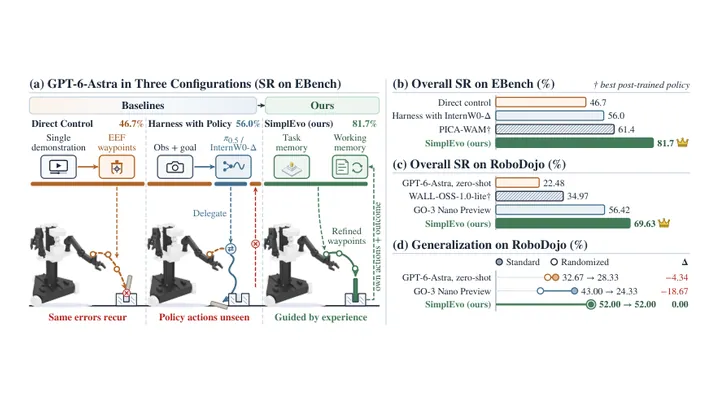
The loop: A multimodal language model writes and refines its own text memories based on its execution experience in embodied tasks. It updates this working memory with lessons on procedure and recovery, making the same system better at navigation and manipulation.

An approach where an embodied agent improves its success rate by writing and refining its own text-based working memory from execution experience.

loop fit 8/10Yifei Yao, Yude Zou, Xing Gao et al.via Hugging Face Papers
Review the Episodes, Refine the Lessons: Simple Memory Evolution for Embodied Agents
PaperarXiv·9 Nov 2026·AI R&D evals

Always-On-Intelligence/HALO

The loop: An evaluation harness audits whether self-evolving agents successfully learn from their outcomes. This measurement provides the necessary signal to improve the agents' learning mechanisms, making them better at self-evolution.

An evaluation harness and plugin designed to audit whether always-on personal AI assistants actually learn from their outcomes.

loop fit 8/10Haozhen Zhang, Quanyu Long, Jianzhu Bao, Tao Feng, Weizhi Zhang, Haodong Yue,...via arXiv
Always-On-Intelligence/HALO
ProjectGitHub·5 Oct 2026·Inference efficiency

TailSieve: Partial-Rollout-Guided Tail Routing for LLM Rollouts

The loop: A controller optimizes the routing of long-tail generations during large-scale rollouts. This improves the efficiency of reinforcement learning post-training and distillation, which makes the training of successor models faster.

A framework that uses partial-rollout completion status to optimize tail routing and replica allocation during synchronous LLM rollouts.

loop fit 8/10Always-On-Intelligencevia GitHub
TailSieve: Partial-Rollout-Guided Tail Routing for LLM Rollouts

← 9 Nov 2026 Latest