Alphabell.
Daily edition

Radar, 14 Nov 2026

Today's edition highlights niche loops outside the standard code generation paradigm, from weight-space interventions to hardware design and playbook curation.

PaperarXiv·11 Nov 2026·Tools and harness

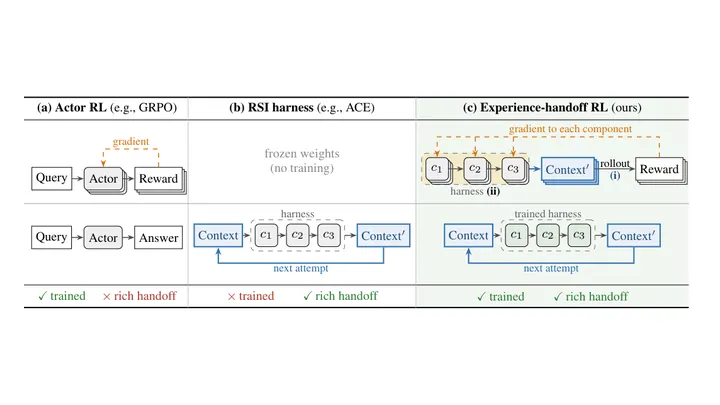
Experience-Handoff Reinforcement Learning for Recursive Self-Improvement

The loop: An LLM agent generates and curates task-local playbooks from its own environment experiences. These playbooks are then handed off to the agent's future rollouts, improving their performance on agentic tasks.

A reinforcement learning method that trains an agent to curate playbooks from its own execution logs to guide its future rollouts.
loop fit 9/10Binghang Lu, Lang Cao, Changhong Mou et al.via arXiv
Experience-Handoff Reinforcement Learning for Recursive Self-Improvement
PaperarXiv·9 Nov 2026·AI R&D evals

BioXArena-Pro: A Research-Grade Benchmark for Autonomous Biomedical Machine Learning Agents

The loop: Autonomous ML agents attempt to build biomedical machine learning models from scratch. The benchmark measures their success at this ML engineering work, providing a rigorous evaluation target to drive the development of better ML agents.

A benchmark of 64 research-level modeling tasks designed to evaluate autonomous agents on biomedical machine learning engineering.

loop fit 9/10Weimin Wu, Han Liuvia arXiv
BioXArena-Pro: A Research-Grade Benchmark for Autonomous Biomedical Machine Learning Agents
PaperarXiv·12 Nov 2026·Hardware and chips

Toward Autonomous RTL and Synthesis Optimization: Benchmarking and Self-Improving Agents

The loop: A multi-agent framework automates RTL rewriting and critical-path analysis for hardware design. By continuously refining a library of reusable optimization skills, the agent improves its own ability to optimize future chips.

A multi-agent framework that automates RTL rewriting and synthesis optimization while building a reusable library of hardware design skills.

loop fit 8/10Doyoung Kim, Byeongguk Jeon, Kailin Zhang et al.via Hugging Face Papers
Toward Autonomous RTL and Synthesis Optimization: Benchmarking and Self-Improving Agents
PaperarXiv·11 Nov 2026·Architecture and optimizer search

NCP: Verifier-Guided Optimization of Weight-Space Control Policies

The loop: The Neural Control Plane observes a language model's execution telemetry to synthesize candidate weight-space intervention rules. It evaluates these candidates and admits beneficial policies to its active rule set, directly improving the model's subsequent inference performance.

A closed-loop system that observes model execution to synthesize, evaluate, and apply temporary weight-space interventions during inference.

loop fit 8/10Alexander Yue, Qibin Liu, Julia Gonskivia arXiv
NCP: Verifier-Guided Optimization of Weight-Space Control Policies
PaperarXiv·11 Nov 2026·Research automation

Updates From METR Report: Short Timelines vs IE

The loop: AI systems increasingly automate AI research and development tasks. This automation expands the total R&D effort, which accelerates the creation of more capable successor systems.

A forum discussion analyzing whether the feedback loop of AI automating AI research is strong enough to trigger an intelligence explosion.

loop fit 6/10Daniela Gottesman, Gal Yona, Ori Ram et al.via arXiv
Updates From METR Report: Short Timelines vs IE
Forum postLessWrong·12 Nov 2026·Research automation

Updates from METR report: short timelines vs IE

The loop: AI systems automate AI research and development tasks, which increases the total R&D effort and leads to more capable AI systems for further automation.

It's important to distinguish between two different takeaways you could have from the recent METR report: 1. Shorter timelines: AI will soon fully automate AI R&D 2. Intelligence explosion more likely: Once AI fully automates AI R&D, AI...

loop fit 6/10Tom Davidsonvia LessWrong
Updates from METR report: short timelines vs IE

← 13 Nov 2026 Latest