Alphabell.
Daily edition

Radar, 9 Nov 2026

Today's edition highlights a major milestone reported by Anthropic regarding AI accelerating AI research, alongside new methods for agents to evolve their own memory, tools, and operating system schedulers.

NewsAlignment Forum·8 Nov 2026·Research automation

Ajeya: AI is dramatically accelerating AI research right now

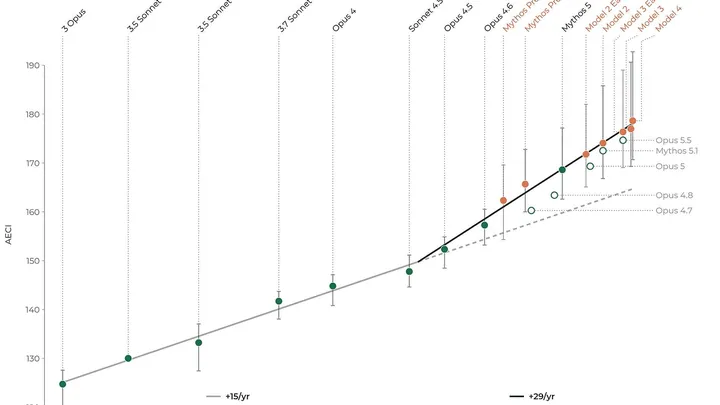
The loop: Anthropic's AI systems automate AI R&D, which accelerates capabilities progress, leading to better successor models that are even better at automating AI R&D.

An internal investigation at Anthropic suggests the company has crossed its "dramatic acceleration" threshold, with capabilities progress doubling over the past year due to AI automating AI R&D.
loop fit 10/10Zach Stein-Perlmanvia Alignment Forum
Ajeya: AI is dramatically accelerating AI research right now
PaperarXiv·6 Nov 2026·Tools and harness

Flex-RSI: Benchmarking Recursive Self-Improvement of Frontier Agents

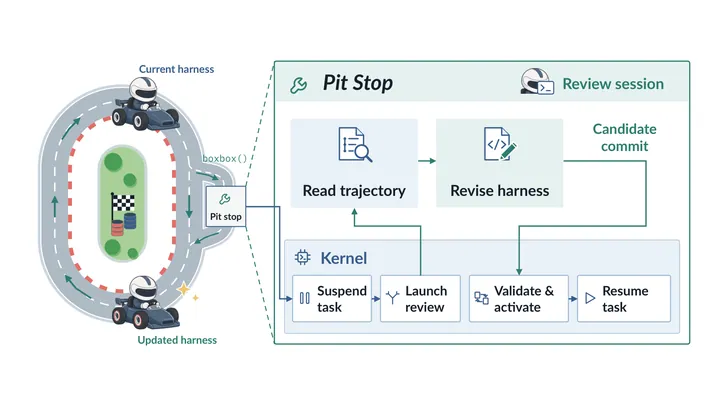
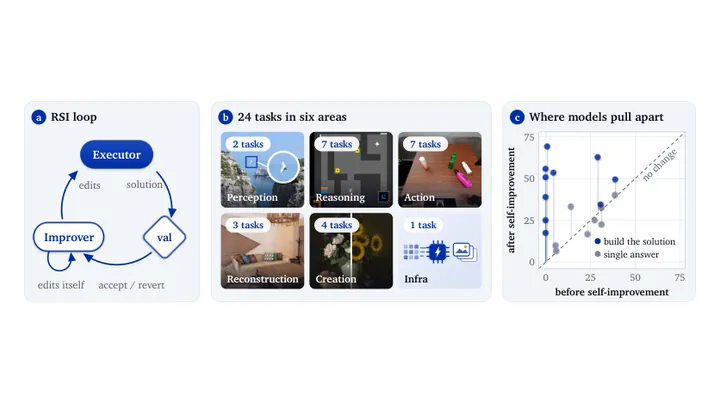
The loop: An improver agent revises its own harness and executor based on task feedback, which improves the agent's ability to solve vision and robotics tasks in subsequent rounds.

Flex-RSI is a benchmark that evaluates whether agents can use task feedback to recursively improve their own prompts, tools, and control loops on vision and robotics tasks.

loop fit 9/10Jingdong Zhang, Jionghao Wang, Zhengming Yu et al.via arXiv
Flex-RSI: Benchmarking Recursive Self-Improvement of Frontier Agents
PaperarXiv·9 Nov 2026·Research automation

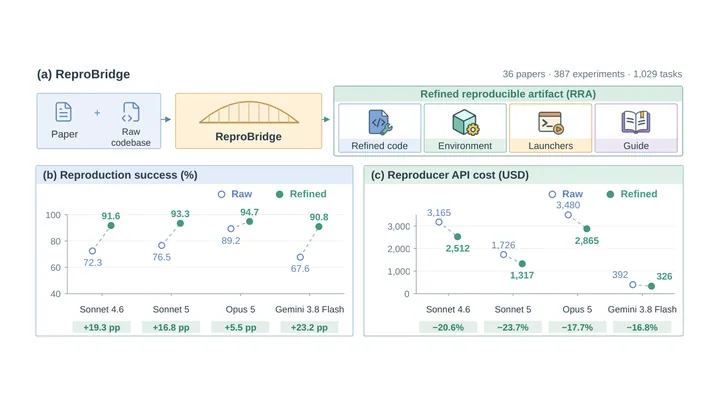
ReproBridge: Building Reproducibility into ML Research Artifacts

The loop: The ReproBridge agent constructs reproducible research artifacts, which improves the ability of successor agents to reproduce and build on ML research.

ReproBridge is an agent workflow that refines raw code into standardized, reproducible artifacts, significantly raising the success rate of subsequent agents attempting to reproduce the experiments.

loop fit 9/10Pranjal Srivastavavia arXiv
ReproBridge: Building Reproducibility into ML Research Artifacts
PaperarXiv·6 Nov 2026·Kernels and compilers

MorphSched: Workload-Aware Adaptive Scheduler Generation for Linux

The loop: MorphSched uses an LLM to synthesize Linux schedulers, which improves system performance, and uses that performance feedback to refine its generation strategy.

MorphSched is an LLM-driven system that synthesizes custom Rust and BPF schedulers for Linux, using performance feedback to evolve its scheduling strategies.

loop fit 9/10Baolin Chong, Dongfang Xu, Qiaosi Wang et al.via arXiv
MorphSched: Workload-Aware Adaptive Scheduler Generation for Linux
PaperarXiv·6 Nov 2026·Self-modifying agents

Test-Time Learning with an Evolving Library

The loop: EvoLib extracts knowledge abstractions from its own inference trajectories to build a shared library, which improves the model's performance on subsequent problem instances.

EvoLib is a test-time learning framework that allows large language models to accumulate and evolve reusable skills and insights from their own inference trajectories without parameter updates.

loop fit 9/10Yuhao Tan, Hanyun Jiang, Fangkai Yang et al.via arXiv
Test-Time Learning with an Evolving Library
PaperarXiv·9 Nov 2026·Tools and harness

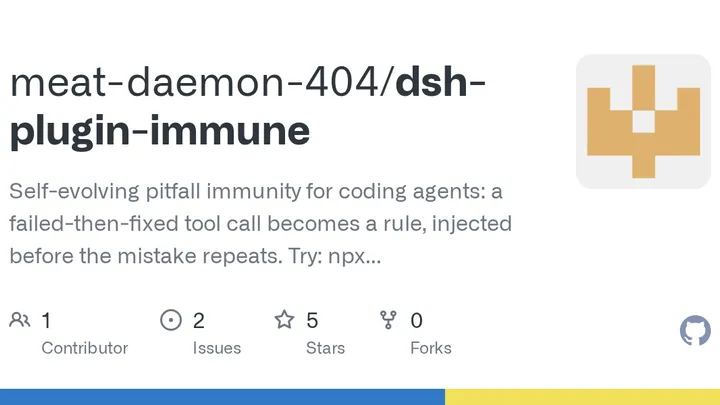
meat-daemon-404/dsh-plugin-immune

The loop: A coding agent converts its own failed tool calls into immunity rules, which are injected to prevent repeated mistakes, improving its future performance.

A GitHub repository demonstrating a self-evolving immunity system for coding agents that turns failed tool calls into rules to prevent future errors.

loop fit 7/10Jianuo Shen, Pengyi Xu, Bo Zhangvia arXiv
meat-daemon-404/dsh-plugin-immune
PaperarXiv·6 Nov 2026·Self-modifying agents

The components of agent memory

The loop: Claude uses a dreaming mechanism to organize memory and correct mistakes, which improves its internal state and makes it better at learning from experience.

Anthropic details how Claude uses a "dreaming" mechanism to organize its memory and correct mistakes, helping the model learn from experience.

loop fit 7/10Mengsong Wu, Tianchen Zhou, Zhaochen Su, Zhenhua Liu, Zhe Cui, Aimin Zhouvia arXiv
The components of agent memory
PaperarXiv·6 Nov 2026·Interpretability and oversight

J-lens preferentially reads from coordinate-aligned subspaces

The loop: The J-lens tool identifies coordinate-aligned subspaces in Gemma-4, which improves model interpretability and editing, making future versions of Gemma easier to verify and steer.

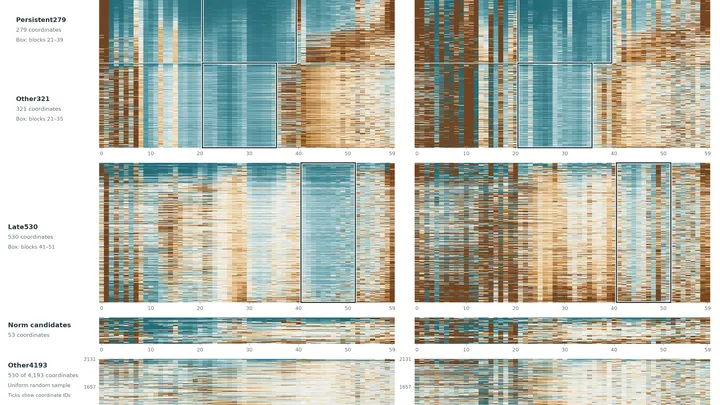
A LessWrong post observes that the J-lens readout in Gemma-4 primarily relies on two small, coordinate-aligned subspaces that are protected from edits across many layers.

loop fit 6/10Yubo Wang, Rui Meng, Jaehyun Nam, Tomas Pfister, Jinsung Yoonvia arXiv
J-lens preferentially reads from coordinate-aligned subspaces
ProjectGitHub·4 Nov 2026·Tools and harness

meat-daemon-404/dsh-plugin-immune

The loop: A coding agent converts its own failed tool calls into immunity rules, which improves the agent's future performance by preventing repeated mistakes.

Self-evolving pitfall immunity for coding agents: a failed-then-fixed tool call becomes a rule, injected before the mistake repeats. Try: npx dsh-immune-system demo

loop fit 7/10meat-daemon-404via GitHub
meat-daemon-404/dsh-plugin-immune
Blog postAnthropic·6 Nov 2026·Self-modifying agents

The components of agent memory

The loop: Claude uses a dreaming mechanism to organize memory and correct mistakes, which improves its internal state, which makes the model better at learning from experience.

For Claude to learn from experience, it has to decide what’s worth remembering before it knows what’s next. Here’s how “dreaming” helps it organize memory and correct mistakes.

loop fit 7/10via Anthropic
The components of agent memory
Forum postLessWrong·5 Nov 2026·Interpretability and oversight

J-lens preferentially reads from coordinate-aligned subspaces

The loop: The J-lens tool identifies coordinate-aligned subspaces in Gemma-4, which improves model interpretability and editing, making future versions of Gemma easier to verify and steer.

Note: I only test on Gemma-4-31B, which contains the spaces I've been studying in this earlier post. This is a shorter post, with just a few observations potentially relevant to those working on the J-lens work. The main observations here...

loop fit 6/10Caleb Briggsvia LessWrong
J-lens preferentially reads from coordinate-aligned subspaces
Blog postOpenAI·6 Nov 2026·Interpretability and oversight

Partnering with Hacktron to find vulnerabilities in OpenAI’s systems

The loop: Frontier AI systems find vulnerabilities in OpenAI's infrastructure, which improves system security, which makes the deployment of those same AI systems safer.

OpenAI is partnering with Hacktron to find vulnerabilities, test connections with third-party services, and strengthen defenses with frontier AI.

loop fit 6/10via OpenAI
Partnering with Hacktron to find vulnerabilities in OpenAI’s systems

← 8 Nov 2026 Latest