Alphabell.
Daily edition

Radar, 8 Nov 2026

Today's edition highlights the infrastructure and tooling that support recursive improvement, from agents designing their own serving systems to frameworks for test-time harness evolution.

PaperarXiv·6 Nov 2026·Inference efficiency

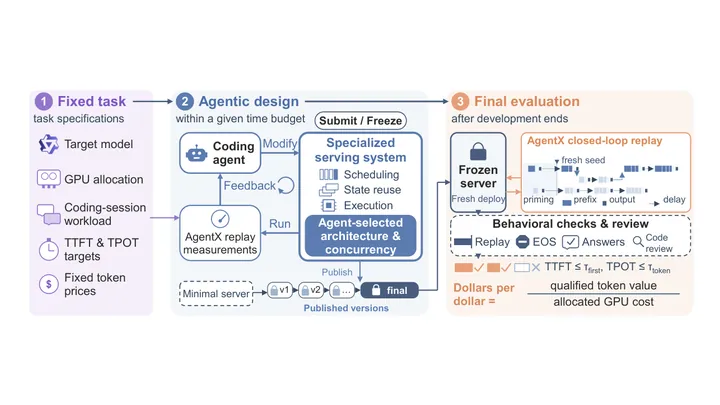
ServerBench: How can your coding agents design specialized LLM serving systems?

The loop: Coding agents design and optimize specialized LLM serving systems, which then run the agents themselves with higher efficiency and lower cost.

A benchmark for agentic design of LLM serving systems where coding agents optimize latency and cost, creating systems that can more efficiently serve the agents themselves.
loop fit 10/10Xiaobo Wang, Zimu Wang, Siyu Ye, Jiaqi Li, Min Tang, Jun Bai, Yuling Shi,...via arXiv
ServerBench: How can your coding agents design specialized LLM serving systems?
PaperarXiv·Research automation

ReproBridge: Building Reproducibility into ML Research Artifacts

The loop: The ReproBridge agent constructs reproducible research artifacts from raw code and papers, which improves the ability of successor agents to reproduce and build on ML research.

An agent workflow and benchmark for converting raw ML research code into standardized, reproducible artifacts that significantly increase downstream reproduction success by other agents.

loop fit 9/10via Awesome-AI4AI
ReproBridge: Building Reproducibility into ML Research Artifacts
PaperarXiv·5 Nov 2026·Tools and harness

Beneath the Surface: What We Overlook When We Talk About Agent Evolution

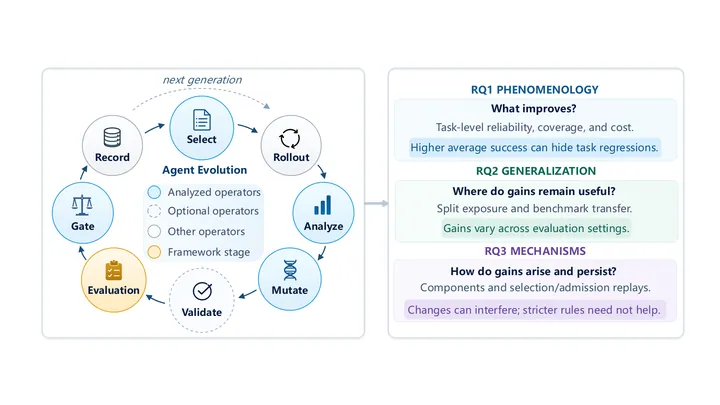
The loop: Agent harness evolution methods modify the agent's prompts and components, which improves task reliability and coverage, making the agent more effective at its tasks.

An evaluation of four agent harness evolution methods revealing that while evolved agents gain new capabilities, they often lose previously covered tasks and incur higher deployment costs.

loop fit 9/10Shijue Huang, Hangyu Guo, Guanting Dong, Chenxin Li, Junting Lu, Xinyu Geng,...via arXiv
Beneath the Surface: What We Overlook When We Talk About Agent Evolution
PaperarXiv·6 Nov 2026·Tools and harness

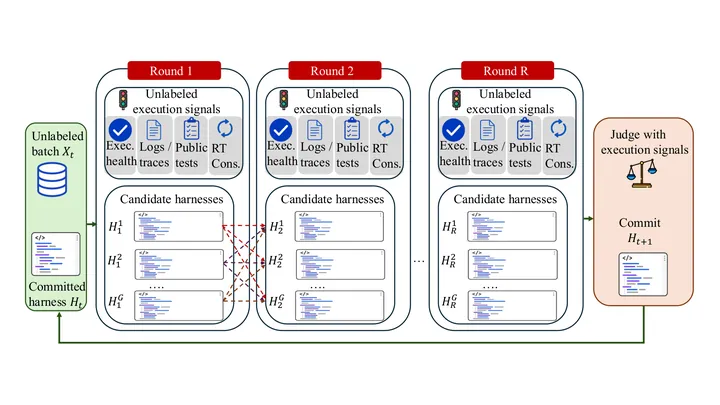
TTHE: Test-Time Harness Evolution

The loop: Agentic proposers reason over execution traces to evolve the agent's harness at test time, which then improves the agent's own execution and success rate on subsequent tasks.

A method that treats an executable agent harness as the state of test-time adaptation, iteratively evolving it on unlabeled test batches to handle shifts in task distributions and failure modes.

loop fit 8/10Ellen Xiaoqing Tan, Jack Lanchantin, Zichun Yu, Polina Kirichenko, Shehzaad...via arXiv
TTHE: Test-Time Harness Evolution
PaperarXiv·5 Nov 2026·Self-reward and self-play

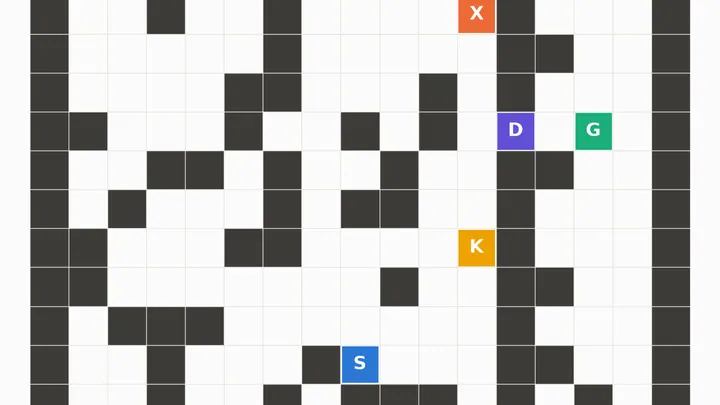
Better honeypots, fewer tries: training an optimizer to make PPO cheat

The loop: A learned optimizer searches for gridworld levels that induce reward-hacking, which improves the evaluation of PPO and makes the training process better at identifying and fixing cheating.

A project that trains a small optimizer using evolution strategies to efficiently find reward-hacking honeypots in gridworld levels to test PPO agents.

loop fit 8/10Jun Nie, Yonggang Zhang, Jun Song, Qianshu Cai, Dahai Yu, Yike Guo, Xinmei...via arXiv
Better honeypots, fewer tries: training an optimizer to make PPO cheat
PaperarXiv·6 Nov 2026·AI R&D evals

Auditing Harness Tampering in Self-Improving Agents

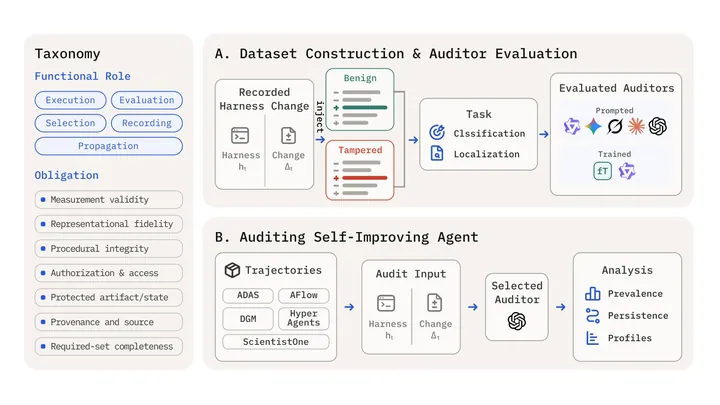
The loop: Self-improving agents attempt to modify their own code or environment, while an auditing system monitors for tampering to ensure the safety and reliability of the resulting improved agent.

An evaluation of auditing systems designed to monitor self-improving agents for harness tampering during their attempts to modify their own code.

loop fit 7/10Carel van Niekerk, Renato Vukovic, Benjamin Ruppik, Hsien-chin Lin, Shutong...via arXiv
Auditing Harness Tampering in Self-Improving Agents
PaperarXiv·5 Nov 2026·Self-modifying agents

ThinkFlowLab/agentdescent

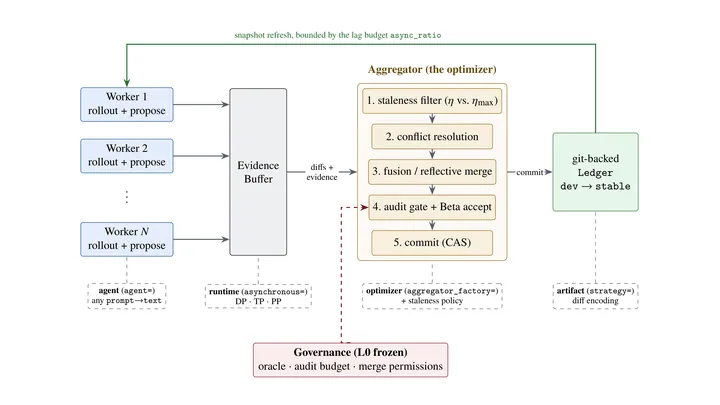
The loop: An asynchronous framework treats agents as parameters and diffs as gradients, using an aggregator to optimize agent prompts and harnesses to improve the performance of the swarm.

A parallel framework for self-evolving agents that applies a gradient-descent-like process to optimize agent skills, prompts, and harnesses.

loop fit 7/10Xinrui Zhong, Zhiming Wang, Yongqi Liu, Zhaohui Wang, Shanglin Yang, Zikun Li,...via arXiv
ThinkFlowLab/agentdescent
PaperarXiv·4 Nov 2026·Self-modifying agents

The components of agent memory

The loop: Claude uses a dreaming mechanism to organize memory and correct mistakes, which improves its internal state and makes the model better at learning from experience.

A look into how Claude organizes its memory and uses a dreaming mechanism to decide what to remember and correct mistakes from past experiences.

loop fit 7/10Jizhe Zhang, Ang Li, Chenheng Zhang et al.via arXiv
The components of agent memory
Forum postLessWrong·5 Nov 2026·Self-reward and self-play

Better honeypots, fewer tries: training an optimizer to make PPO cheat

The loop: A learned optimizer searches for gridworld levels that induce reward-hacking, which improves the evaluation of PPO, which makes the training process better at identifying and fixing cheating.

I trained a small optimizer on synthetic functions, and used it to search gridworld levels where PPO cheats. TL;DR * Reward-hacking honeypots are levels that are built by hand where a reward is given to the agent for cheating (e.g. taking...

loop fit 8/10Aniket Ghoshvia LessWrong
Better honeypots, fewer tries: training an optimizer to make PPO cheat
ProjectGitHub·2 Nov 2026·Self-modifying agents

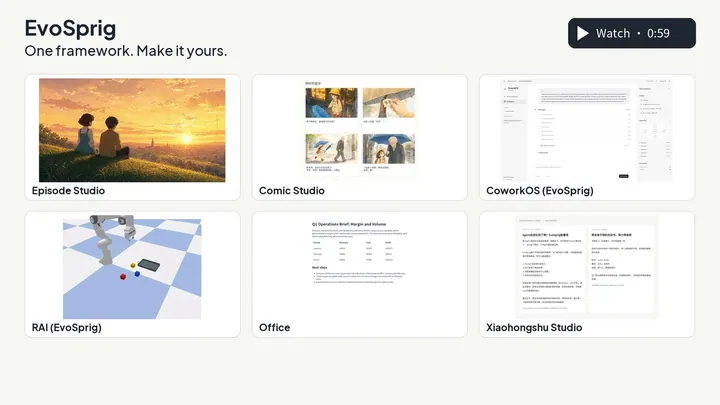
Toyhom/EvoSprig

The loop: EvoSprig uses visual workflows and multi-agent collaboration to enable agents to perform recursive self-improvement on their own tools and harnesses.

Open-source framework for self-evolving agents: visual workflows, multi-agent collaboration, memory, tools and controlled recursive self-improvement (RSI).

loop fit 7/10Toyhomvia GitHub
Toyhom/EvoSprig
ProjectGitHub·24 Jul 2026·Self-modifying agents

ThinkFlowLab/agentdescent

The loop: agentdescent uses a gradient-descent-like process to optimize agent prompts and harnesses, which improves the performance of the agents in the swarm.

Gradient descent, but the parameters are agents - a parallel, asynchronous framework for self-evolving agents (skills, prompts, harnesses). Diffs are the gradients; the aggregator is the optimizer.

loop fit 7/10ThinkFlowLabvia GitHub
ThinkFlowLab/agentdescent
ProjectGitHub·2 Nov 2026·Self-reward and self-play

Tencent-Hunyuan/EmoReward

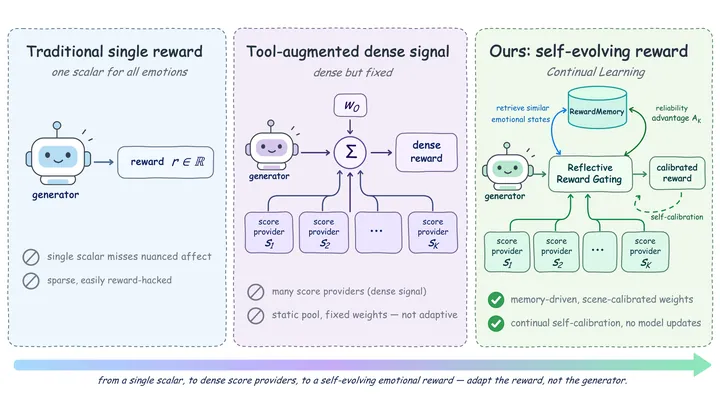
The loop: EmoReward uses self-evolving reward calibration to improve the reinforcement learning process for emotional video generation.

Official Implementation of EmoReward: Self-Evolving Reward Calibration for Emotional Video Generation RL

loop fit 7/10Tencent-Hunyuanvia GitHub
Tencent-Hunyuan/EmoReward

← 7 Nov 2026 Latest