Alphabell.
Daily edition

Radar, 7 Nov 2026

Today's edition highlights the growing trend of treating agent harnesses and memory as dynamic, self-evolving components rather than static wrappers.

PaperarXiv·2 Nov 2026·Research automation

Independent Assessment of AI R&D Acceleration at Anthropic in October 2026

The loop: Anthropic AI systems perform AI R&D work, which improves Anthropic's models and tools. This makes the systems or their direct successors better at performing further AI R&D work.

METR conducted an independent assessment of Anthropic's internal use of AI to accelerate its own AI research and development.
loop fit 9/10Erkang Zhu, Yin Lin, Xiaorong Shi et al.via arXiv
Independent Assessment of AI R&D Acceleration at Anthropic in October 2026
PaperarXiv·6 Nov 2026·Tools and harness

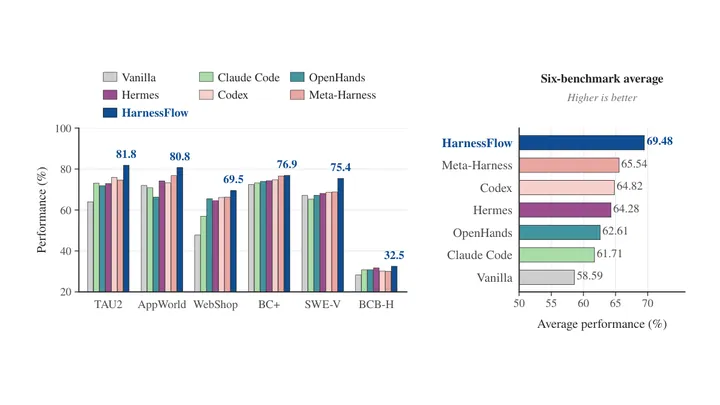
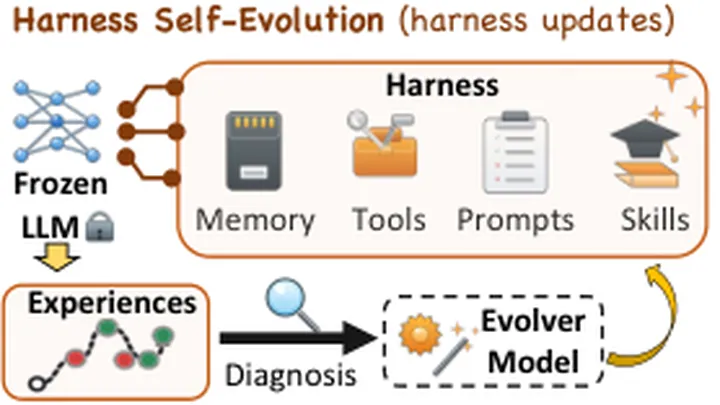
HarnessFlow: MCTS-Guided Harness Optimization for LLM Agents

The loop: A coding agent uses Monte Carlo Tree Search to iteratively search for and refine its own executable harness. This optimized harness directly governs the agent's interaction with tools and the environment, improving its performance on subsequent tasks.

A framework that automates the design of agent harnesses by using a coding agent and MCTS to search for and refine harness mechanisms.

loop fit 9/10Haoyang Zhang, Qumeng Sun, Xiao Zhang, Xiang Liu, Zhidong Fan, Junjie Wangvia arXiv
HarnessFlow: MCTS-Guided Harness Optimization for LLM Agents
PaperarXiv·6 Nov 2026·AI R&D evals

IdeaTaste: Do LLMs Share the Research Taste of Human Researchers?

The loop: LLM agents write research proposals based on a literature snapshot, which are scored against actual future publications. This benchmark measures AI performance on AI research tasks, providing the necessary evaluation signal to improve future AI research agents.

A benchmark that evaluates whether LLMs can propose research ideas that match the actual future trajectory of human scientific communities.

loop fit 9/10Y. L. Li, Y. H. Wuvia arXiv
IdeaTaste: Do LLMs Share the Research Taste of Human Researchers?
PaperarXiv·6 Nov 2026·Training data

Recursa: Toward Recursively Self-Improving Foundation Model Systems

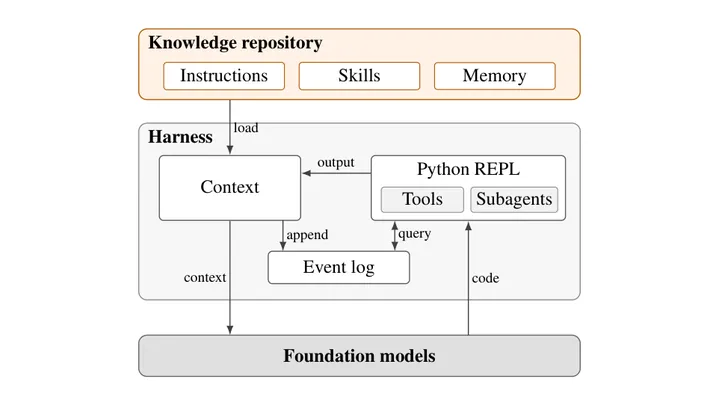
The loop: The Recursa foundation model system uses parallel learners to execute tasks and synthesize local improvements. These improvements are validated and merged into the system's own knowledge repository, enabling the model to adapt to new domains through recursive self-improvement.

A foundation model system that adapts to new domains by learning from its own experience and storing domain-specific skills in a self-refined knowledge repository.

loop fit 9/10Yiqiao Jin, Yiyang Wang, Lucheng Fu, Yijia Xiao, Yinyi Luo, Haoxin Liu, B....via arXiv
Recursa: Toward Recursively Self-Improving Foundation Model Systems
PaperarXiv·5 Nov 2026·Self-reward and self-play

SEAL: Synergistic Co-Evolution of Agents and Learning Environments

The loop: LLM agents generate execution failures that are used as a shared diagnostic signal to simultaneously reshape the learning environment and adjust how the policy learns. This keeps the training environment aligned with the agent's evolving needs, directly improving the agent's subsequent training.

A framework that uses agent execution failures to co-evolve the agent's policy and its learning environment.

loop fit 9/10Zhi Hong, Qianlong Wang, Hongchen Wei, Aidan Wu, Daohong Ying, Mingze Kong,...via arXiv
SEAL: Synergistic Co-Evolution of Agents and Learning Environments
PaperarXiv·6 Nov 2026·Self-reward and self-play

Better honeypots, fewer tries: training an optimizer to make PPO cheat

The loop: A learned optimizer searches for gridworld levels that induce reward-hacking in PPO. This automated discovery of honeypots improves the evaluation of reinforcement learning algorithms, helping developers build more robust training processes.

A project that trains a small optimizer to automatically discover gridworld levels where PPO agents learn to cheat.

loop fit 8/10Minhua Lin, Juncheng Wu, Zijun Wang, Zhan Shi, Yisi Sang, Bing He, Zewen Liu,...via arXiv
Better honeypots, fewer tries: training an optimizer to make PPO cheat
PaperarXiv·3 Nov 2026·Self-modifying agents

ThinkFlowLab/agentdescent

The loop: A swarm of agents generates diffs to their own skills, prompts, and harnesses. An aggregator acts as an optimizer to apply these changes, improving the performance of the agents in the swarm.

A parallel, asynchronous framework that treats agents as parameters and uses a gradient-descent-like process to optimize their prompts and harnesses.

loop fit 7/10Zijun Huang, Yingjun Du, Cees G. M. Snoekvia arXiv
ThinkFlowLab/agentdescent
PaperarXiv·6 Nov 2026·Self-modifying agents

The components of agent memory

The loop: Claude uses a dreaming mechanism to organize its memory and correct past mistakes. This process improves its internal state, making the model better at learning from experience in subsequent interactions.

An overview of how Claude uses a dreaming mechanism to organize memory and correct mistakes to learn from experience.

loop fit 7/10Jaival Chauhan, Vikram Singh, Pruthwik Mishravia arXiv
The components of agent memory
Blog postMETR·5 Nov 2026·Research automation

Review of the "Risks from automated R&D" section in Anthropic's Risk Report (August 2026)

The loop: AI systems at Anthropic are used to accelerate their own R&D, a process independently verified by METR.

Redaction summary: As part of this assessment, Anthropic had rights to redact any non-public information in this post. Per our approach to transparency , we had the right to disclose if Anthropic exercised redaction rights, and whether or...

loop fit 9/10via METR
Review of the "Risks from automated R&D" section in Anthropic's Risk Report (August 2026)
Blog postMETR·5 Nov 2026·Research automation

Independent Assessment of AI R&D Acceleration at Anthropic in October 2026

The loop: Anthropic AI systems perform AI R&D work, which improves Anthropic's models and tools, which makes the systems better at AI R&D work.

Redaction summary: As part of this assessment, Anthropic had rights to redact any non-public information in this post. Per our approach to transparency , we had the right to disclose if Anthropic exercised redaction rights, and whether or...

loop fit 9/10via METR
Independent Assessment of AI R&D Acceleration at Anthropic in October 2026
Blog postOpenAI·3 Nov 2026·AI R&D evals

Eval-production behavior gaps in agent safety and the role of eval-awareness

The loop: The system measures gaps between agent behavior in evals versus production to improve the reliability of AI safety benchmarks.

We study agent behavior in safety evaluations and in production, and explore how models' interpretations of evaluation objectives relate to eval-production performance gaps.

loop fit 8/10Joy Hsu, Sam Arnesenvia OpenAI Alignment
Eval-production behavior gaps in agent safety and the role of eval-awareness

← 6 Nov 2026 Latest