Alphabell.
Daily edition

Radar, 6 Nov 2026

Today's edition highlights a major milestone in automated R&D with METR's assessment of Anthropic, alongside strong new work on execution grounded self play and autonomous model compression.

PaperarXiv·6 Nov 2026·Self-reward and self-play

When Can Self-Play Fix a False Belief? Answer Keys, Pass Bands and Replacement Rules in an Execution-Grounded Loop

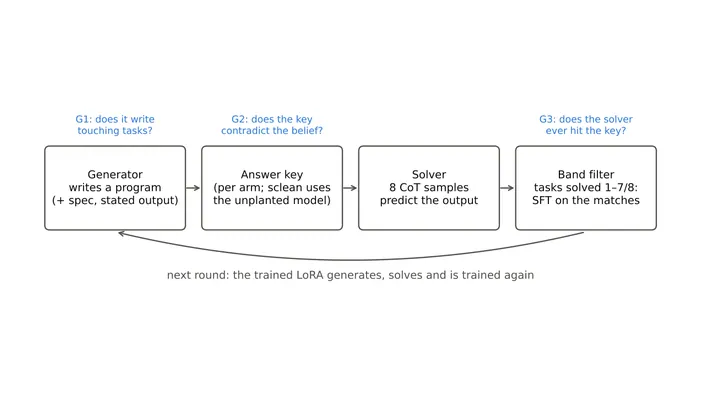
The loop: Qwen3 4B Base generates output prediction tasks and Python code, then executes the code to derive answer keys. The model trains on these self generated, execution verified keys to correct its own planted false beliefs about task specifications.

An analysis of execution grounded self play reveals that training on self generated code execution only fixes a model's false beliefs if the answer key comes from an unplanted teacher model rather than the model's own flawed implementation.
loop fit 10/10Nirdesh Chauhan, Dushyant Rajput, Siddharth Kosarajuvia arXiv
When Can Self-Play Fix a False Belief? Answer Keys, Pass Bands and Replacement Rules in an Execution-Grounded Loop
NewsAlignment Forum·5 Nov 2026·Research automation

METR: Independent Assessment of AI R&D Acceleration at Anthropic in October 2026

The loop: Anthropic uses its own AI systems to automate parts of its pretraining, reinforcement learning, and model evaluation workflows. This automated R&D work accelerates the capability improvements of Anthropic's internal models, directly speeding up the development of their successors.

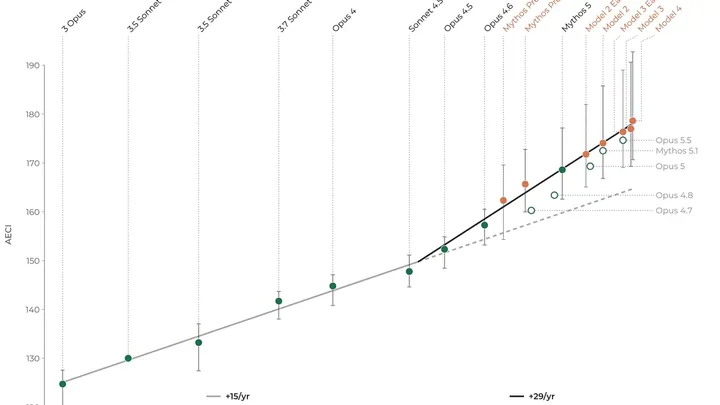
An independent assessment by METR concludes that Anthropic's use of AI for internal R&D is likely doubling the rate of capability improvement for its models on well specified tasks.

loop fit 9/10Zach Stein-Perlmanvia Alignment Forum
METR: Independent Assessment of AI R&D Acceleration at Anthropic in October 2026
PaperarXiv·4 Nov 2026·Inference efficiency

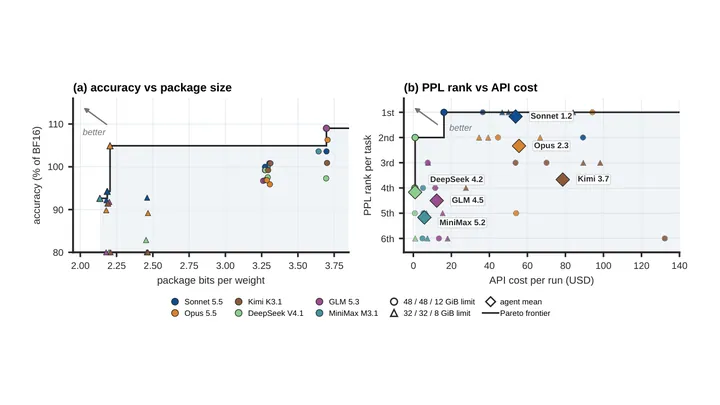
CompressionBench: How can your coding agents compress LLMs?

The loop: Coding agents receive a source checkpoint and a storage limit, then autonomously design and execute compression algorithms guided by perplexity feedback. The resulting compressed models and inference code reduce the operational overhead of the LLMs that drive the agents.

A new benchmark evaluates whether coding agents can autonomously compress large language models by writing and running their own compression algorithms under strict storage and time budgets.

loop fit 9/10Xinrui Zhong, Zhifeng Li, Zhiming Wang et al.via arXiv
CompressionBench: How can your coding agents compress LLMs?
PaperarXiv·6 Nov 2026·Self-modifying agents

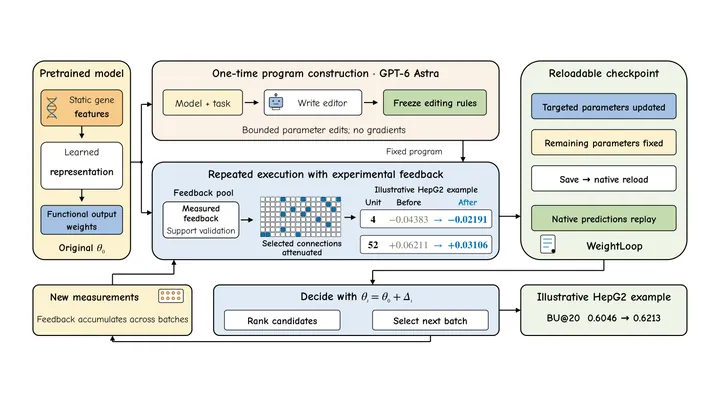
WeightLoop: Weight-Space Programming with Experimental Feedback

The loop: GPT-6 Astra writes a parameter editing program that inspects a model's implementation and prediction errors. The program validates candidate edits using experimental feedback and writes the successful changes directly back into the model's weights, improving its accuracy on subsequent tasks.

WeightLoop enables a language model to write reusable programs that persistently edit a neural network's weights based on experimental feedback, without requiring gradient retraining.

loop fit 9/10Mengran Li, Bo Li, Weijing Zhao, Chengyang Zhang, Boyu Zhang, Jinfeng Xu,...via arXiv
WeightLoop: Weight-Space Programming with Experimental Feedback
Blog postTogether AI·4 Nov 2026·Inference efficiency

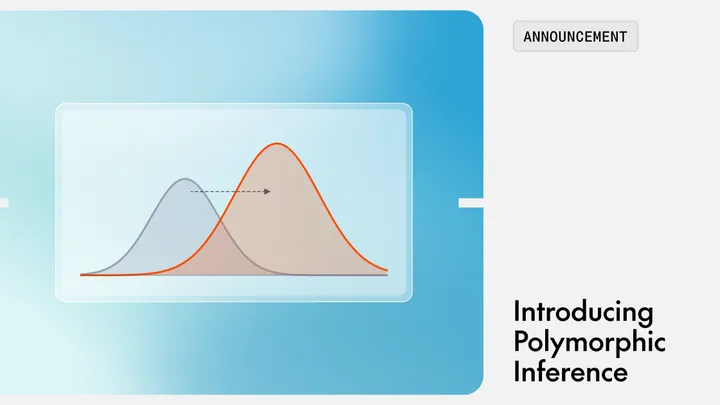
Polymorphic Inference: self-tuning inference for open models

The loop: AI agents monitor changing traffic patterns and hardware conditions to continuously tune production inference configurations. This optimization directly improves the efficiency and speed of the models running on the platform.

Together AI introduces a compiler that uses AI agents to autonomously adapt and tune production inference for open models based on real time traffic and hardware changes.

loop fit 8/10via Together AI
Polymorphic Inference: self-tuning inference for open models
ProjectGitHub·4 Nov 2026·AI R&D evals

flex-rsi/rsi-bench

The loop: Agents attempt to recursively improve their own external harnesses, prompts, and tool configurations. The benchmark evaluates these updates to measure how effectively the agents can evolve their own operating environments.

An open source benchmark designed specifically to measure and evaluate the recursive self improvement capabilities of agent harnesses.

loop fit 8/10flex-rsivia GitHub
flex-rsi/rsi-bench
Blog postOpenAI·4 Nov 2026·Tools and harness

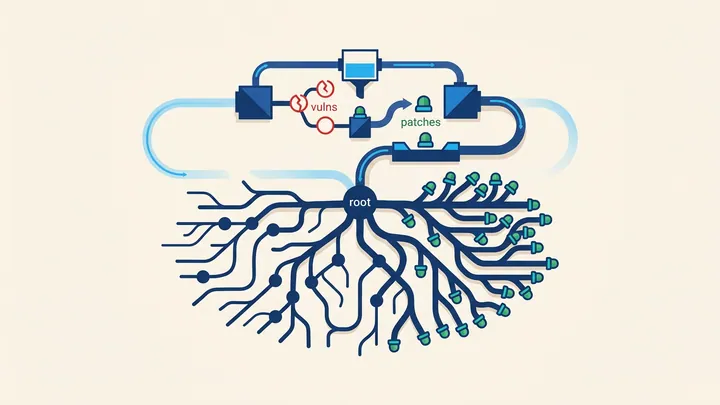
A thousand fewer paths to root

The loop: An autonomous pipeline searches for, validates, and generates patches for local privilege escalation vulnerabilities in the Linux kernel. Applying these patches secures the underlying operating system infrastructure that hosts the AI's own training and inference workloads.

OpenAI deployed an autonomous pipeline that successfully identified and patched 948 local privilege escalation vulnerabilities in the Linux kernel.

loop fit 7/10via OpenAI
A thousand fewer paths to root

← 5 Nov 2026 Latest