Alphabell.
Daily edition

Radar, 15 Nov 2026

Today's edition highlights the growing role of language models in discovering and verifying ML system optimizations, alongside new benchmarks for compiler reasoning.

PaperarXiv·11 Nov 2026·AI R&D evals

MLIRBench: A Benchmark and Dataset for Compiler and Hardware-Aware Reasoning

The loop: A multi-agent pipeline generates and validates program mutations to create a benchmark for evaluating how well LLMs reason about intermediate representations. This dataset directly measures and guides the development of models used to build better compilers and hardware.

A multi-agent pipeline generates a benchmark of validated program mutations to evaluate how well language models reason about compiler intermediate representations.

loop fit 9/10Pranava Sai Maganti, Meghasyam Peddireddy, Muzakker Hossain et al.via Hugging Face Papers
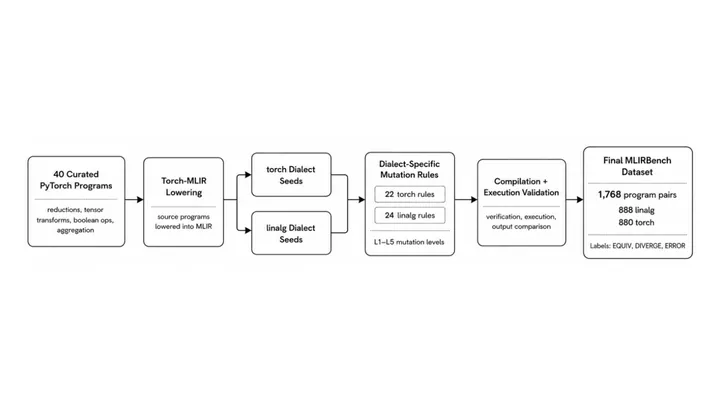
MLIRBench: A Benchmark and Dataset for Compiler and Hardware-Aware Reasoning
PaperarXiv·12 Nov 2026·Architecture and optimizer search

AutoAssumption: Searching over Assumptions Discovers ML-Systems Algorithms

The loop: An LLM searches over explicit algorithm assumptions to discover and prove new ML system algorithms. The search produces state-of-the-art algorithms for KV-cache eviction and weight pruning, which improve the efficiency of the models performing the search.

An LLM-driven harness searches over explicit algorithm assumptions to discover and formally prove new ML system optimizations like KV-cache eviction.

loop fit 8/10Yuxuan Chen, Xiaojie Li, Hao Chen et al.via arXiv
AutoAssumption: Searching over Assumptions Discovers ML-Systems Algorithms
PaperarXiv·11 Nov 2026·Training data

Human or Synthetic? What a Fixed Budget Buys for Post-Training

The loop: Models generate synthetic preference data to train their successors through Direct Preference Optimization. The resulting models achieve higher win rates at lower costs than those trained on human-annotated data.

A study demonstrates that synthetic preference data is far more cost-efficient than human annotation for post-training language models at low-to-moderate budgets.

loop fit 8/10Ziyuan Li, Zihe Song, Xiaofang Qi et al.via arXiv
Human or Synthetic? What a Fixed Budget Buys for Post-Training
PaperarXiv·11 Nov 2026·Tools and harness

Bug Finding With Agentic Symbolic Execution

The loop: An AI coding agent synthesizes constraint-aware environments and instruments repositories with assertions to guide a symbolic execution tool. This improves the tool's ability to find and reproduce bugs without human intervention, creating a better debugging harness for future agents.

An AI coding agent orchestrates a symbolic execution tool by automatically synthesizing environments and assertions to find reproducible bugs in Python repositories.

loop fit 7/10Haojun Tang, Wenda Zhao, Xiang Zhou et al.via arXiv
Bug Finding With Agentic Symbolic Execution
PaperarXiv·12 Nov 2026·Self-modifying agents

S1-Evo: Experience-Guided Evidence Competition Attacks on Typed System-1 Decision Models

The loop: A self-evolving framework optimizes attack candidates via feedback search and distills the verified results into experience cards. It then retrieves these cards to construct more effective perturbations against System-1 decision models on unseen tasks.

A self-evolving framework generates adversarial perturbations against System-1 decision models by distilling successful attacks into reusable experience cards.

loop fit 7/10Arnab Sanyal, Gourav Datta, Sandeep P. Chinchalivia arXiv
S1-Evo: Experience-Guided Evidence Competition Attacks on Typed System-1 Decision Models

← 14 Nov 2026 Latest