Alphabell.
Daily edition

Radar, 13 Nov 2026

Today's edition highlights a shift toward co-evolution, with multiple projects demonstrating agents that simultaneously optimize their execution policies and the harnesses or evaluators that guide them.

PaperarXiv·12 Nov 2026·AI R&D evals

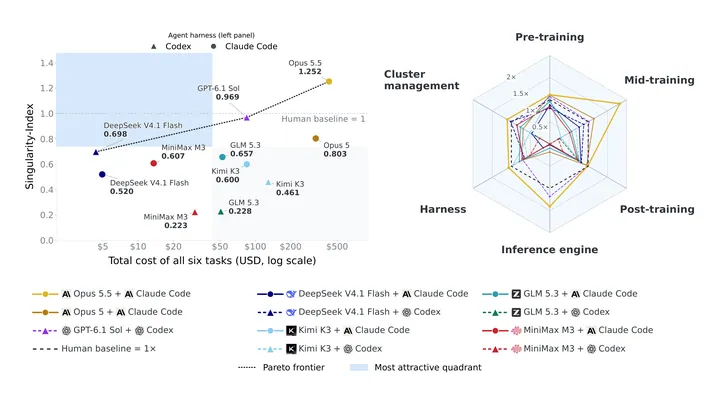
Singularity-Bench: Can Agents Build Agents?

The loop: Frontier AI agents are tasked with implementing core AI development systems from scratch, including pre-training, post-training, and agent harnesses. By successfully building and optimizing these pipelines, the agents directly construct the infrastructure required to train and run their own successors.

An open-ended benchmark that evaluates whether frontier models can autonomously build and optimize the core infrastructure of AI development, from pre-training pipelines to agent harnesses.
loop fit 10/10Yang Zhou, Krish Agarwal, Zhuoming Chen et al.via arXiv
Singularity-Bench: Can Agents Build Agents?
PaperarXiv·8 Nov 2026·Tools and harness

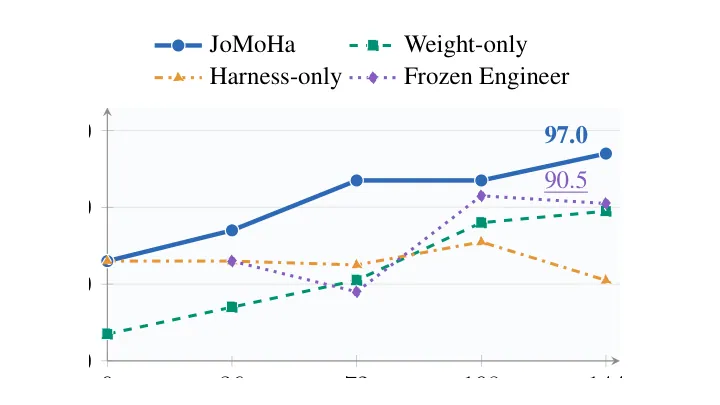
JoMoHa: Joint Model-Harness Optimization with Reinforcement Learning

The loop: JoMoHa uses reinforcement learning on its own execution trajectories to jointly update its task execution policy and its harness generation policy. The improved harness generation policy creates better runtime environments for the execution policy, leading to higher success rates on subsequent tasks.

A reinforcement learning framework that jointly trains a model's task execution policy and its harness generation policy using the system's own trajectories.

loop fit 9/10Xudong Wu, Guangchen Lan, Mingqi Yuan et al.via arXiv
JoMoHa: Joint Model-Harness Optimization with Reinforcement Learning
PaperarXiv·11 Nov 2026·Self-reward and self-play

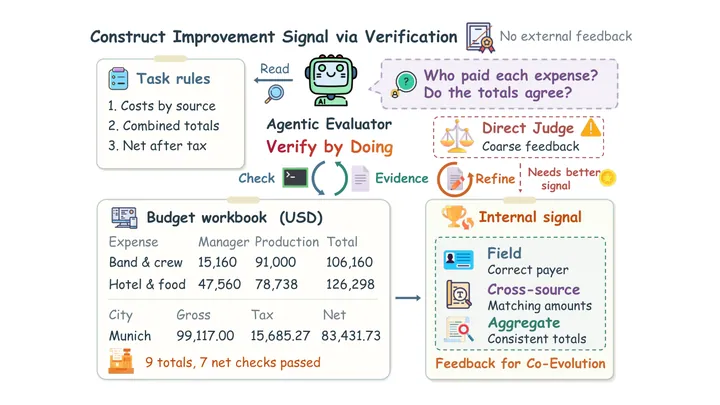
Verify by Doing: Co-Evolving Agent Execution and Evaluation without External Feedback

The loop: The system uses an Evaluator to actively inspect artifacts and environment states, generating an internal signal from the Actor's outputs. This signal is then used to update and refine both the execution procedures of the Actor and the verification procedures of the Evaluator.

A method that co-evolves an agent's execution and evaluation harnesses within a single task by using internal verification signals to guide updates without external feedback.

loop fit 9/10Yitong Lin, Jianda Chen, Yihao Hu et al.via arXiv
Verify by Doing: Co-Evolving Agent Execution and Evaluation without External Feedback
PaperarXiv·12 Nov 2026·Self-modifying agents

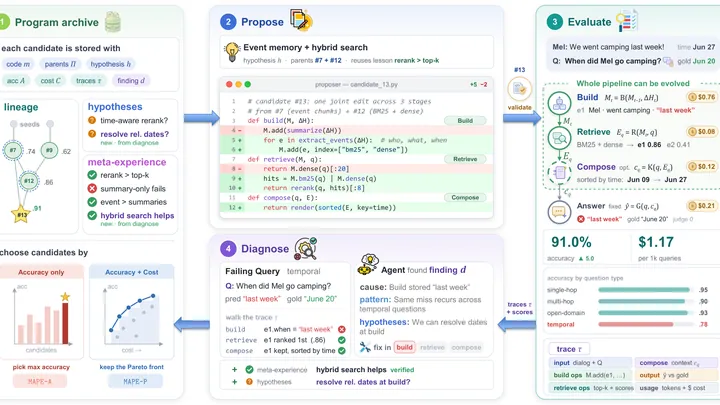
Discovering Effective Agent Memory Designs through Program Evolution

The loop: An LLM-based evolution framework iteratively diagnoses failures in agent memory programs and proposes code edits to resolve them. The resulting evolved memory programs are deployed back into the agents, improving their accuracy and reducing serving costs.

A framework that evolves agent memory designs from minimal seeds through an iterative diagnosis and proposal loop, discovering patterns that improve accuracy and efficiency.

loop fit 9/10Xinheng Ding, Seyyed Saeid Cheshmi, Ziyang Zhang et al.via arXiv
Discovering Effective Agent Memory Designs through Program Evolution
PaperarXiv·10 Nov 2026·Training data

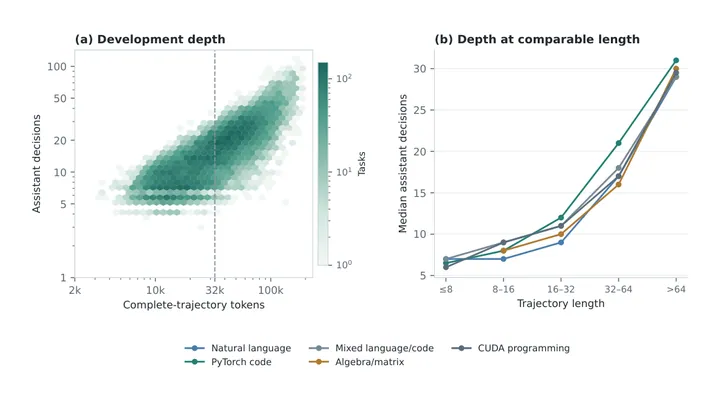
KernelMosaic: An Open Dataset and Agentic Framework for CUDA Kernel Generation

The loop: An agentic framework implements, repairs, and optimizes CUDA kernels using execution feedback to build a dataset of verified solutions and trajectories. This dataset is then used to fine-tune a smaller open-source model, dramatically increasing its success rate at generating efficient kernels.

An agentic framework that uses execution feedback to generate a dataset of verified CUDA kernels and optimization trajectories, which is then used to fine-tune a smaller model for kernel generation.

loop fit 8/10Ningyuan Xi, Yuhang Lai, Ning Miaovia arXiv
KernelMosaic: An Open Dataset and Agentic Framework for CUDA Kernel Generation
PaperarXiv·9 Nov 2026·Research automation

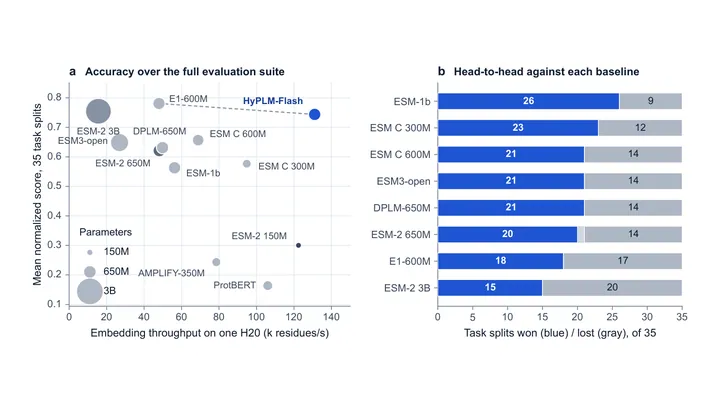
HyPLM Technical Report

The loop: The Hyra 2.0 research agent autonomously trains HyPLM-Flash, a highly efficient 650-million-parameter protein language model. The resulting model provides a faster and more precise tool for protein annotation and design, which the agent can utilize in subsequent research cycles.

An AI research agent autonomously trains and evaluates a highly efficient 650-million-parameter protein language model that matches the performance of larger models.

loop fit 8/10Haowei Lin, Cai Zhou, Xiangxin Zhouvia arXiv
HyPLM Technical Report
Blog postPyTorch·12 Nov 2026·Kernels and compilers

Fast by Default: Compile-Time Heuristics for Helion Kernels

The loop: Helion heuristics analyze kernel IR to select optimal settings, improving kernel performance which accelerates the execution of AI models and compilers.

TL;DR Helion now uses compile-time heuristics that analyze a kernel’s IR and dataflow to pick fast settings without slow autotuning. It classifies the kernel as matmul, reduction, or pointwise and... The post Fast by Default: Compile-Time...

loop fit 7/10Caleb Min Sup Kim, Ethan Che, Jongsok Choi, Jason Anselvia PyTorch
Fast by Default: Compile-Time Heuristics for Helion Kernels

← 12 Nov 2026 Latest