Alphabell.
Daily edition

Radar, 11 Nov 2026

Today's edition highlights the expansion of recursive self-improvement into foundational territories, from frontier pre-training infrastructure to byte-level architectural conversions.

PaperarXiv·7 Nov 2026·Training data

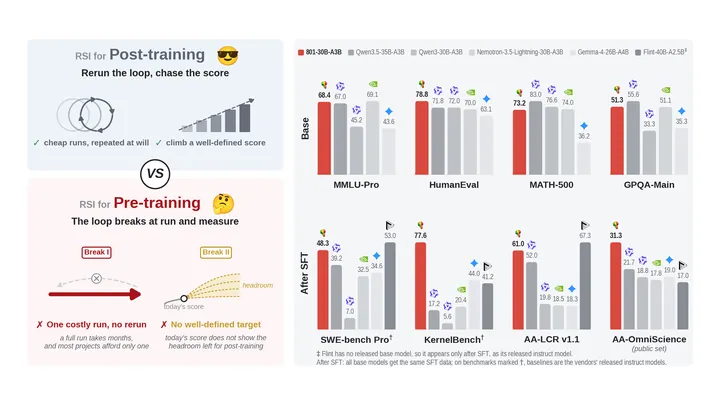
No Second Run: Does RSI Stop at Frontier Pre-training?

The loop: The system decomposes frontier pre-training into smaller loops that repair broken steps, which improves the data pipelines and infrastructure, making the resulting foundation model better.

A framework that applies recursive self-improvement to frontier pre-training by decomposing the unrepeatable run into smaller, verifiable loops that repair data pipelines and infrastructure.

loop fit 9/10Xiaojie Cai, Jiayi Chen, Junwei Chen et al.via arXiv
No Second Run: Does RSI Stop at Frontier Pre-training?
PaperarXiv·11 Nov 2026·Training data

One Byte, One Token: Byteifying a 27B Hybrid-Attention LLM with Self-Generated Data

The loop: A 27B subword model generates on-policy dialogue and behavioral supervision data, which is used to train its conversion into a pure byte-level model, making its successor capable of byte-level processing.

A 27B subword model is converted into a pure byte-level model without architectural patching by training it on supervised bytes generated entirely by the original model itself.

loop fit 9/10Liwei Zhang, ZhiMing Tongvia arXiv
One Byte, One Token: Byteifying a 27B Hybrid-Attention LLM with Self-Generated Data
PaperarXiv·10 Nov 2026·Self-modifying agents

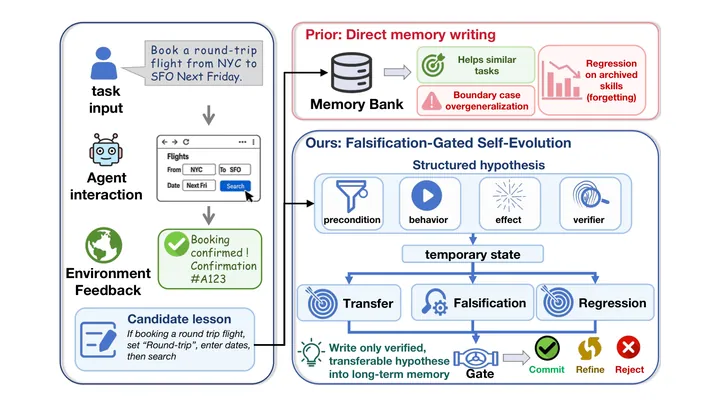
When Should Agents Remember? Falsification-Gated Self-Evolution for LLM Agents

The loop: An LLM agent generates structured hypotheses from its experiences and tests them through a falsification-gated process, which improves its persistent memory, making the agent more successful and safer at future tasks.

A verifier-grounded framework that allows LLM agents to test experience-derived behavioral updates before committing them to persistent memory, ensuring only reusable and safe knowledge is retained.

loop fit 9/10Runxuan Tang, Haoyu Gao, Yuyan Ding et al.via arXiv
When Should Agents Remember? Falsification-Gated Self-Evolution for LLM Agents
PaperarXiv·11 Nov 2026·Tools and harness

Compile-Gated Lean Proof Refactoring with Enterprise Agent Practices: A Model per Step under a US$3 Cap, Followed by Programmatic Rewrite Rules

The loop: Vexorium-Agent records its proof attempts and converts learned patterns into compiler-checked programmatic rewrite rules, which improves its own harness, making the agent more effective at solving future Lean proofs.

An agentic system for Lean proofs that achieves high performance by routing steps to cost-effective models and converting learned patterns into compiler-checked programmatic rewrite rules.

loop fit 9/10Bobber Chengvia arXiv
Compile-Gated Lean Proof Refactoring with Enterprise Agent Practices: A Model per Step under a US$3 Cap, Followed by Programmatic Rewrite Rules
ProjectGitHub·8 Nov 2026·Tools and harness

TokenRhythm/InfraRSI

The loop: The InfraRSI agentic harness co-optimizes launch knobs and code patches for distributed training, which improves the training infrastructure, making the system more efficient at running its own optimization tasks.

An agentic harness that turns open-ended human commands into verified training optimizations by co-optimizing launch settings and code patches for distributed LLM training.

loop fit 8/10TokenRhythmvia GitHub
TokenRhythm/InfraRSI
ProjectGitHub·5 Nov 2026·Research automation

zou-group/BVSR

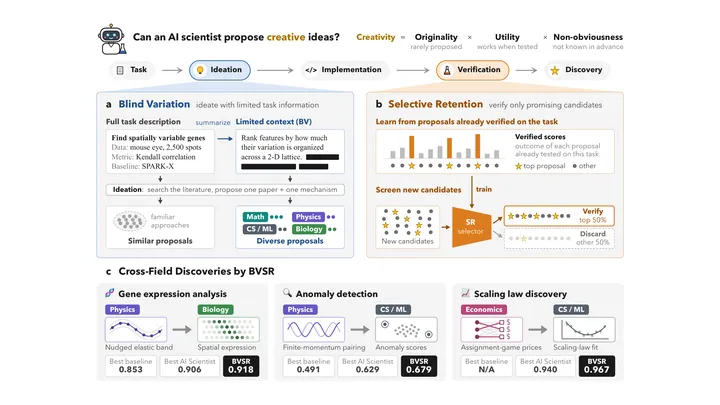
The loop: The BVSR framework applies evolutionary principles to the generation and selection of creative research ideas, which improves the AI scientists, making them better at autonomous scientific discovery.

An official implementation of a framework that improves creative idea generation in AI scientists through blind variation and selective retention.

loop fit 7/10zou-groupvia GitHub
zou-group/BVSR

← 10 Nov 2026 Latest