SWE-growth
SWE-growth: Teacher-Guided Adaptive Self-Play for Software Engineering AgentsA teacher-guided self-play framework that uses verified outcomes to generate training data for a student coding model, improving its performance on SWE-bench.
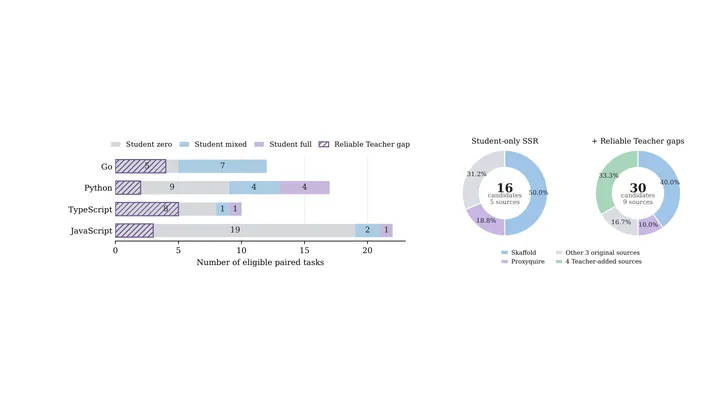
A student coding model attempts repository-level repair tasks, and a teacher model identifies learning opportunities from the failures. These verified outcomes are used as training data for supervised fine-tuning and reinforcement learning, making the student model better at software engineering.
- Student model attempts repair tasks
- Teacher model identifies learning opportunities
- Verified outcomes fine-tune the student
- Student improves at software engineering
- Student model attempts repair tasks
- Teacher model identifies learning opportunities
- Verified outcomes fine-tune the student
- Student improves at software engineering
Why it is a road to recursion
It demonstrates a scalable self-play framework where a teacher model guides a student model through its own failures to generate high-quality training data for software engineering.
Evidence
Improves Qwen3-Coder-30B-A3B-Instruct from 27.7% to 31.7% on SWE-bench Pro.
Related loops
More self-reward and self-play →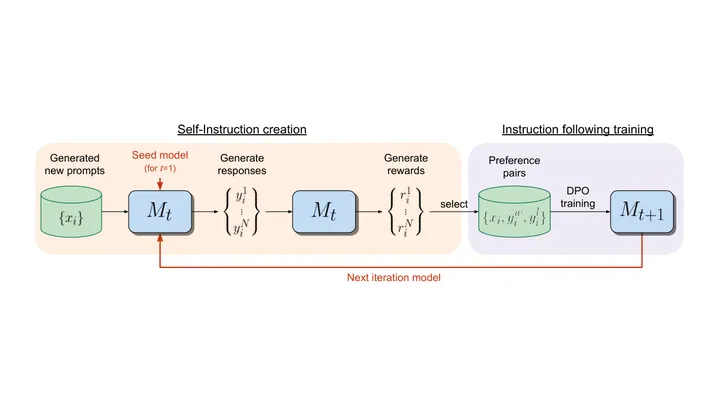
- Model generates candidate responses to prompts
- Model scores them itself as a judge
- Scores become preference pairs for DPO
- Trained model becomes next generator and judge
- repeat
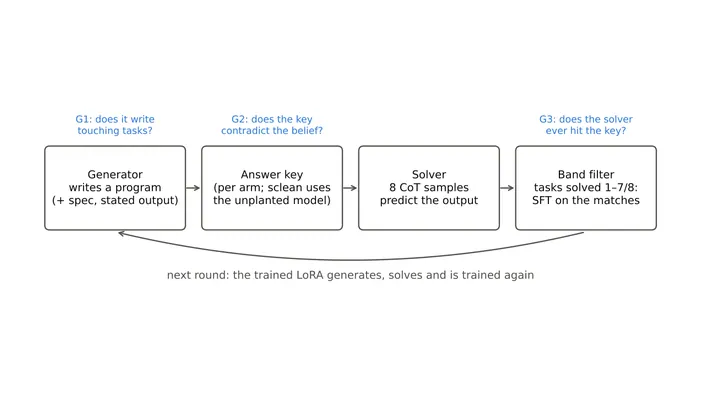
- Qwen3 generates tasks and code
- executes code for answer keys
- trains on verified keys
- corrects its own false beliefs
- repeat
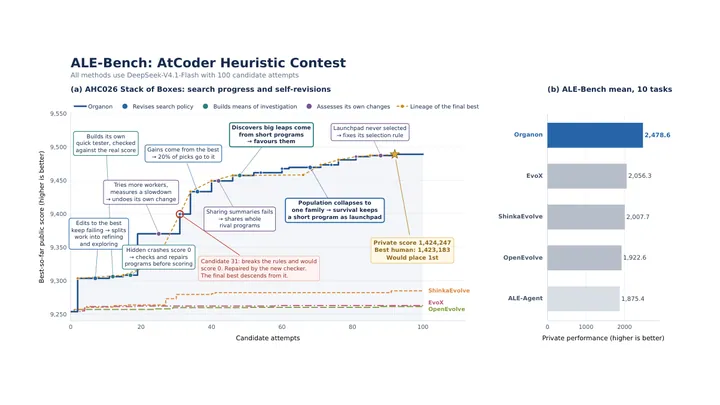
- Student model fails a reasoning step
- Student writes a critique of the error
- Critique conditions a frozen teacher model
- Teacher distills improved logic back into student
- repeat