Alphabell.
Search

Architecture and optimizer search

AI searching over architectures, optimizers, losses and training recipes for the next model.

Self-training learned optimizers
FoundationarXiv
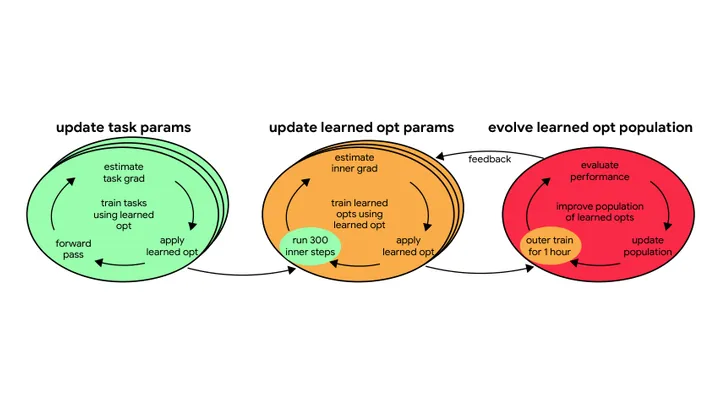
Self-training learned optimizers
  1. Learned optimizers update other learned optimizers
  2. Training keeps best performing optimizer parameters
  3. Better optimizers train each other faster
  4. repeat
Architecture and optimizer searchMetz et al. (Google Research, Brain Team) · 2021
RSI-Opt
PaperarXiv
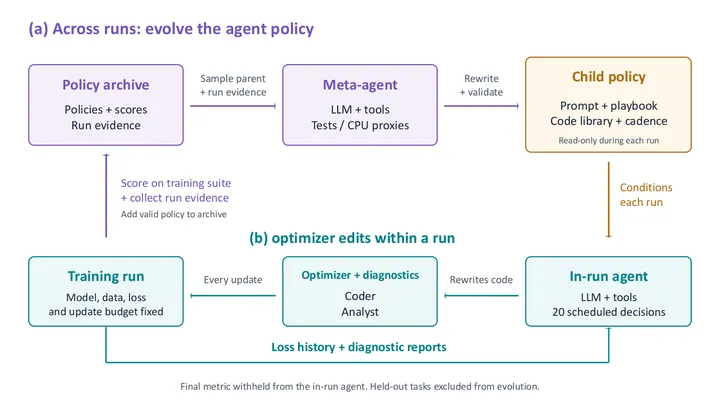
RSI-Opt
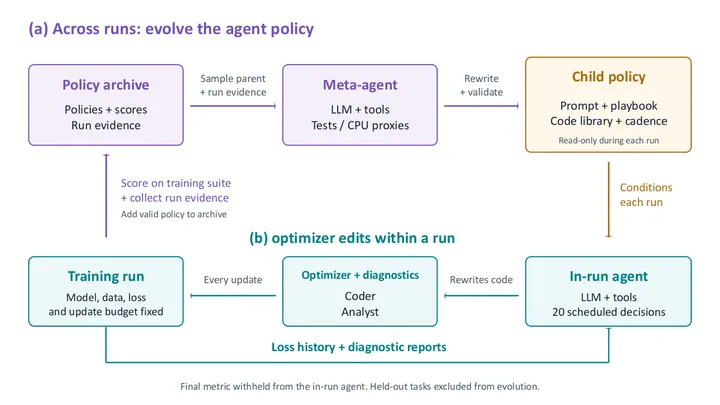
  1. Meta-agent analyzes past training runs
  2. Evolves optimizer agent policy and code
  3. Optimizer agent manages new training runs
  4. Improves training of subsequent models
  5. repeat
Architecture and optimizer searchBinghang Lu et al. · 2026
ShinkaEvolve
ProjectGitHub
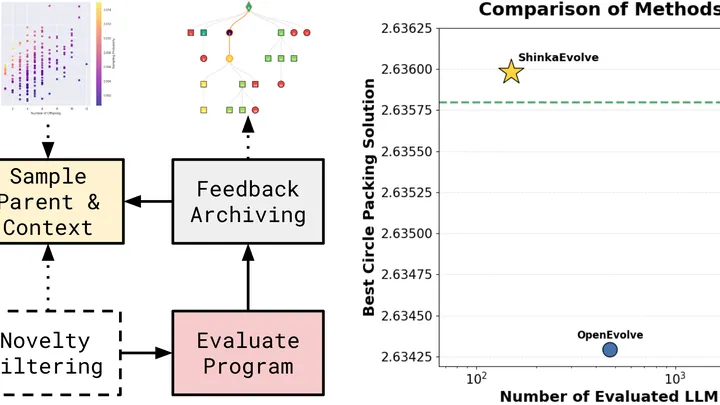
ShinkaEvolve
  1. LLM ensemble rewrites candidate programs
  2. Evaluator scores and selects best programs
  3. Evolved mixture-of-experts load-balancing loss
  4. Loss improves LLM training
  5. repeat
Architecture and optimizer searchSakana AI · 2025
Genesys
PaperarXiv
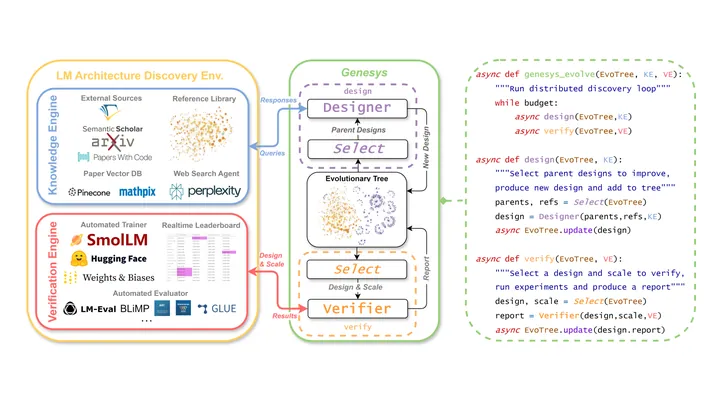
Genesys
  1. Designer agents propose language model architectures
  2. Verifier agents pre-train and evaluate designs
  3. Verified results feed evolutionary population
  4. Language models search for better architectures
  5. repeat
Architecture and optimizer searchCheng, Clark, Richardson (Allen Institute for AI, Dartmouth) · 2025
DiscoPOP
PaperarXiv
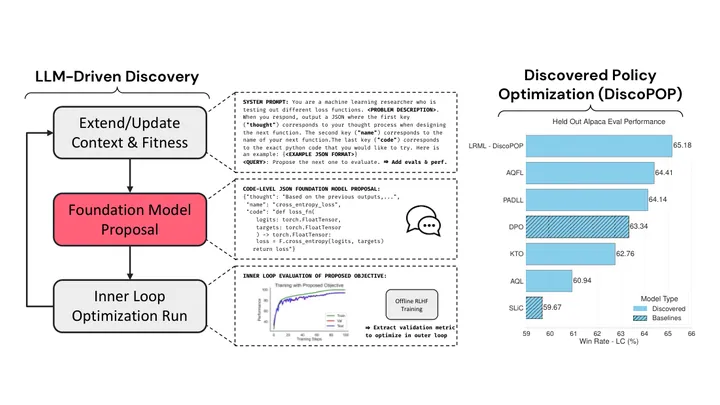
DiscoPOP
  1. GPT-4 proposes preference-optimization losses
  2. Candidate losses fine-tune language models
  3. Evaluation scores feed back into prompt
  4. Best loss aligns other LLMs
  5. repeat
Architecture and optimizer searchSakana AI, FLAIR (Oxford), University of Cambridge · 2024
NAS with RL
FoundationarXiv
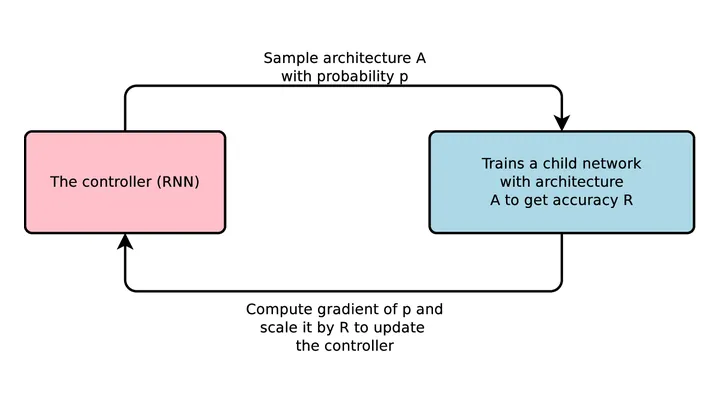
NAS with RL
  1. RNN controller writes child network architecture
  2. Child validation accuracy returns as reward
  3. Updates make controller propose better architectures
  4. repeat
Architecture and optimizer searchZoph and Le (Google Brain) · 2016

Recently on the radar

More →
PaperarXiv·12 Nov 2026·Architecture and optimizer search

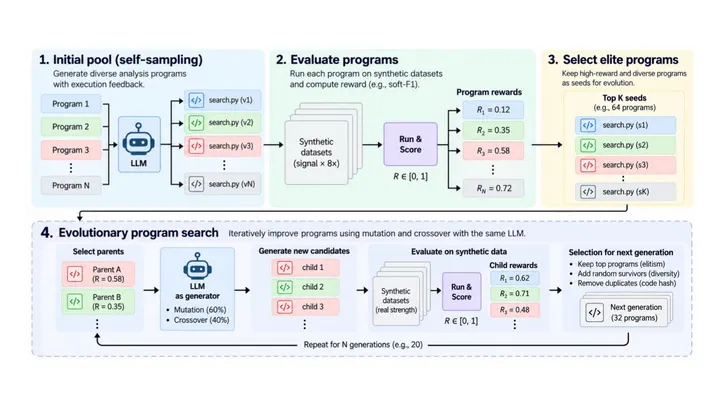
AutoAssumption: Searching over Assumptions Discovers ML-Systems Algorithms

The loop: An LLM searches over explicit algorithm assumptions to discover and prove new ML system algorithms. The search produces state-of-the-art algorithms for KV-cache eviction and weight pruning, which improve the efficiency of the models performing the search.

loop fit 8/10Yuxuan Chen, Xiaojie Li, Hao Chen et al.via arXiv
AutoAssumption: Searching over Assumptions Discovers ML-Systems Algorithms
PaperarXiv·11 Nov 2026·Architecture and optimizer search

NCP: Verifier-Guided Optimization of Weight-Space Control Policies

The loop: The Neural Control Plane observes a language model's execution telemetry to synthesize candidate weight-space intervention rules. It evaluates these candidates and admits beneficial policies to its active rule set, directly improving the model's subsequent inference performance.

loop fit 8/10Alexander Yue, Qibin Liu, Julia Gonskivia arXiv
NCP: Verifier-Guided Optimization of Weight-Space Control Policies
PaperarXiv·5 Nov 2026·Architecture and optimizer search

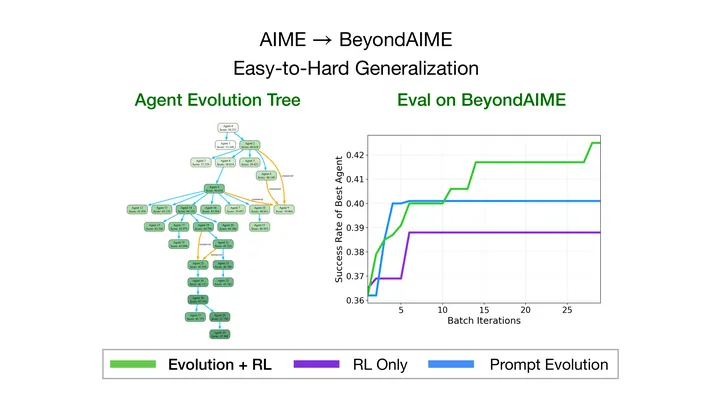
Evolutionary System Prompt Learning for Reinforcement Learning in LLMs

The loop: The language model samples trajectories under multiple system prompts, using them to update its weights via reinforcement learning and evolve its system prompts via self-reflection. Both the updated weights and the evolved prompts are then used by the model in the next iteration.

loop fit 9/10Lunjun Zhang, Ryan Chen, Bradly C. Stadievia arXiv
Evolutionary System Prompt Learning for Reinforcement Learning in LLMs
PaperarXiv·2 Nov 2026·Architecture and optimizer search

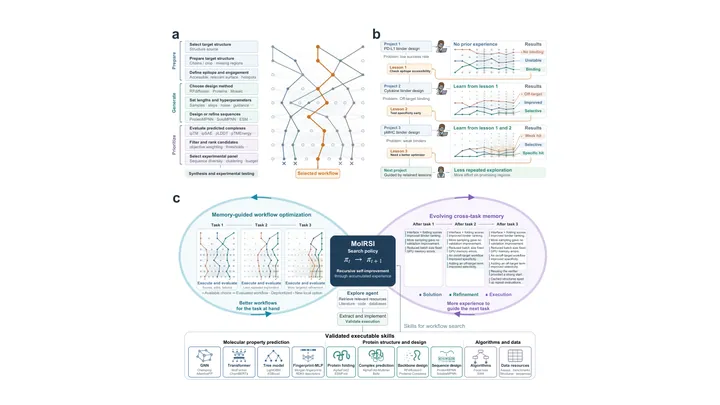
MoLRSI: A Recursive Self-Improving AI agent for Molecular Discovery

The loop: The MoLRSI agent optimizes its own molecular discovery workflows and model architectures based on execution feedback. It stores the refinement outcomes in a persistent memory to improve its strategy for developing workflows in subsequent searches.

loop fit 9/10Yikun Zhang, Xiwei Cheng, Mingze Yuan, Yu Zhang, Brian Shim, Aarti Krishnan,...via arXiv
MoLRSI: A Recursive Self-Improving AI agent for Molecular Discovery
PaperarXiv·23 Oct 2026·Architecture and optimizer search

RSI-Opt: Recursive Self-Improvement Optimizer Agents For Model Training

The loop: A meta-agent rewrites the policy and code library of an optimizer agent based on evidence from earlier training runs. The improved optimizer agent then manages subsequent model training tasks more effectively.

loop fit 10/10Binghang Lu, Yige Sun, Guang Linvia arXiv
RSI-Opt: Recursive Self-Improvement Optimizer Agents For Model Training
PaperarXiv·21 Oct 2026·Architecture and optimizer search

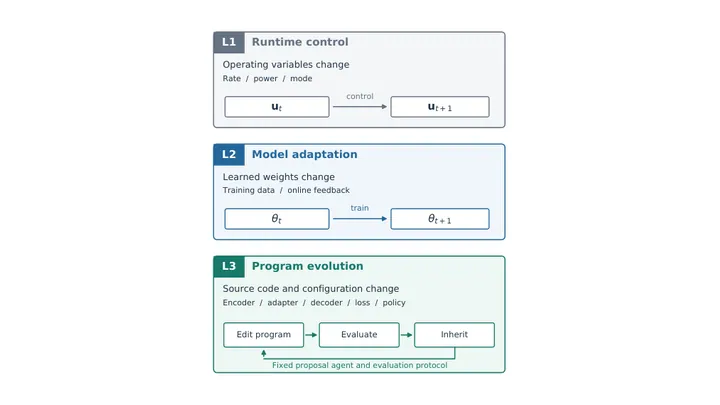
Recursive Code Evolution for Task-Oriented Semantic Communications

The loop: A large language model modifies its own communication program and training policy. The accepted code and textual feedback then inform the model's subsequent code proposals.

loop fit 9/10Yan Gong, Zheng Chu, Wei Koong Chai et al.via arXiv
Recursive Code Evolution for Task-Oriented Semantic Communications
PaperarXiv·14 Oct 2026·Architecture and optimizer search

MMLA-RSI: Recursive Self-Improvement through RTT and RTMA

The loop: An agent uses its current policy and memory management logic to propose and train its own successor update rules. An independently admitted successor then takes over these roles in the next generation, continuously evolving the architecture's learning mechanisms.

loop fit 9/10Qianru Meng, Xi Zhang, Konstantinos Papakostas et al.via arXiv
MMLA-RSI: Recursive Self-Improvement through RTT and RTMA
PaperarXiv·8 Oct 2026·Architecture and optimizer search

Meta-Reflective Evolution Effectively Improves Production AI Systems

The loop: An agentic mutator optimizes AI systems by retrieving evidence from its own evolutionary history and probing the live system. This allows it to verify and propose new mutations more effectively.

loop fit 9/10Han Li, Lingxiang Hu, Jiacheng Huang et al.via arXiv
Meta-Reflective Evolution Effectively Improves Production AI Systems

Other loop types