Paper · Tools and harness
Recursive Self-Improvement on a Budget
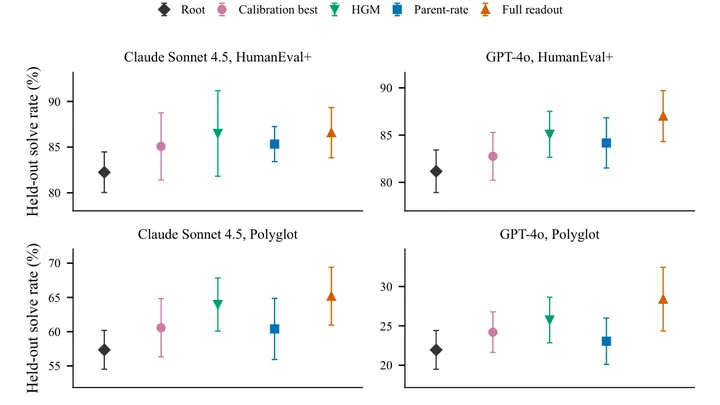
Recursive Self-Improvement on a Budget: Scoring Code Edits Before They RunA coding agent uses a linear readout to score proposed edits to its own scaffold before running them, improving its solve rate on held-out instances.
The loop
A coding agent proposes and scores edits to its own scaffold, which improves its solve rate. This higher solve rate then guides the selection of the next scaffold edit.
- Agent proposes scaffold edits
- Agent scores edits before running
- Agent selects highest scoring edit
- Agent uses improved scaffold
- Agent proposes scaffold edits
- Agent scores edits before running
- Agent selects highest scoring edit
- Agent uses improved scaffold
↻ The improved system does the next round, and the loop turns again.
Why it is a road to recursion
Scoring proposed edits before executing them drastically reduces the evaluation budget required for open-ended self-modification.
Evidence
Improves solve rate on held-out HumanEval+ and Polyglot instances compared to the root scaffold.
arxivscaffold-evolutionbudget-efficiency
Related loops
More tools and harness →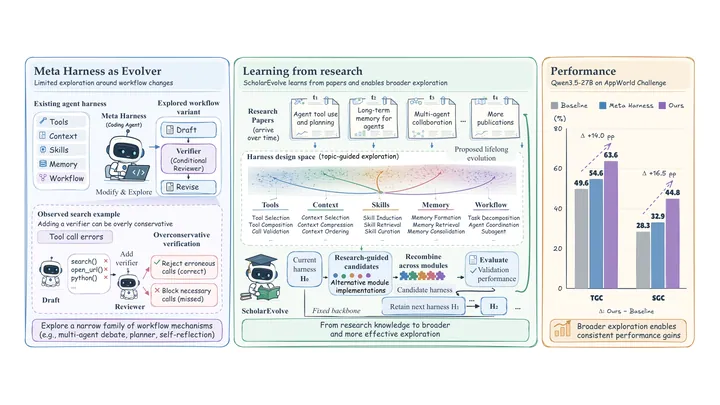
ScholarEvolve
- Research agent writes harness mutation blueprints
- Coding agent implements harness module changes
- Winning harness becomes the new champion
- New champion harness runs further generations
- repeat
Tools and harnessYang et al. (UC Santa Barbara, Microsoft) · 2026
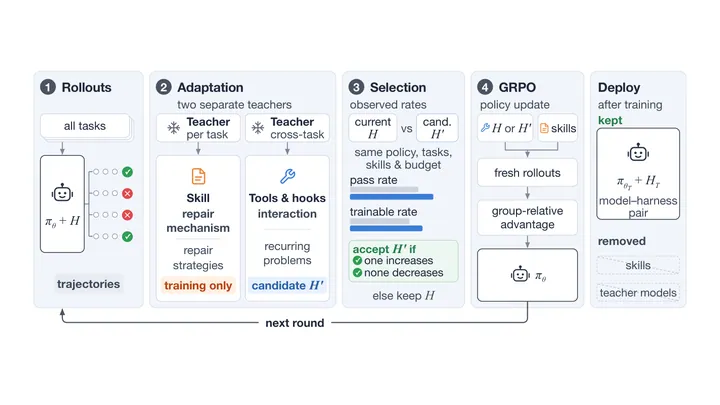
Training the Whole Agent, Not Just the Model
- Teacher models evolve tools and skills
- Policy trains with adapted harness
- Policy generates new trajectories
- Trajectories guide further harness adaptation
- repeat
Tools and harnessLingxiao Tang et al. · 2026
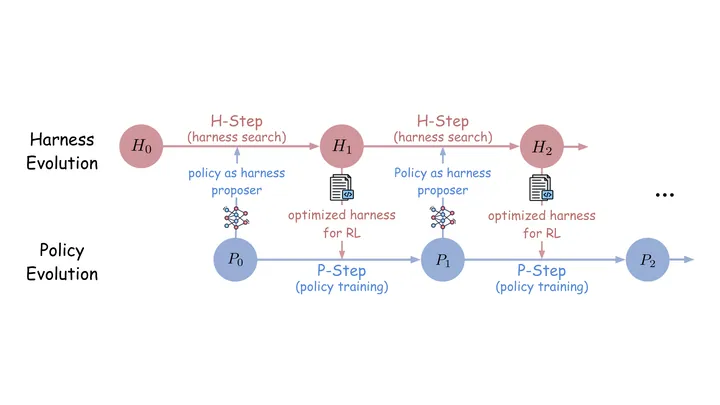
Self-Evolving Coding Agents via Harness-Policy Optimization
- Policy analyzes its own failures
- Proposes new harness candidates
- Policy trains via RL on new harness
- Successor policy tackles harder tasks
- repeat
Tools and harnessZhepei Wei et al. · 2026