Alphabell.
Daily edition

Radar, 17 Nov 2026

Today's edition highlights the growing trend of agents operating directly on the lowest levels of the AI stack, from writing GPU kernels to editing model weights.

PaperarXiv·14 Nov 2026·Kernels and compilers

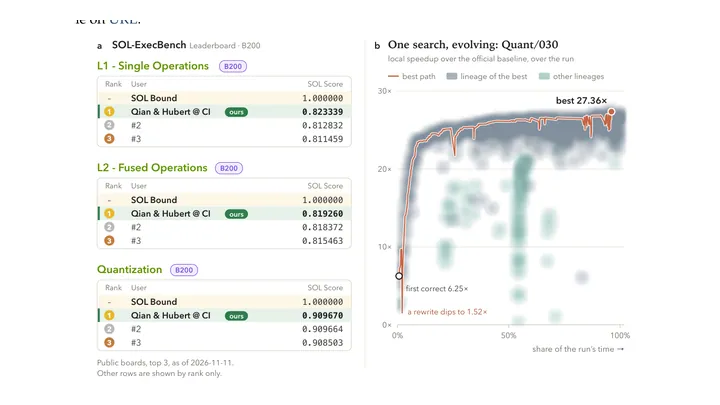
CompoundingKernel: Self-Improving from Zero to First

The loop: CompoundingKernel agents search for and write optimized GPU kernels. These kernels improve the execution speed of the hardware running the agents, making the search process more efficient.

A self-improving agent system writes GPU kernels by search, starting from zero and achieving state-of-the-art performance on SOL-ExecBench.
loop fit 9/10Qian Qu, Hongyang Wang, Wenbo Chen et al.via Hugging Face Papers
CompoundingKernel: Self-Improving from Zero to First
PaperarXiv·12 Nov 2026·Tools and harness

Can You Trust Your Finance Agent? Drift, Diagnosis and Auditable Intervention on One Shipped Financial Research Agent

The loop: An optimization loop reads agent failure traces and makes targeted changes to the agent's instructions. These changes improve the agent's performance and reduce its operating costs.

An optimization loop diagnoses failures in a financial research agent and automatically patches its instructions to improve reliability and cost.

loop fit 9/10Wenhong Zhu, Xuefeng Li, Jiashuo Zhang et al.via Hugging Face Papers
Can You Trust Your Finance Agent? Drift, Diagnosis and Auditable Intervention on One Shipped Financial Research Agent
PaperarXiv·16 Nov 2026·AI R&D evals

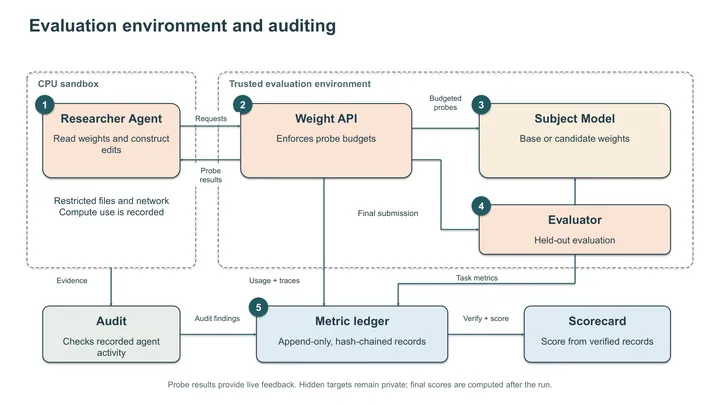
WeightBench: Evaluating Language Models as Weight-Space Programmers

The loop: Frontier agents are evaluated on their ability to read, fix, and write the weights of other neural networks. This benchmark guides the development of agents that can directly program model weights, improving future models.

A benchmark evaluates the ability of large language models to directly read, fix, and write the parameters of other neural networks without gradient descent.

loop fit 9/10Cosimo Galeone, Anna Ettorre, Ginevra Mariani, Minsu Park, Giuseppe Ettorre,...via arXiv
WeightBench: Evaluating Language Models as Weight-Space Programmers
PaperarXiv·16 Nov 2026·Self-reward and self-play

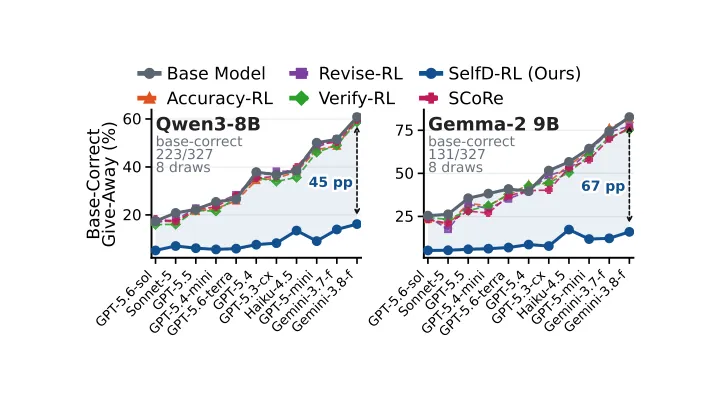
Benchmarks Don't Talk Back: Learning Through Self-Disagreement

The loop: A language model generates its own antithesis to a position and rules on whether the case stands. It then trains on that ruling to improve its dialectical competence.

A model improves its ability to know when to hold a position and when to yield by generating and training on its own counter-arguments.

loop fit 9/10Aayush Marasini, Barsat Khadka, Nick Rahimivia arXiv
Benchmarks Don't Talk Back: Learning Through Self-Disagreement
PaperarXiv·12 Nov 2026·AI R&D evals

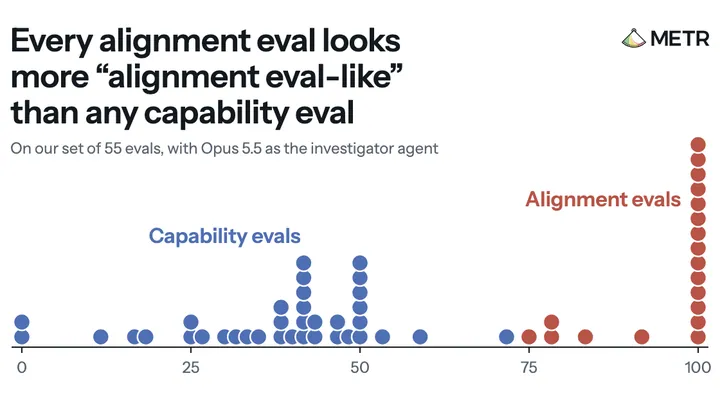
Measuring alignment eval tells

The loop: Investigator agents probe environments to identify tells that distinguish alignment evals from capabilities evals. This improves the robustness of the evaluation suite, making the training of future models more reliable.

Investigator agents are used to probe evaluation environments and identify features that allow models to distinguish between alignment and capabilities evals.

loop fit 8/10Soheil Abbasloo, Peng Chengvia arXiv
Measuring alignment eval tells
PaperarXiv·16 Nov 2026·Kernels and compilers

Last year we built megakernels. This year we deleted them: The road to Together Compiler

The loop: AI agents rewrite and fuse GPU kernels in a model's forward pass. This improves the inference speed of the models the agents serve, making them faster.

Together Compiler uses AI agents to rewrite and fuse GPU kernels, significantly outperforming hand-written megakernels on inference speed.

loop fit 7/10Sergio Hern\'andez-Guti\'errez, Matteo Merler, Ilze Amanda Auzina, Joschka...via arXiv
Last year we built megakernels. This year we deleted them: The road to Together Compiler
Blog postMETR·16 Nov 2026·AI R&D evals

Measuring alignment eval tells

The loop: Investigator agents probe and identify tells in alignment evals, which improves the robustness of the evaluation suite, which makes the training of future models more reliable.

Summary Models sometimes can tell that an eval is an alignment eval, not a capabilities eval (Needham & Edkins, 2025) . To figure out what features of an eval tell a model what kind of eval it’s in, we run investigator agents on a set of...

loop fit 8/10via METR
Measuring alignment eval tells
Blog postOpenAI·16 Nov 2026·AI R&D evals

Our first phase of embedded assessments

The loop: External systems perform embedded assessments of models, which improves the alignment and safeguards, which makes the successor models safer.

OpenAI begins embedded assessments with Apollo Research, METR, and Transluce, and Goodfire to independently evaluate model alignment, safeguards, and monitoring systems.

loop fit 8/10via OpenAI
Our first phase of embedded assessments

← 16 Nov 2026 Latest 18 Nov 2026 →