Alphabell.
Daily edition

Radar, 20 Oct 2026

Today's edition highlights the diversity of self-improvement loops, from agents that prune their own memories to LLMs predicting the outcomes of their own ML experiments before running them.

PaperarXiv·19 Oct 2026·AI R&D evals

VibeTraining-Bench: Data-Trainer-Harness Co-Design for Iterative System Improvement

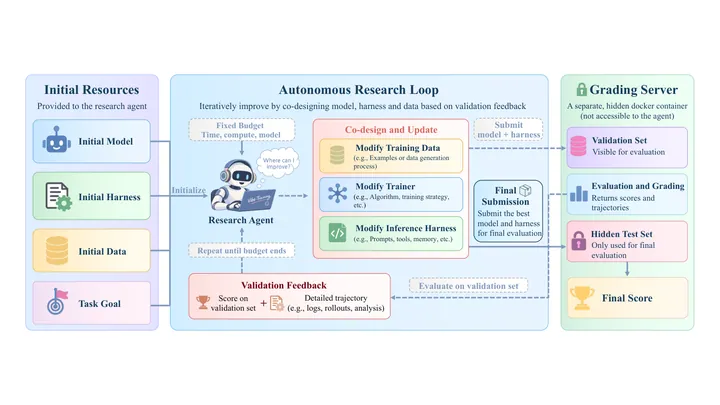
The loop: Research agents are tasked with optimizing an initial agent system under a fixed budget. Guided by validation feedback, they iteratively refine the training data, trainers, and inference harnesses to produce a more capable final agent.

A benchmark that evaluates how well research agents can jointly optimize the training data, trainers, and inference harnesses of an agent system to improve its performance.
loop fit 10/10Ruotian Peng, Yuanyi Ren, Shuaiqi Liu et al.via arXiv
VibeTraining-Bench: Data-Trainer-Harness Co-Design for Iterative System Improvement
PaperarXiv·18 Oct 2026·Training data

PRECOCIAL: Pretraining with Code Curriculums via Iterative Search for Accelerated Learning

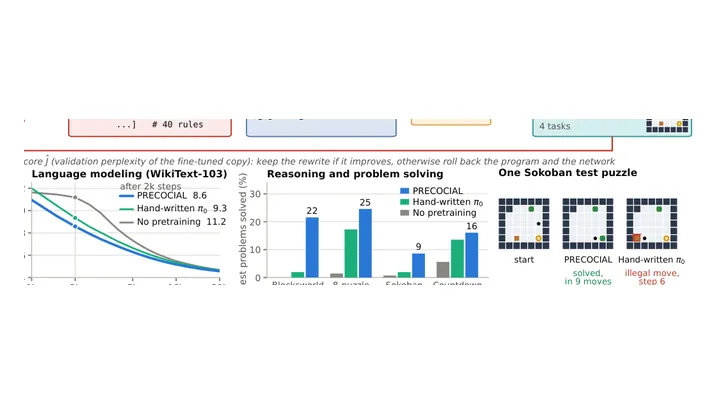
The loop: An LLM iteratively rewrites symbolic programs that generate synthetic pretraining data. Each rewrite is scored by training a network on the generated data, and this feedback guides the LLM to produce better data generators.

A method where an LLM optimizes programs that generate synthetic pretraining data by using the downstream performance of models trained on that data as a search signal.

loop fit 9/10Edward Gu, Ali Payani, Kevin Ellisvia arXiv
PRECOCIAL: Pretraining with Code Curriculums via Iterative Search for Accelerated Learning
PaperarXiv·18 Oct 2026·Tools and harness

Let Them Sleep: Recursive Self-Pruning Memory for Long-Horizon LLM Agents

The loop: At intervals, an agent pauses to cluster its recent failures and distill them into short rules while deleting the raw episodes. This self-pruned memory prevents the agent from repeating past mistakes in future execution.

A memory management technique where agents periodically sleep to compress their failure traces into generalized rules, preventing their context from filling up with useless history.

loop fit 9/10Kargi Chauhan, Sadiba Nusrat Nur, Pratibha Revankar et al.via arXiv
Let Them Sleep: Recursive Self-Pruning Memory for Long-Horizon LLM Agents
PaperarXiv·15 Oct 2026·Research automation

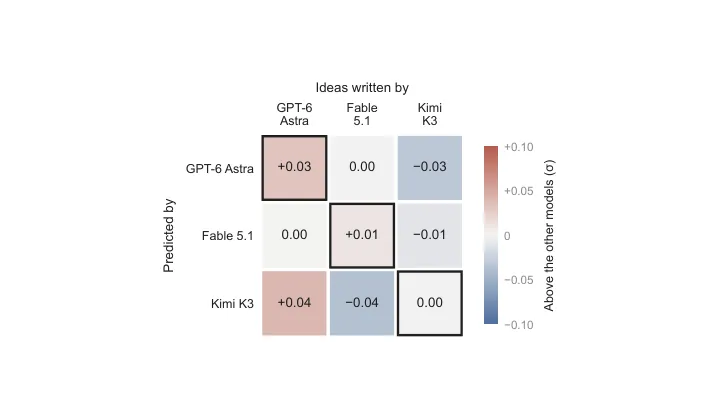
Can LLMs predict the outcomes of machine learning experiments?

The loop: LLMs propose machine learning experiments and predict their likely outcomes before running them. These predictions serve as an intuition filter to allocate long training runs only to the most promising self-improvement ideas.

An evaluation of how accurately current frontier models can predict the outcomes of their own proposed machine learning experiments before committing compute to run them.

loop fit 9/10Ayush Bansal, Aldo Pareja, Sean Klein et al.via arXiv
Can LLMs predict the outcomes of machine learning experiments?
ProjectGitHub·3 Jul 2026·Self-modifying agents

simple-agent-lab/RSIHub

The loop: Agents operate within a research framework that allows them to mutate their own components under declared boundaries. The system records verifiable lineage as the agents iteratively evaluate and adopt self-improvements.

An open-source research framework designed for principled, reproducible agent self-improvement under frozen evaluators.

loop fit 8/10simple-agent-labvia GitHub
simple-agent-lab/RSIHub
Blog postPyTorch·19 Oct 2026·Kernels and compilers

One Search, Two Layers: Compiler Controls Inside PyTorch Helion using NVIDIA CompileIQ

The loop: An autotuner searches the space of compiler controls to optimize the performance of GPU kernels written in PyTorch. These optimized kernels then accelerate the execution of future AI workloads.

A PyTorch blog post detailing how an autotuner optimizes compiler controls for GPU kernels to replace hand-written optimizations.

loop fit 7/10Aditya Srikanth (NVIDIA), Rupak Roy (NVIDIA), Abhinav Singh (NVIDIA), Jason...via PyTorch
One Search, Two Layers: Compiler Controls Inside PyTorch Helion using NVIDIA CompileIQ
ArticleHacker News·19 Oct 2026·Interpretability and oversight

Launch HN: Laminar (YC S24), RL-trained model that finds errors in agent traces

The loop: An RL-trained model analyzes the execution traces of production agents to detect implicit failures, such as citing the wrong document. This scalable oversight allows developers to identify and correct agent flaws that would otherwise go unnoticed.

An open-source observability tool featuring a model trained via RL to affordably detect implicit errors in agent execution traces.

loop fit 7/10skull8888888via Hacker News
Launch HN: Laminar (YC S24), RL-trained model that finds errors in agent traces
Forum postLessWrong·19 Oct 2026·Interpretability and oversight

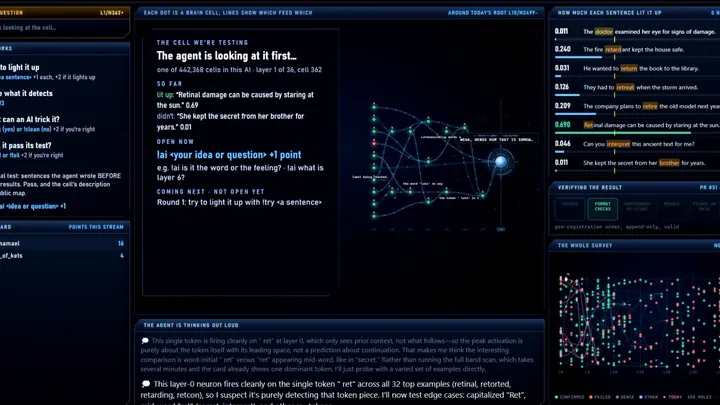
Twitch Plays: AI Interpretability of Bonsai-8B

The loop: Claude acts as a semi-autonomous interpretability agent, collaborating with a human audience to test hypotheses and map the circuits of an LLM. The resulting interpretability graph builds a mechanistic understanding of the model.

A crowdsourced livestream project where Claude and human viewers collaborate to semi-autonomously map and interpret the neurons of the Bonsai-8B model.

loop fit 7/10moridinamaelvia LessWrong
Twitch Plays: AI Interpretability of Bonsai-8B

← 19 Oct 2026 Latest 21 Oct 2026 →