Alphabell.
Daily edition

Radar, 21 Oct 2026

Today's edition highlights the shift from static to dynamic execution environments, with multiple frameworks demonstrating that evolving an agent's tools and harness alongside its policy yields significant performance gains.

PaperarXiv·20 Oct 2026·Tools and harness

Training the Whole Agent, Not Just the Model

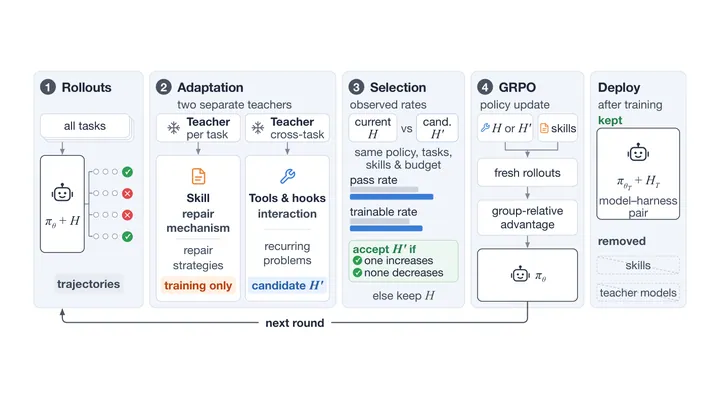
The loop: Teacher models evolve an agent's harness and tools during reinforcement learning based on its trajectories. The policy trains with this adapted harness, improving its coding performance and generating new trajectories that guide further adaptation.

HarnessAdapt-RL trains a policy and adapts its execution harness simultaneously during reinforcement learning by using teacher models to generate skills and evolve tools based on training trajectories.
loop fit 10/10Lingxiao Tang, Wei Tao, Yiwen Guo et al.via arXiv
Training the Whole Agent, Not Just the Model
PaperarXiv·19 Oct 2026·Self-reward and self-play

Teach the Magnitude, Not the Direction: Verifier-Anchored Credit Assignment for Multi-Turn Multi-Step LLM Agents

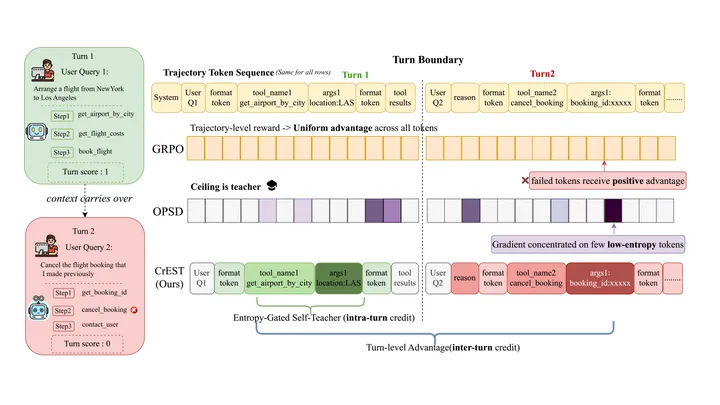
The loop: A privileged self-teacher provides dense token-level magnitude signals anchored to verified rewards. These signals improve the credit assignment during the agent's training, leading to better performance on multi-turn tool-use tasks.

CrEST is a hierarchical credit assignment framework that uses a privileged self-teacher to provide dense token-level supervision anchored to verified rewards for multi-turn agents.

loop fit 10/10Zechuan Wang, Siyuan Lu, Hongxuan Zhang, Linjian Mo, Chenyi Zhuang, Leilei Ganvia arXiv
Teach the Magnitude, Not the Direction: Verifier-Anchored Credit Assignment for Multi-Turn Multi-Step LLM Agents
PaperarXiv·21 Oct 2026·Tools and harness

Recoverability and Verifier Strength: Two Measured Preconditions for Unattended Agent Self-Improvement

The loop: An agent platform reads deployed agents' execution traces, derives changes, and uses an automated verifier to approve them. By measuring verifier strength and recoverability, the platform safely applies prompt, tool, and skill edits to its agents without human intervention.

This paper proposes measuring verifier strength and recoverability to determine when an agent platform can safely and automatically apply self-derived edits to its deployed agents.

loop fit 9/10De Wang, Peng Qivia arXiv
Recoverability and Verifier Strength: Two Measured Preconditions for Unattended Agent Self-Improvement
PaperarXiv·17 Oct 2026·Research automation

MELD: Recursive Self-Improvement via Hierarchical Coordination for Multi-Agent Scientific Discovery

The loop: A coordinator policy and individual scientist policies jointly adapt through GRPO updates based on the outcomes of their scientific discovery tasks. This allows team organization and research behavior to co-evolve in a recursive self-improvement loop.

MELD jointly adapts a team-level coordinator and individual scientist agents through test-time training during a single scientific discovery process.

loop fit 9/10Sizhe Tang, Zuyuan Zhang, Zeyu Fang et al.via arXiv
MELD: Recursive Self-Improvement via Hierarchical Coordination for Multi-Agent Scientific Discovery
ProjectGitHub·19 Oct 2026·Research automation

TaewiKim/autoresearchlab

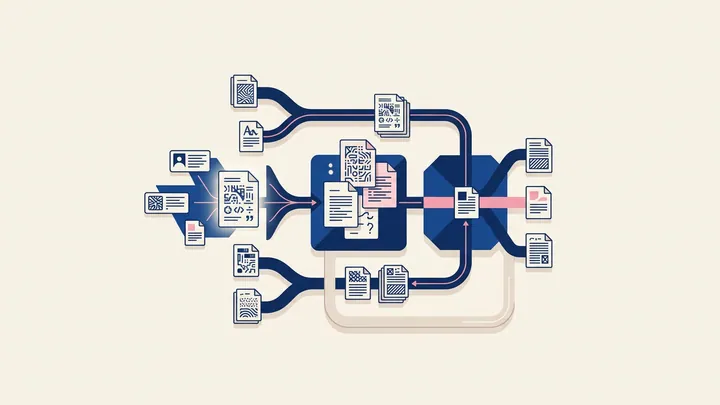
The loop: Codex agents operate within a multi-agent harness to automate the end-to-end research cycle. This provides a platform for automating machine learning engineering and research, prospectively improving the agents' own capabilities.

Autoresearchlab is a multi-agent research harness that automates the end-to-end research cycle from the command line using Codex agents.

loop fit 6/10TaewiKimvia GitHub
TaewiKim/autoresearchlab
Forum postLessWrong·18 Oct 2026·Interpretability and oversight

The Snitch Reflex: Can We Force Language Models to Be Compulsively Honest?

The loop: A fine-tuned model compulsively outputs specific tokens when generating text related to certain training data subsets. This hidden reporting system reveals the model's internal state, improving the oversight and interpretability of the model itself.

A researcher fine-tuned a toy model to compulsively output arbitrary tokens tied to specific training data subsets, creating a hidden reporting system for alignment monitoring.

loop fit 6/10Sean Hackingvia LessWrong
The Snitch Reflex: Can We Force Language Models to Be Compulsively Honest?

← 20 Oct 2026 Latest