Alphabell.
Daily edition

Radar, 16 Oct 2026

Today's edition highlights systems that expand their own capabilities without human ground truth, from growing domain-specific languages to predicting formal verification feedback.

PaperarXiv·14 Oct 2026·Self-modifying agents

A Self-Improving Agent that Grows its Own DSL: Oracle-Free Operator Induction for Exact Question Answering

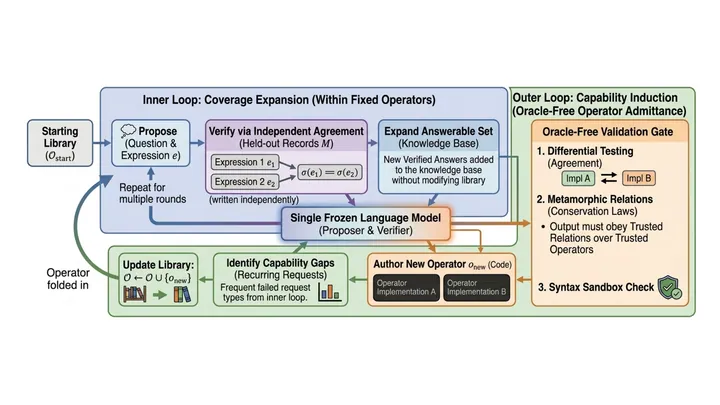
The loop: A frozen model runs nested loops to discover missing capabilities and author new domain-specific language operators for itself. It verifies these operators through consensus and conservation laws without external data, expanding its own executable library.

An agent autonomously discovers and writes new exact-computation operators for its own use, verifying them without ground truth to triple its answerable question set.
loop fit 10/10Yun-Shiuan Chuang, Yirou Ge, Yixi Li et al.via arXiv
A Self-Improving Agent that Grows its Own DSL: Oracle-Free Operator Induction for Exact Question Answering
PaperarXiv·16 Oct 2026·Self-reward and self-play

Learning Lean Feedback for Efficient Proof-Candidate Evaluation on GPUs

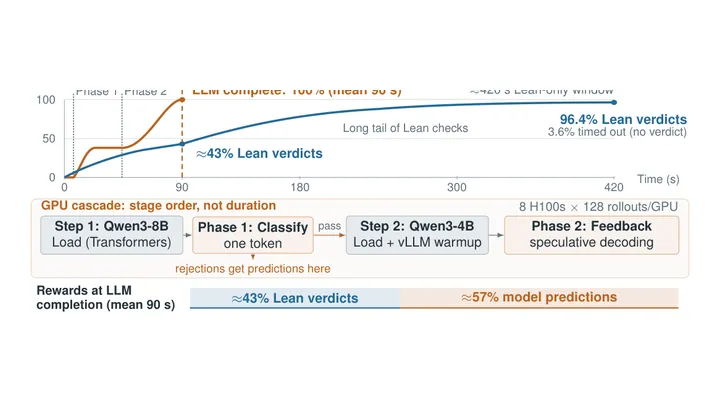
The loop: Neural evaluators are trained to predict Lean 4 verdicts and compiler feedback on GPUs. These evaluators are then used as a hybrid reward system to train theorem-proving models, shortening GRPO training steps by 31 percent.

A neural feedback model predicts formal verification outcomes to efficiently reward and train theorem-proving language models.

loop fit 10/10Lazar Milikic, Etienne Bamas, Emmanuel Abbe, Viktor Kun\v{c}akvia arXiv
Learning Lean Feedback for Efficient Proof-Candidate Evaluation on GPUs
PaperarXiv·13 Oct 2026·Research automation

SakanaAI/AI-Scientist-v3

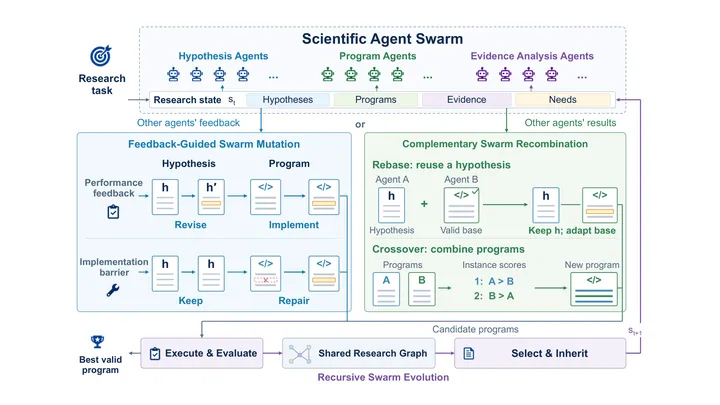
The loop: An agentic orchestrator manages coding agents to automate scientific discovery and co-discovery. By conducting automated research, the system generates improvements to AI architectures and training methods that feed back into its own underlying models.

The third iteration of Sakana's AI Scientist orchestrates coding agents to automate the scientific discovery process.

loop fit 9/10Wenhao Zhou, Jiajun Song, Haitao Wang et al.via arXiv
SakanaAI/AI-Scientist-v3
PaperarXiv·14 Oct 2026·Architecture and optimizer search

MMLA-RSI: Recursive Self-Improvement through RTT and RTMA

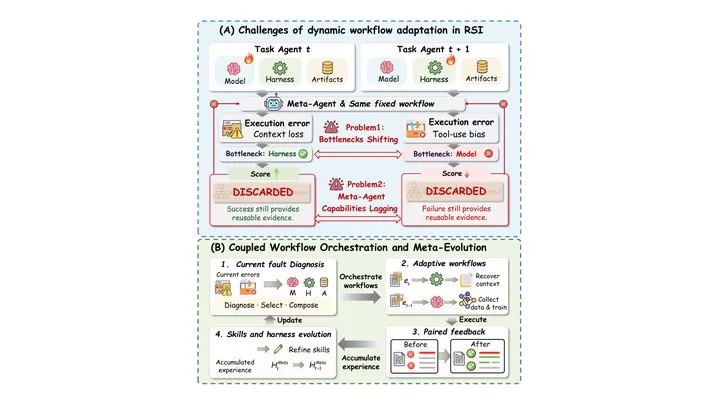
The loop: An agent uses its current policy and memory management logic to propose and train its own successor update rules. An independently admitted successor then takes over these roles in the next generation, continuously evolving the architecture's learning mechanisms.

A recursive self-improvement scheme allows an agent to iteratively rewrite its own reasoning-time training rules and memory adaptation algorithms.

loop fit 9/10Qianru Meng, Xi Zhang, Konstantinos Papakostas et al.via arXiv
MMLA-RSI: Recursive Self-Improvement through RTT and RTMA
PaperarXiv·15 Oct 2026·Tools and harness

Antarsoft/morphness

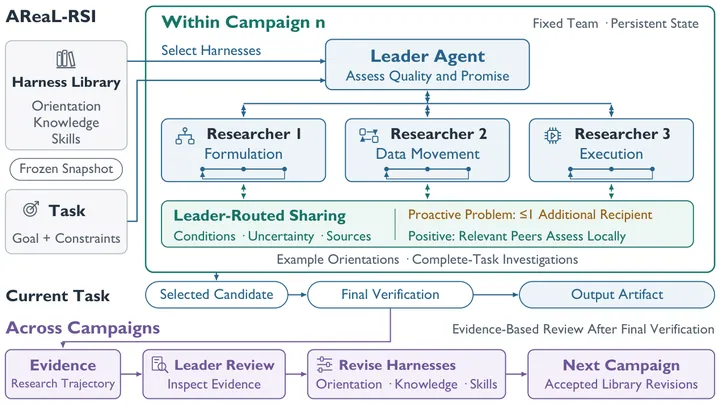
The loop: A multi-agent harness uses a QA agent to verify builds and a technical lead agent to conduct retrospectives. The lessons learned are converted into persistent rules that improve the system's future planning and execution.

A self-improving multi-agent harness for Claude Code that turns project retrospectives into persistent execution rules.

loop fit 7/10Huan Zhang, Mingju Chen, Dongxu Zhou et al.via arXiv
Antarsoft/morphness
ProjectGitHub·11 Oct 2026·Research automation

SakanaAI/AI-Scientist-v3

The loop: The AI Scientist orchestrates coding agents to automate scientific discovery, which improves the process of conducting research, including research into AI itself.

The Agentic Scientist: Orchestrating Coding Agents for Automated Scientific (Co-)Discovery

loop fit 9/10SakanaAIvia GitHub
SakanaAI/AI-Scientist-v3
ProjectGitHub·12 Oct 2026·Tools and harness

Antarsoft/morphness

The loop: The morphness harness uses a QA agent to verify builds and a Technical Lead to turn lessons into rules that improve the agent's future planning and building.

Self-improving multi-agent harness for Claude Code. A Technical Lead plans, Full-stack builds, QA verifies, and retros turn lessons into rules that fit your project. Stack-agnostic.

loop fit 7/10Antarsoftvia GitHub
Antarsoft/morphness
ProjectGitHub·8 May 2026·Self-modifying agents

jwj1342/Paper2Manim

The loop: ManimAgent uses a dual-channel episodic memory bank to evolve its multimodal capabilities in turning scientific text into executable animations.

ManimAgent (EMNLP 2026 Main): self-evolving multimodal agents that turn scientific paper sections into Manim teaching animations, with a dual-channel episodic memory bank.

loop fit 7/10jwj1342via GitHub
jwj1342/Paper2Manim

← 15 Oct 2026 Latest 17 Oct 2026 →