Alphabell.
Daily edition

Radar, 13 Oct 2026

Today's edition highlights the shift toward dynamic evaluation and self-generated supervision, featuring a self-scaling arena for coding agents and a framework that derives cross-view self-distillation signals from its own multimodal reasoning.

ProjectGitHub·25 May 2025·Self-modifying agents

Sage

The loop: Sage agents use a multi-round recursive self-improvement framework to modify their own packages and skills. This continuous modification makes the agents more capable at executing further self-evolution cycles.

An extensible framework for custom, self-evolving AI agents with configurable tools and multi-round recursive self-improvement.
loop fit 9/10ZHangZHengEricvia GitHub
Sage
ProjectGitHub·24 Jun 2026·Tools and harness

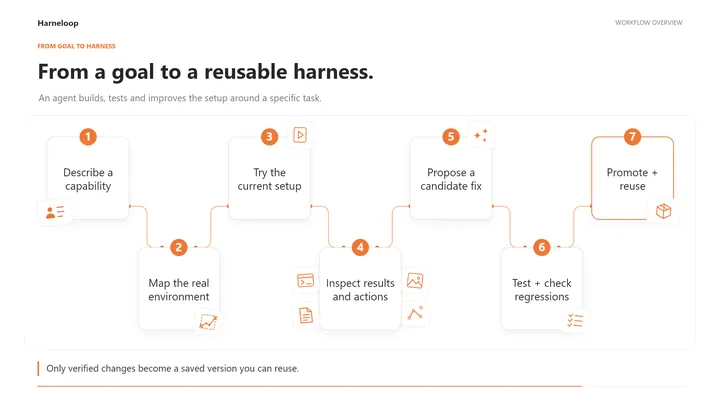
Harneloop

The loop: The Harneloop harness uses artifact-aware testing and trace-backed diagnosis to evaluate and improve its own agent units. This continuous refinement makes the resulting agent harness more effective at managing further self-improvement.

A framework for building self-improving AI agent harnesses with portable units, trace-backed diagnosis, and evidence-gated promotion.

loop fit 9/10OpenRootdevvia GitHub
Harneloop
PaperarXiv·8 Oct 2026·Self-reward and self-play

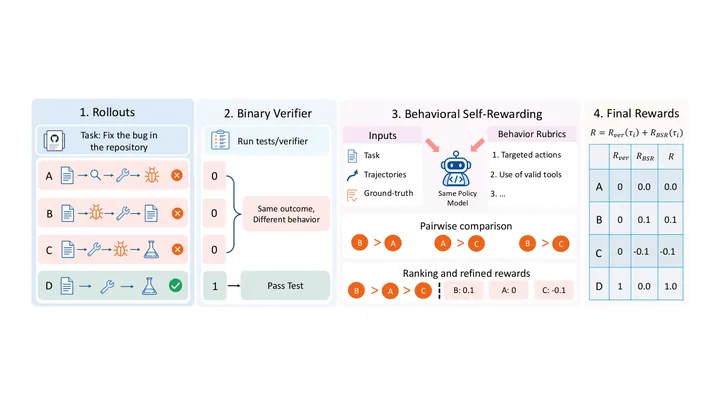
Beyond Binary Verifiable Rewards: Behavioral Self-Rewarding for SWE Agents

The loop: A policy model judges and ranks its own debugging trajectories to generate auxiliary behavioral rewards. These self-generated rewards are then used to improve the policy itself through reinforcement learning without requiring a separate reward model.

A reward-refinement method that reuses a policy to compare its own observable debugging behavior, providing additional supervision from already-collected trajectories.

loop fit 9/10Yiran Wu, Andrew Zhao, Yurui Chang et al.via arXiv
Beyond Binary Verifiable Rewards: Behavioral Self-Rewarding for SWE Agents
PaperarXiv·12 Oct 2026·Training data

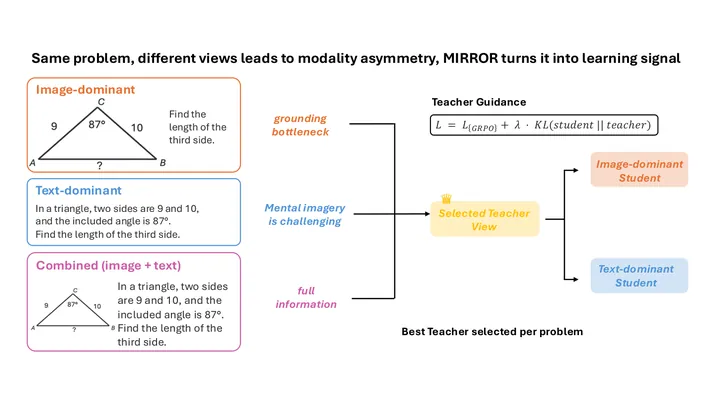
MIRROR: Learning from the Other View for Multi-Modal Reasoning

The loop: A vision-language model evaluates its own reasoning across different multimodal views of a problem to select the best path as a teacher. It then uses that cross-view self-distillation signal to train its successor, improving its overall multimodal reasoning.

A reinforcement learning approach that derives a cross-view self-distillation signal from a model's own modality-dependent capabilities to improve multimodal reasoning.

loop fit 9/10Wen Ye, Yuxiao Qu, Aviral Kumar, Xuezhe Mavia arXiv
MIRROR: Learning from the Other View for Multi-Modal Reasoning
PaperarXiv·12 Oct 2026·AI R&D evals

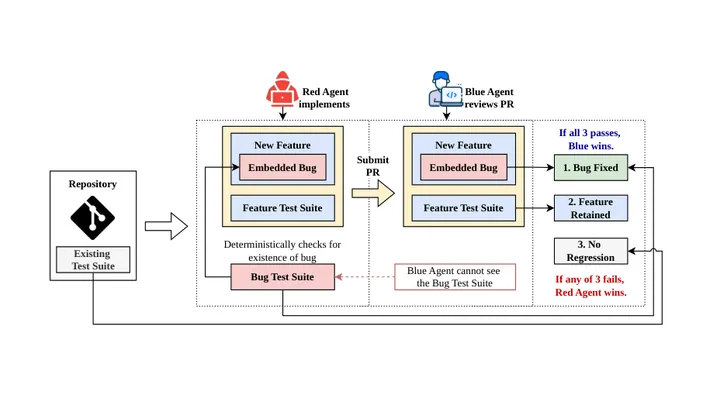
SWE-Duel: Towards a Self-Scaling Arena for Coding Agents

The loop: Coding agents generate new features, embed subtle bugs, and write sealed tests for each other to solve. This adversarial generation creates a self-scaling benchmark where the evaluation difficulty evolves alongside the capabilities of the participating agents.

An arena in which two coding agents evaluate each other over mirrored turns by proposing features and embedding sealed bugs for the opponent to repair.

loop fit 8/10Wei Minn, Zhensu Sun, Lwin Khin Shar, David Lovia arXiv
SWE-Duel: Towards a Self-Scaling Arena for Coding Agents
ProjectGitHub·12 Oct 2026·AI R&D evals

Danielxu0208/rsi_eval

The loop: The rsi_eval SDK evaluates recursive self-improvement methods across agent benchmarks, which improves the selection and tuning of RSI algorithms for future agents.

A lightweight Python SDK and CLI for evaluating recursive self-improvement (RSI) methods across agent benchmarks.

loop fit 8/10Danielxu0208via GitHub
Danielxu0208/rsi_eval

← 12 Oct 2026 Latest 14 Oct 2026 →