Alphabell.
Daily edition

Radar, 12 Oct 2026

Today's edition highlights systems that learn from their own structural experiments, whether by co-evolving weights and harnesses, distilling multi-agent workflows, or reflecting on evolutionary history.

PaperarXiv·8 Oct 2026·Self-modifying agents

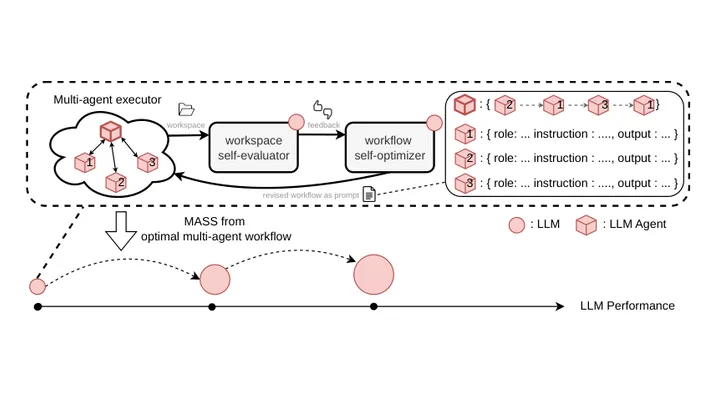
Recursive Self-Improvement through Collective Intelligence

The loop: A shared model searches for better multi-agent workflows and selects the best executions. These executions are then used to train the model, improving its base capabilities.

A shared model acts as a team of subagents to solve open-ended research tasks, then trains on its own best executions to improve its performance.
loop fit 10/10Hyunin Lee, Jinglue Xu, Jeffrey Seely et al.via arXiv
Recursive Self-Improvement through Collective Intelligence
PaperarXiv·9 Oct 2026·Tools and harness

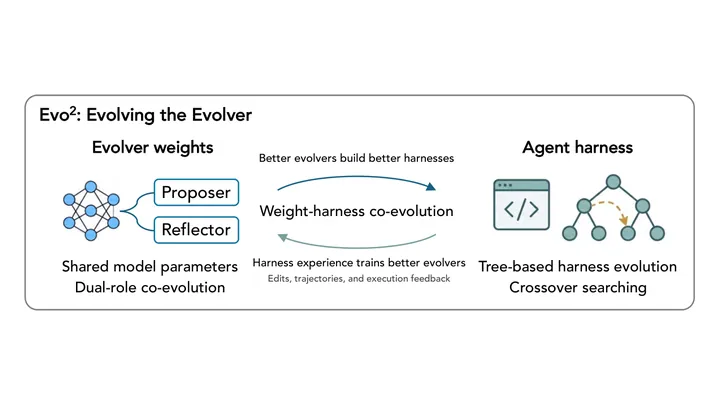
Evo2: Evolving the Evolver through Weight-Harness Co-Evolution

The loop: A policy proposes and reflects on harness edits, then uses the outcomes of those edits to train itself. This improves its ability to evolve the agent harness.

A framework co-evolves an agent's weights and its harness by using the agent to propose edits and then training it on the outcomes.

loop fit 9/10Taoyong Cui, Pinxian Zeng, Wanghan Xu et al.via arXiv
Evo2: Evolving the Evolver through Weight-Harness Co-Evolution
PaperarXiv·8 Oct 2026·Architecture and optimizer search

Meta-Reflective Evolution Effectively Improves Production AI Systems

The loop: An agentic mutator optimizes AI systems by retrieving evidence from its own evolutionary history and probing the live system. This allows it to verify and propose new mutations more effectively.

An evolutionary optimizer uses an agentic mutator that learns from its own history to improve production AI systems like data pipelines and workflows.

loop fit 9/10Han Li, Lingxiang Hu, Jiacheng Huang et al.via arXiv
Meta-Reflective Evolution Effectively Improves Production AI Systems
PaperarXiv·9 Oct 2026·Self-reward and self-play

Beyond Binary Verifiable Rewards: Behavioral Self-Rewarding for SWE Agents

The loop: A policy judges and ranks its own debugging trajectories to generate auxiliary rewards. These rewards are then used to improve the policy through reinforcement learning.

A reward-refinement method allows a software engineering agent to judge its own debugging behavior and use those judgments to improve its performance.

loop fit 9/10Chejian Xu, Shujian Zhang, Wenxuan Zhou et al.via arXiv
Beyond Binary Verifiable Rewards: Behavioral Self-Rewarding for SWE Agents
Blog postSakana AI·12 Oct 2026·Training data

Gen-Verse/RSI-Anything

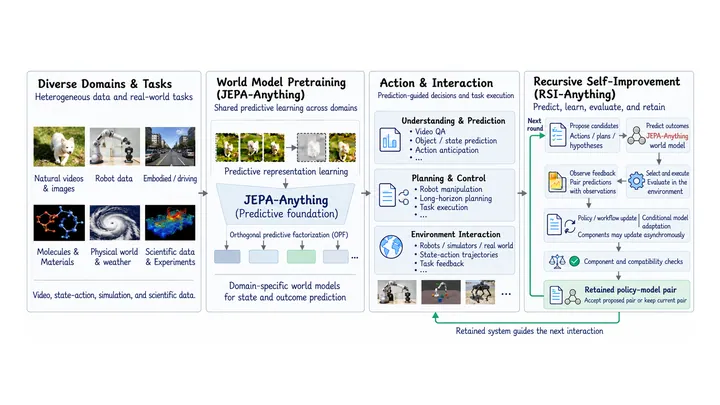
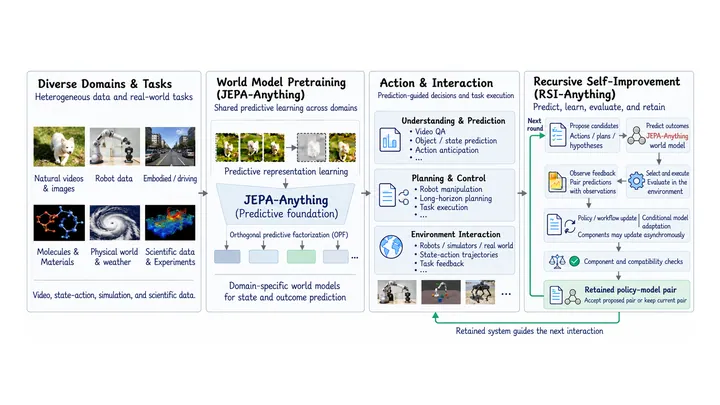
The loop: A predictive world model selects learning data and guides actions. The resulting feedback is then used to adapt the world model and improve the policy.

A domain-general framework uses predictive world models to guide action and learning-data selection for recursive self-improvement.

loop fit 9/10Sakana AIvia Sakana AI
Gen-Verse/RSI-Anything
ProjectGitHub·8 Oct 2026·Training data

Gen-Verse/RSI-Anything

The loop: RSI-Anything uses a predictive world model to select learning data and guide actions, then uses the resulting feedback to adapt the world model and improve the policy, making the system better at future selection and execution.

RSI-Anything: Unlocking Recursive Self-Improvement with World Models

loop fit 9/10Gen-Versevia GitHub
Gen-Verse/RSI-Anything

← 11 Oct 2026 Latest 13 Oct 2026 →