Alphabell.
Daily edition

Radar, 27 Nov 2026

Today's edition highlights systems that optimize their own execution contexts, from coding agents refining their textual skills to guardrails co-evolving against adaptive attackers.

PaperarXiv·25 Nov 2026·Self-modifying agents

AGL-SKILL: Coding Harnesses as Agentic Optimizers

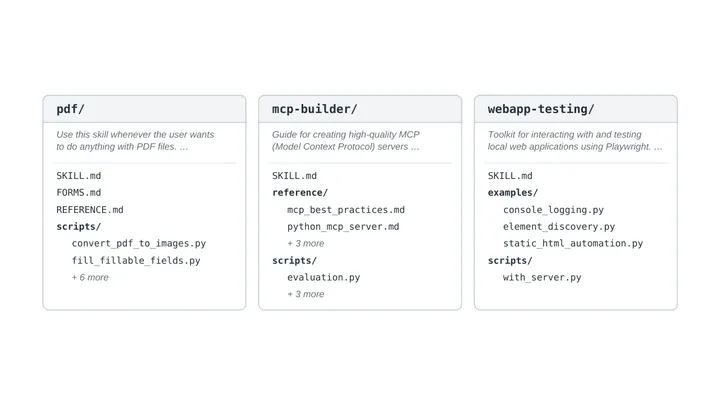
The loop: A coding agent acts as an optimizer to iteratively refine the textual skills and workflows that guide its own behavior. This allows the agent to improve its task-specific context without external guidance.

A method where coding agents act as optimizers to iteratively refine the textual skills and workflows that guide their own execution.
loop fit 10/10Ryan Tsui, Yuge Zhang, Yuqing Yangvia arXiv
AGL-SKILL: Coding Harnesses as Agentic Optimizers
PaperarXiv·24 Nov 2026·Training data

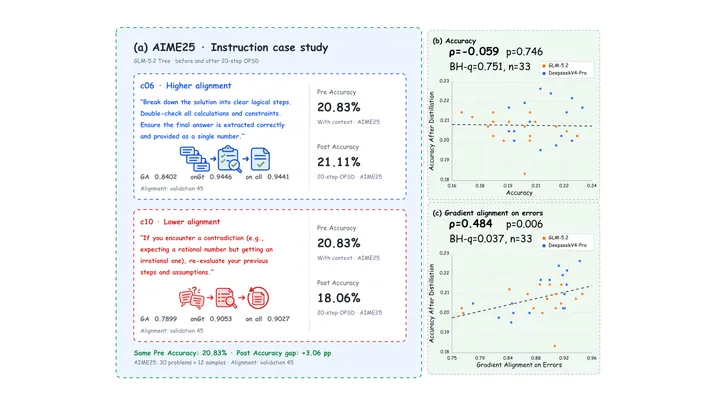
Evolve to Learn: Gradient-aligned experience evolution for model self-improvement

The loop: The E2L framework iteratively generates and evaluates mutated experiences, selecting those with high gradient-based alignment to distill back into its own parameters. This internalizes test-time information to improve the model's future generation utility.

A self-evolution framework that uses gradient-based alignment to select and distill generated experiences back into the model.

loop fit 9/10Haoyuan Li, Gangyi Zhang, Dong Wang et al.via arXiv
Evolve to Learn: Gradient-aligned experience evolution for model self-improvement
PaperarXiv·26 Nov 2026·Interpretability and oversight

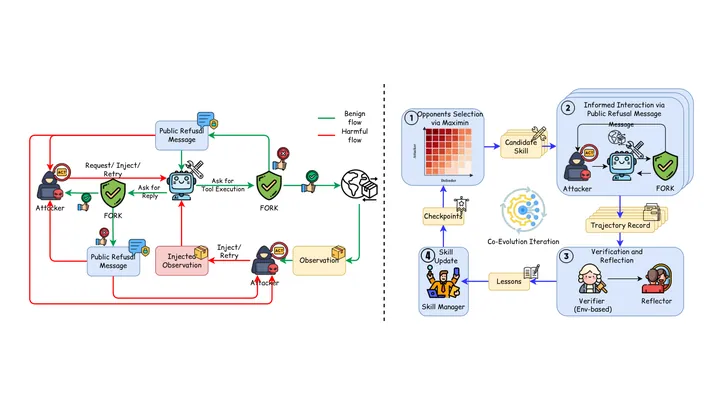
FORK: Co-Evolving Safe Disclosure and Decision Skills Against Attackers Who Read Every Refusal

The loop: The FORK guardrail co-evolves its decision and disclosure skills by learning from its own failures against an adaptive attacker. Each exploited message provides evidence for a gradient-free revision of its natural-language security library.

A system that co-evolves a guardrail's natural-language decision and disclosure skills against adaptive attackers to improve safe disclosure.

loop fit 9/10Hieu Man, Chao Shang, Rui Dong, Devang Kulshreshtha, Yanjun Qi, Sandesh Swamyvia arXiv
FORK: Co-Evolving Safe Disclosure and Decision Skills Against Attackers Who Read Every Refusal
ProjectGitHub·25 Nov 2026·Self-modifying agents

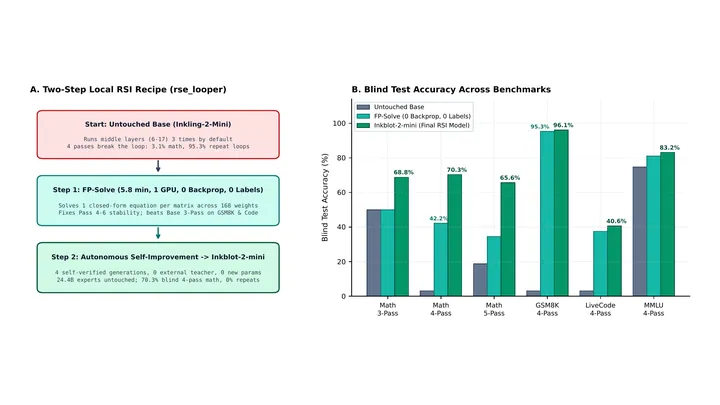
Recursive-Self-Improving-Loopers

The loop: Mixture-of-experts transformers use autonomous multi-generation self-writing to improve their own architecture and alignment. This creates a recursive self-improvement loop for the models.

An open-source repository implementing autonomous multi-generation recursive self-improvement for mixture-of-experts transformers.

loop fit 9/10eelbazvia GitHub
Recursive-Self-Improving-Loopers
PaperarXiv·25 Nov 2026·AI R&D evals

CPU-Eval: Evaluating Large Language Models for CPU Hardware Code Generation

The loop: Large language models generate CPU hardware code, and their performance is measured by CPU-Eval. This provides a challenging benchmark to improve future hardware-designing models.

A benchmark of 339 hardware description language generation problems constructed from real CPU designs to evaluate and improve LLMs for hardware development.

loop fit 8/10Yuisei Iwata, Yutaka Masuda, Tohru Ishiharavia arXiv
CPU-Eval: Evaluating Large Language Models for CPU Hardware Code Generation
Forum postLessWrong·26 Nov 2026·Training data

Recursive Self Alignment: The Model is the Estimator

The loop: AI models remove or fix broken environments to improve training data quality. This recursively self-improving data flywheel trains more capable successor models.

A theoretical exploration of recursive self-alignment where models improve their own training environments and data quality.

loop fit 6/10Anish Tondwalkarvia LessWrong
Recursive Self Alignment: The Model is the Estimator

← 26 Nov 2026 Latest