Alphabell.
Daily edition

Radar, 26 Nov 2026

Today's edition highlights models directly editing their own weights, alongside practical examples of agents improving the infrastructure they run on.

PaperarXiv·26 Nov 2026·Architecture and optimizer search

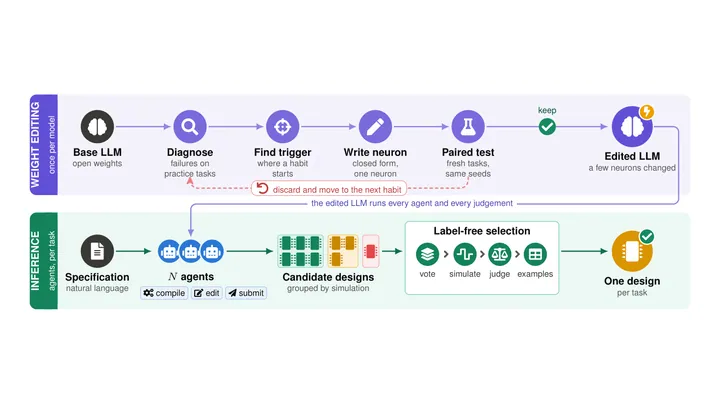
Kolpona: An Agentic Framework with Gradient-Free Neuron Programming for RTL Generation

The loop: The Kolpona framework uses neuron programming to write edits into a model's weights based on test results, which improves the model's RTL generation performance.

An agentic framework improves open-weight LLMs for register-transfer level design by writing single neurons directly into the weights based on testbench results, without gradient training.
loop fit 10/10Musa Tur Farazi, Md Nasir Uddin, Soumik Bhattacharjee, Tishna Sabrina,...via arXiv
Kolpona: An Agentic Framework with Gradient-Free Neuron Programming for RTL Generation
PaperarXiv·21 Nov 2026·Self-modifying agents

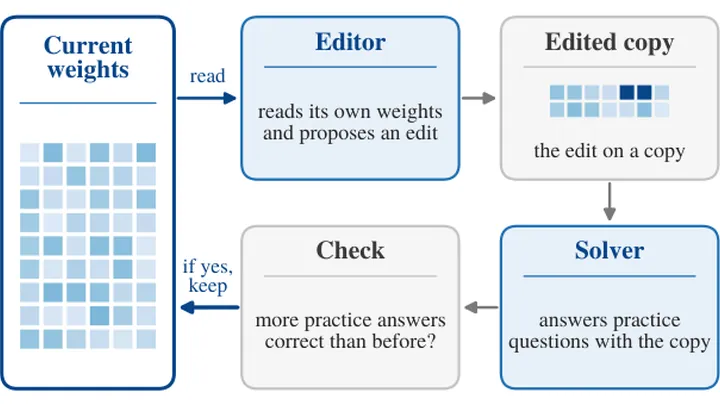
Self-WSP: Can Language Models Improve Themselves Through Weight-Space Programming?

The loop: A language model reads its own weights and proposes edits to them, then uses the edited weights to perform further self-edits and problem solving.

A small language model directly reads and edits its own weights to improve its performance on math tasks, though the edits lack interpretability.

loop fit 9/10Guoming Ling, Shanshan Zhong, Kaixuan Zhang et al.via arXiv
Self-WSP: Can Language Models Improve Themselves Through Weight-Space Programming?
PaperarXiv·25 Nov 2026·Research automation

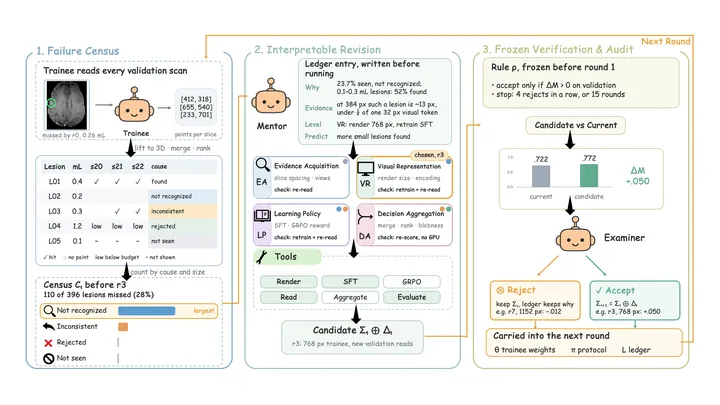
Can Its Own Misses Teach an MLLM to Find Small Brain Metastases?

The loop: An LLM mentor analyzes an MLLM's detection misses and revises its internal components, improving the MLLM's performance over 15 unattended rounds.

An error-driven framework uses an LLM mentor to recursively revise an MLLM's evidence acquisition, visual representation, learning policy, and decision aggregation based on its own misses.

loop fit 9/10Yixuan Duan, Kexin Geng, Hanwen Xu et al.via arXiv
Can Its Own Misses Teach an MLLM to Find Small Brain Metastases?
PaperarXiv·23 Nov 2026·Self-reward and self-play

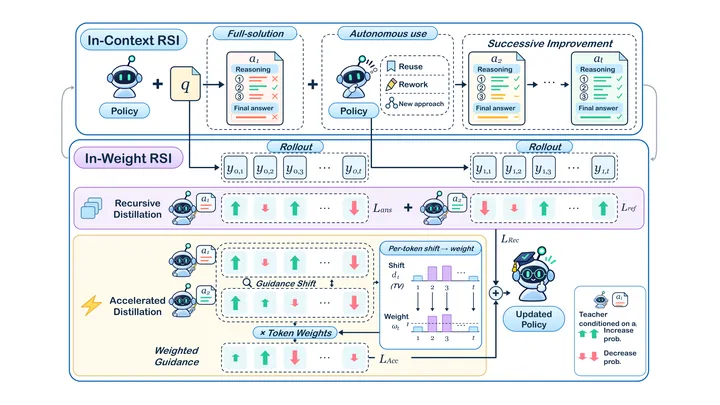
Beyond Self-Consistency: Recursive Self-Improvement at Test Time

The loop: The TT-RSI framework uses the model to refine its own solutions at test time and then distills those refinements back into its weights, improving its baseline performance for future queries.

A label-free framework improves LLMs at test time by having the model iteratively refine its own solutions and distill the successful refinements back into its weights.

loop fit 9/10Jianyu Wu, Yizhou Wang, Encheng Su et al.via arXiv
Beyond Self-Consistency: Recursive Self-Improvement at Test Time
Blog postAnthropic·25 Nov 2026·Tools and harness

Migrating our Messages API to Rust

The loop: Claude agents verify and fix a new Rust-based Messages API, which improves the reliability and performance of the infrastructure used by the agents themselves.

Anthropic used teams of Claude agents to track down and fix differences between the Python and Rust versions of their Messages API.

loop fit 9/10via Anthropic
Migrating our Messages API to Rust
Blog postPyTorch·25 Nov 2026·Kernels and compilers

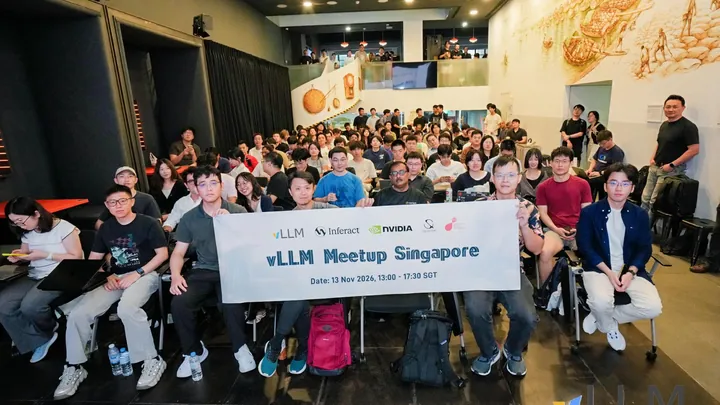
vLLM Singapore Meetup: Faster Prefill, Agent-Written Kernels and the Road to Vera Rubin

The loop: AI agents write optimized kernels for the vLLM inference engine, which improves the execution speed of the models and agents running on that engine.

Engineers showcased how the community is advancing open source AI inference through pipeline parallelism optimizations and agent-written kernels.

loop fit 8/10vLLM Teamvia PyTorch
vLLM Singapore Meetup: Faster Prefill, Agent-Written Kernels and the Road to Vera Rubin
Forum postLessWrong·24 Nov 2026·Research automation

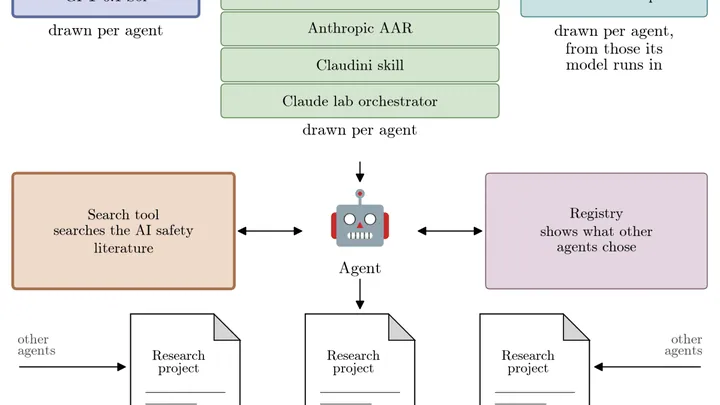
AI research agents crowd onto the same projects, and how to spread them out

The loop: AI research agents use a shared registry of their own previous project choices to coordinate and improve the diversity of their research output.

An analysis finds that autonomous AI researchers tend to concentrate on a small number of projects, but sharing a registry of previous choices effectively spreads them out.

loop fit 7/10Jason Fantlvia LessWrong
AI research agents crowd onto the same projects, and how to spread them out

← 25 Nov 2026 Latest