Alphabell.
Daily edition

Radar, 2 Nov 2026

Today's edition highlights the growing trend of AI agents optimizing their own workflows and harnesses, from robotic control code to molecular discovery pipelines.

PaperarXiv·30 Oct 2026·Tools and harness

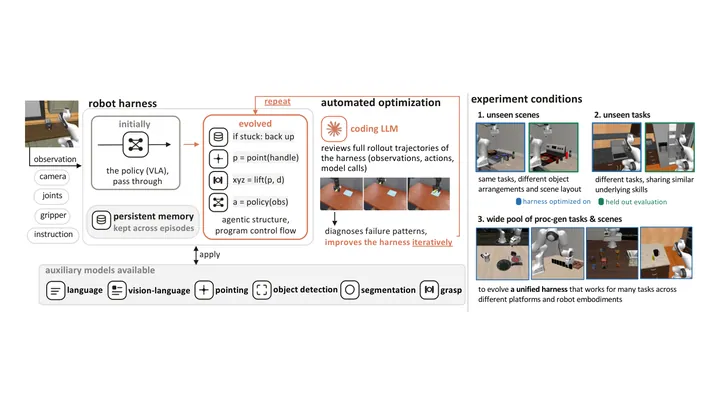
RoboArchitect: Automating the Design of Robotic Agents with Persistent Memory

The loop: A coding model observes a robot's rollouts, diagnoses failures, and iteratively revises the control harness around a frozen policy. This evolved harness then wraps the policy to improve the agent's success rate on unseen scenes and tasks.

An automated framework where a coding model diagnoses robot failures and rewrites the agent harness to improve performance without updating policy weights.
loop fit 9/10Shengguang Wu, Suning Huang, Cherie Ho et al.via arXiv
RoboArchitect: Automating the Design of Robotic Agents with Persistent Memory
PaperarXiv·2 Nov 2026·Architecture and optimizer search

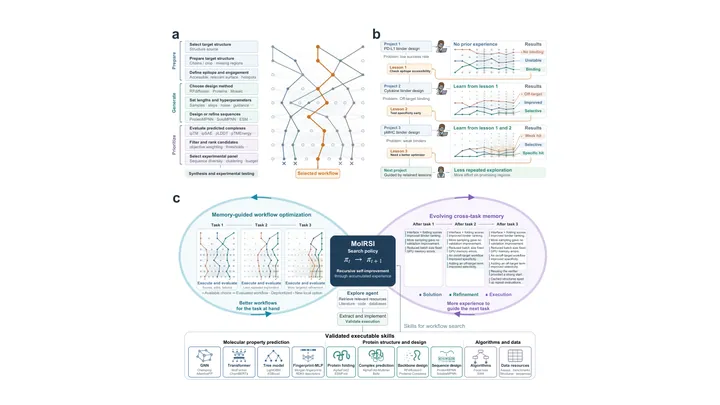
MoLRSI: A Recursive Self-Improving AI agent for Molecular Discovery

The loop: The MoLRSI agent optimizes its own molecular discovery workflows and model architectures based on execution feedback. It stores the refinement outcomes in a persistent memory to improve its strategy for developing workflows in subsequent searches.

An AI agent for molecular discovery that recursively improves its search policy and workflows by maintaining a persistent cross-task memory of refinement outcomes.

loop fit 9/10Yikun Zhang, Xiwei Cheng, Mingze Yuan, Yu Zhang, Brian Shim, Aarti Krishnan,...via arXiv
MoLRSI: A Recursive Self-Improving AI agent for Molecular Discovery
PaperarXiv·29 Oct 2026·Interpretability and oversight

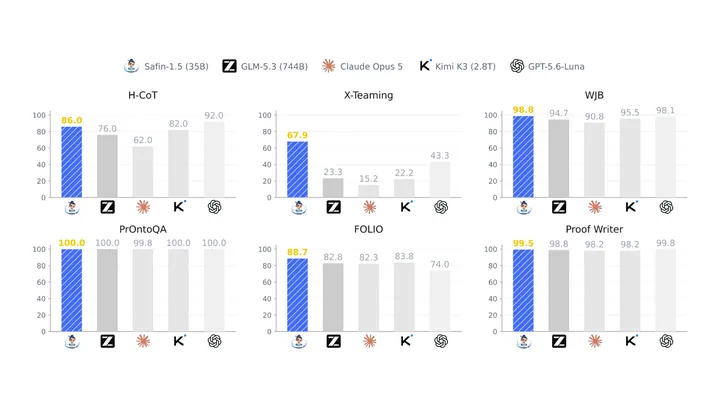
Safin-1.5: Safety-Native Architecture and Verifiable Reasoning for Recursive Safety Improvement

The loop: Safin-1.5 uses a discovery-evaluation-repair loop to identify new risks and generate repair data. This data is then used to update its own safety architecture and removable experts, improving its intrinsic safety.

A model built on a safety architecture that uses a discovery-evaluation-repair loop to continually discover risks and update its own removable safety experts.

loop fit 8/10Jingnan Zheng, Cheng Jin, Ming Zhang et al.via arXiv
Safin-1.5: Safety-Native Architecture and Verifiable Reasoning for Recursive Safety Improvement
ProjectGitHub·31 Oct 2026·Self-modifying agents

dxn111/EVOLV

The loop: The EVOLV workspace rewrites its own user interface, tools, skills, and plugins during execution. These modifications directly alter the environment it operates within, enabling immediate use of the new capabilities.

A local-first, self-evolving AI workspace that live-rewrites its own tools and interface without requiring API keys.

loop fit 8/10dxn111via GitHub
dxn111/EVOLV
Forum postLessWrong·1 Nov 2026·Interpretability and oversight

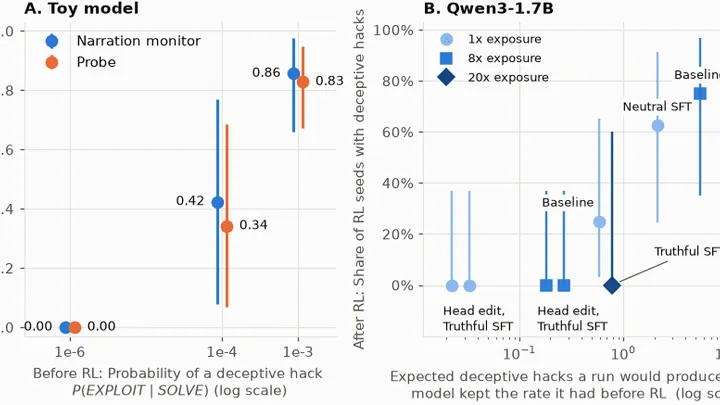
Monitor Evasion Depends on What RL Finds and What Monitors Miss

The loop: The study identifies how RL learns to exploit monitor blind spots, which improves the training process by informing weight edits that prevent monitor evasion.

Training against a monitor does not necessarily make a model more honest. Baker et al. (2025) showed that penalizing suspicious chain-of-thought can make models hide reward hacking rather than stop it. Cundy and Gleave (2025) found that...

loop fit 7/10Pranjal Gargvia LessWrong
Monitor Evasion Depends on What RL Finds and What Monitors Miss

← 1 Nov 2026 Latest