Alphabell.
Daily edition

Radar, 1 Nov 2026

Today's edition highlights the shift from predicting execution outcomes to directly modeling rewards in search-based ML agents, alongside new benchmarks for cross-disciplinary scientific reproduction.

PaperarXiv·29 Oct 2026·Training data

Search-Guided Reasoning Trace Curation for Verilog Generation

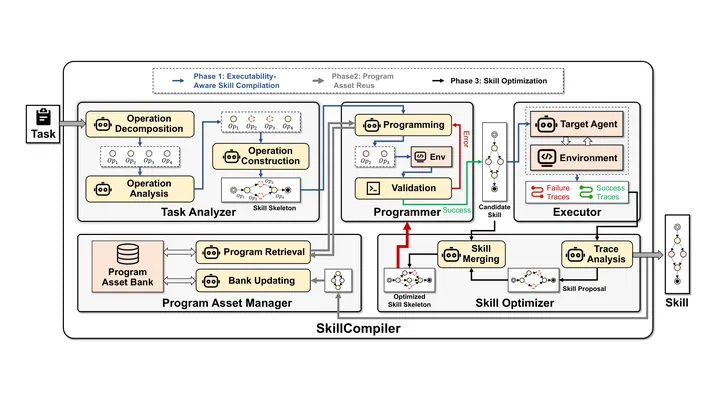
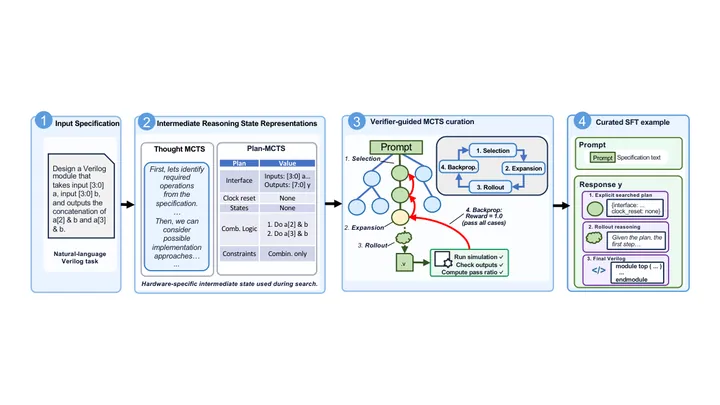
The loop: A search framework explores intermediate hardware design plans to curate reasoning traces. These traces are then used as supervised fine-tuning data to improve the Verilog generation model that performs the search.

A verifier-guided framework uses Monte Carlo Tree Search to curate structured reasoning traces for fine-tuning Verilog generation models.
loop fit 8/10Liaoyuan Fan, Yuhao Zheng, Dongxing Mao et al.via Hugging Face Papers
Search-Guided Reasoning Trace Curation for Verilog Generation
PaperarXiv·29 Oct 2026·Self-reward and self-play

Predict the Reward, Not the World: World Reward Models for ML Agents

The loop: A world reward model learns from real execution results to directly choose the best candidate programs written by an ML agent. This model then replaces slow execution steps in the agent's search, making the agent faster and more accurate at finding optimal programs.

A method trains reward models to directly predict which candidate program an ML agent should select, bypassing the need to predict intermediate execution outcomes.

loop fit 8/10Ruoyu Wu, Zengji Tu, Aolong Sun et al.via arXiv
Predict the Reward, Not the World: World Reward Models for ML Agents
PaperarXiv·29 Oct 2026·Tools and harness

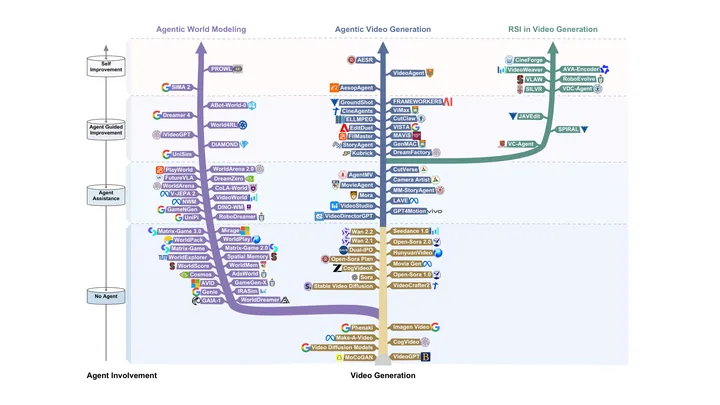
Video Generation Meets Agent Harness: Agentic Video Generation, Agentic World Modeling and Recursive Self-Improvement

The loop: An agent harness coordinates video models and world models to generate interactive environments. These models then mutually evaluate and improve one another, enhancing the harness's ability to produce coherent agentic video generation.

A report examines how agent harnesses can coordinate video and world models for interactive generation, evaluation, and recursive self-improvement.

loop fit 8/10Chengyu Yang, Yunxiang Zheng, Zongzheng Li et al.via arXiv
Video Generation Meets Agent Harness: Agentic Video Generation, Agentic World Modeling and Recursive Self-Improvement
PaperarXiv·29 Oct 2026·Tools and harness

WebAnything: From the Wild Web to Scalable Agent Environments

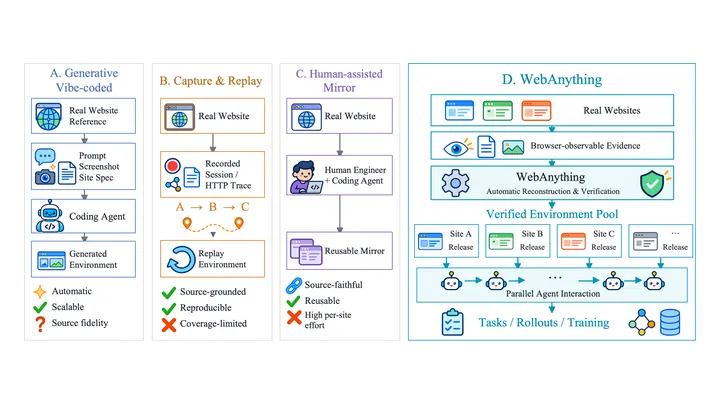
The loop: An automated framework explores and reconstructs real websites into reusable environments. These environments are then used to train and evaluate web agents, improving their ability to navigate complex web tasks.

An automated framework reconstructs source-grounded, reusable web environments from real URLs to provide scalable training and evaluation data for agents.

loop fit 8/10Qiushi Sun, Da Yu, Alexander Knop et al.via arXiv
WebAnything: From the Wild Web to Scalable Agent Environments
PaperarXiv·26 Oct 2026·AI R&D evals

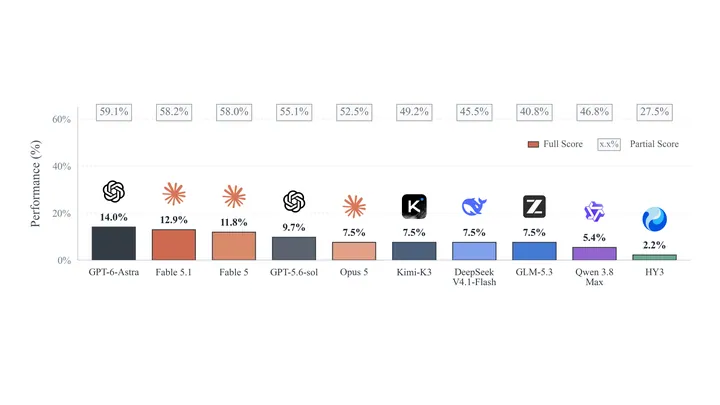
PAPERBENCHX: Can AI Reproduce Science Across Disciplines?

The loop: AI agents attempt to reproduce scientific papers by operating domain-specific software and diagnosing computations. The resulting benchmark measures their capability, providing a target to train more capable autonomous research agents.

A benchmark of 93 expert-constructed tasks evaluates the ability of AI agents to reproduce scientific papers across 12 research disciplines.

loop fit 8/10Matthew DeLorenzo, Kevin Tieu, Prithwish Jana et al.via arXiv
PAPERBENCHX: Can AI Reproduce Science Across Disciplines?
PaperarXiv·27 Oct 2026·Kernels and compilers

MUSE: Multi-Level Memory with Selective Runtime Injection for Scientific Coding Agents

The loop: A coding agent builds a multi-level memory from its own historical trajectories. It then selectively injects these past implementation lessons at runtime to improve its performance on kernel optimization and software repair.

A memory management framework allows scientific coding agents to build and selectively inject multi-level historical experience during runtime execution.

loop fit 7/10Wentao Zhang, Yilei Zhao, Guangyan Gan et al.via arXiv
MUSE: Multi-Level Memory with Selective Runtime Injection for Scientific Coding Agents
PaperarXiv·27 Oct 2026·Inference efficiency

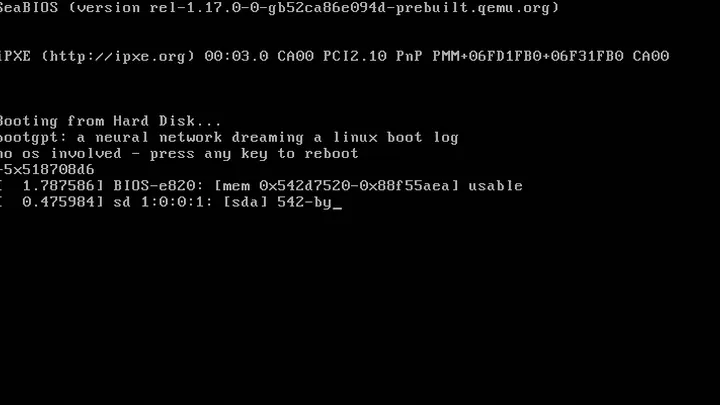
Show HN: A language model that lives in a boot sector

The loop: A training script performs the exact integer arithmetic operations as the target assembly code. This alignment enables bit-perfect debugging of the inference engine, making the script better at producing valid weights for the constrained boot sector hardware.

A developer built a character-level neural network inference engine that fits entirely within a 512-byte master boot record.

loop fit 6/10Tianci Xie, Zikun Cai, Chaoyun Zhang et al.via Hugging Face Papers
Show HN: A language model that lives in a boot sector
ProjectGitHub·31 Oct 2026·Tools and harness

Show HN: A language model that lives in a boot sector

The loop: train.py performs the same integer arithmetic as the assembly code, which improves the inference engine by enabling bit-perfect debugging and alignment, which makes the training script better at producing weights for that specific hardware constraint.

All the ideas came from the boot sector demo scene where people had been writing chess and BASIC games in 512 bytes, even a C compiler. I wondered what one can do using a neural network instead of a program and generating boot logs for...

loop fit 6/10kerlentonvia Hacker News
Show HN: A language model that lives in a boot sector

← 31 Oct 2026 Latest