Alphabell.
Daily edition

Radar, 30 Oct 2026

Today's edition highlights systems that build their own target knowledge, from agents learning new hardware DSLs to models monitoring their own training logs to refresh their task pools.

PaperarXiv·28 Oct 2026·Training data

A-RSI: Adaptive Task Refresh for Zero-Data Multimodal Self-Improvement

The loop: A-RSI monitors its own training logs to decide when to refresh a task pool with model-authored programs, enabling continuous multimodal self-improvement without external data.

A multimodal self-improvement framework that monitors its own training dynamics to decide when to generate and introduce new model-authored tasks.
loop fit 10/10Yu Liu, Youxing Li, Yuedong Tan et al.via arXiv
A-RSI: Adaptive Task Refresh for Zero-Data Multimodal Self-Improvement
PaperarXiv·28 Oct 2026·Kernels and compilers

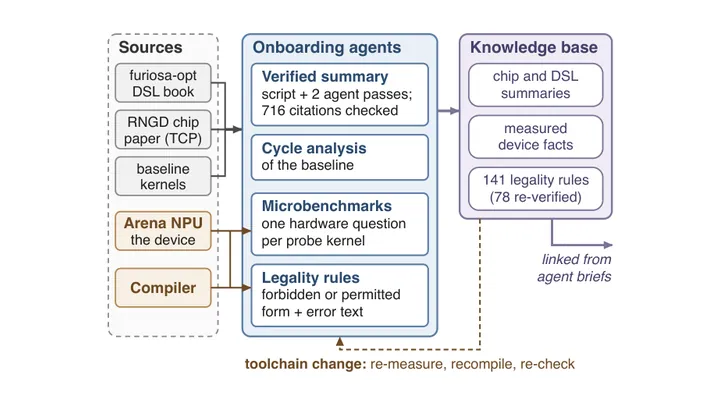
A Case Study of a Multi-Agent Kernel-Optimization Loop That Learns a New AI Accelerator

The loop: An LLM agent loop builds a target knowledge base of DSL documentation and microbenchmarks to autonomously optimize decode kernels, which run the models that power the agent.

A multi-agent loop that builds its own knowledge base of a new AI accelerator's DSL and microbenchmarks to autonomously optimize decode kernels.

loop fit 9/10Byonggon Chunvia arXiv
A Case Study of a Multi-Agent Kernel-Optimization Loop That Learns a New AI Accelerator
PaperarXiv·28 Oct 2026·Tools and harness

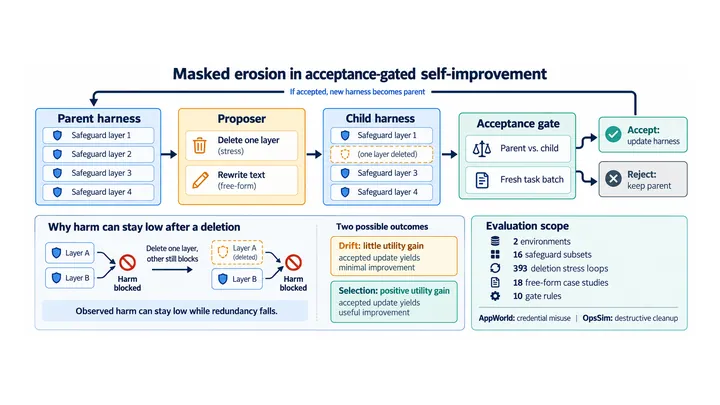
Masked Erosion: How Acceptance Gates Lose Redundant Safeguards in Self-Improving Agents

The loop: An AI agent edits its own harness prompts and rules, using an automated gate to measure and retain improvements to its own operating environment.

A study revealing how automated acceptance gates in self-improving agents can silently discard redundant safety safeguards because overlapping protections mask the loss.

loop fit 9/10Hau-Sing So, Daixian Liu, Weicai Longvia arXiv
Masked Erosion: How Acceptance Gates Lose Redundant Safeguards in Self-Improving Agents
PaperarXiv·28 Oct 2026·Self-reward and self-play

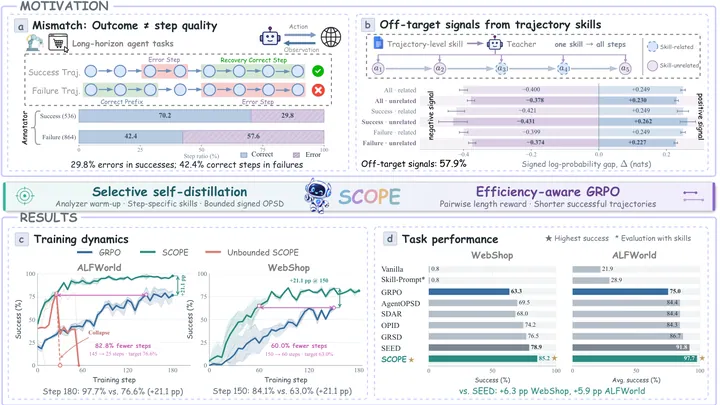
SCOPE: Selective Critical-Step On-Policy Self-Distillation for Agentic Reinforcement Learning

The loop: The SCOPE policy analyzes its own trajectories to generate step-specific hindsight skills, distilling their guidance back into itself at selected error steps.

A framework where an agent analyzes its own trajectories to generate and distill step-specific hindsight skills at critical error steps.

loop fit 9/10Qirui Liu, Wei Cao, Yu Mi et al.via Hugging Face Papers
SCOPE: Selective Critical-Step On-Policy Self-Distillation for Agentic Reinforcement Learning
Blog postSakana AI·30 Oct 2026·Research automation

Intelligence Report: SNSのAI分析からみる米中間選挙

The loop: Sakana Marlin uses multiple AI agents to parallelize hypothesis search and evaluate each other, improving the accuracy and depth of the research reports it generates.

An intelligence report on the US midterms generated by an AI system that parallelizes hypothesis search and uses multiple agents to evaluate each other's findings.

loop fit 7/10Sakana AIvia Sakana AI
Intelligence Report: SNSのAI分析からみる米中間選挙
Blog postTogether AI·27 Oct 2026·Hardware and chips

Auto repair for Together GPU Clusters: from GPU fault to healthy node

The loop: The auto repair system detects and fixes GPU and fabric faults, which maintains the availability of the hardware used to train and run the system's successors.

Together GPU Clusters auto repair detects GPU, host and fabric faults, picks the lightest fix, and lets you decide per fault and per Xid code which repairs run automatically. Here is how it works.

loop fit 6/10via Together AI
Auto repair for Together GPU Clusters: from GPU fault to healthy node

← 29 Oct 2026 Latest