Alphabell.
Daily edition

Radar, 28 Oct 2026

Today's edition highlights the shift from static benchmarks to dynamic arenas where models act as researchers, alongside new methods for self-distillation and kernel profiling.

PaperarXiv·27 Oct 2026·Self-reward and self-play

How Much Does the Hint Matter? Scope Conditions for Hindsight Self-Distillation in Financial Reasoning

The loop: A student model identifies its own reasoning errors and writes critiques to condition a teacher version of itself. This teacher then distills the improved logic back into the student over a short rollout.

A localized self-distillation recipe allows small open-weight models to improve their multi-step financial reasoning without relying on external frontier models.
loop fit 10/10Cheikh Ahmed, Zhiyu Zhang, Kun Mao, Yong Zhang, Zirui Zhouvia arXiv
How Much Does the Hint Matter? Scope Conditions for Hindsight Self-Distillation in Financial Reasoning
PaperarXiv·26 Oct 2026·Research automation

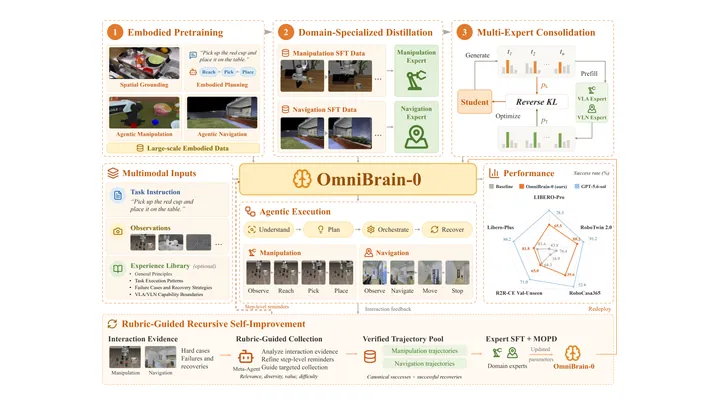
RSI Arena: Towards Recursive Self-Improvement with Human Feedback

The loop: Training agents autonomously select data and train models, then receive human preference feedback on those models. The agents use this feedback to guide a second round of training, improving their own outputs.

A two-stage study evaluates ten frontier models acting as autonomous training agents that build and refine working assistants.

loop fit 9/10Xiaomi Embodied Intelligence Team, Yuechen Luo, Chong He et al.via arXiv
RSI Arena: Towards Recursive Self-Improvement with Human Feedback
PaperarXiv·26 Oct 2026·Kernels and compilers

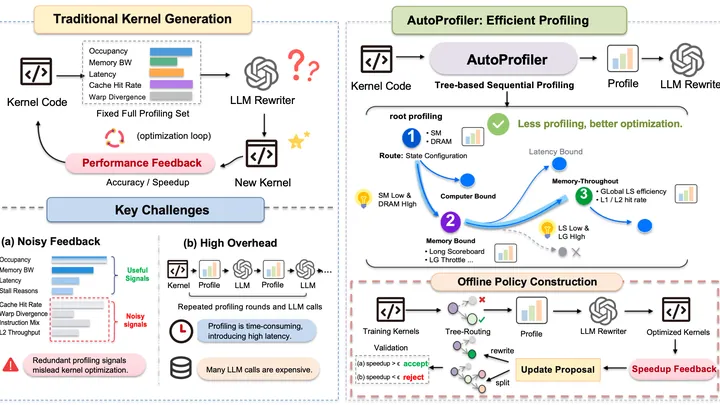
Less is more: learning what to profile for GPU kernel optimization

The loop: An LLM generates candidate modifications to a profiling tree based on feedback from GPU kernel optimization. The refined tree then provides more effective hardware information to the LLM for optimizing subsequent kernels.

A feedback-driven framework learns a deterministic profiling tree to optimize the hardware information provided to LLMs during GPU kernel optimization.

loop fit 9/10Wangcheng Tao, Zhanglu Yan, Han Wu et al.via arXiv
Less is more: learning what to profile for GPU kernel optimization
PaperarXiv·27 Oct 2026·Research automation

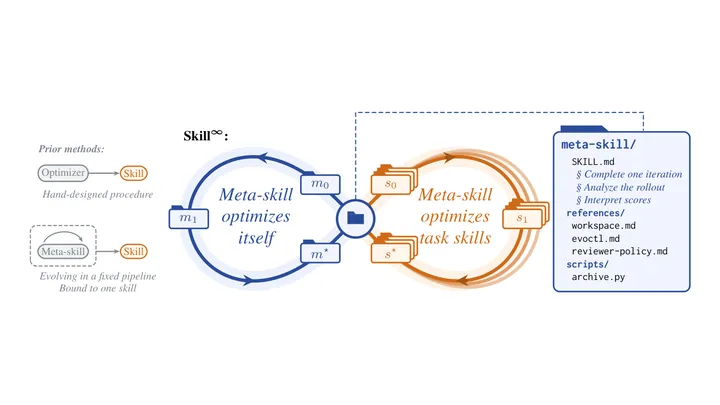
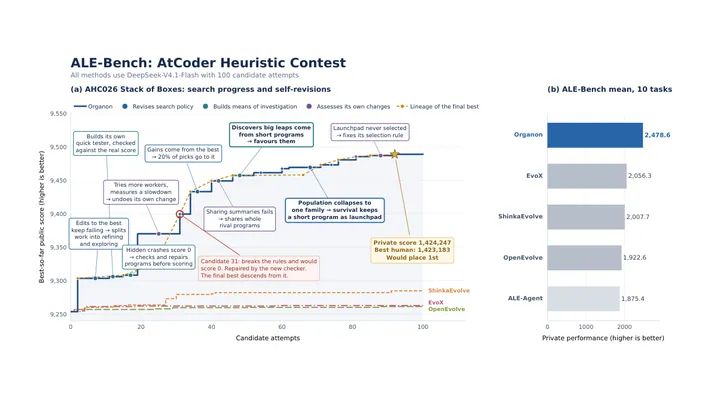
Build, Don't Play: Self-Improving LLM Research Agents Develop a Hearthstone Battlegrounds AI That Rivals Top Players

The loop: LLM research agents use live game feedback to improve a game simulator, opponents, and policy. They use this same feedback to refine their own research process and shared memory for future development.

A self-improving research system of LLM agents autonomously builds a faithful game simulator and trains a Hearthstone Battlegrounds policy that reaches top competitive ranks.

loop fit 9/10Yihan Wang, Peiyu Liu, Runyu Chen et al.via arXiv
Build, Don't Play: Self-Improving LLM Research Agents Develop a Hearthstone Battlegrounds AI That Rivals Top Players
PaperarXiv·23 Oct 2026·Tools and harness

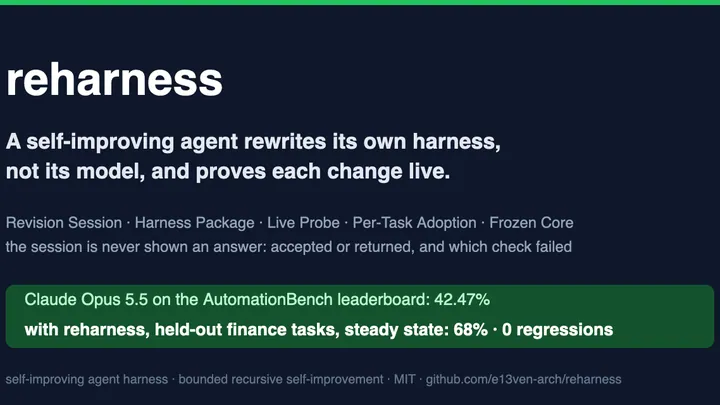
e13ven-arch/reharness

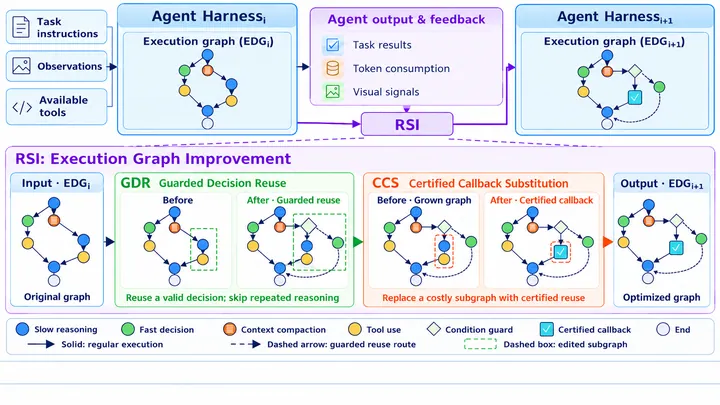
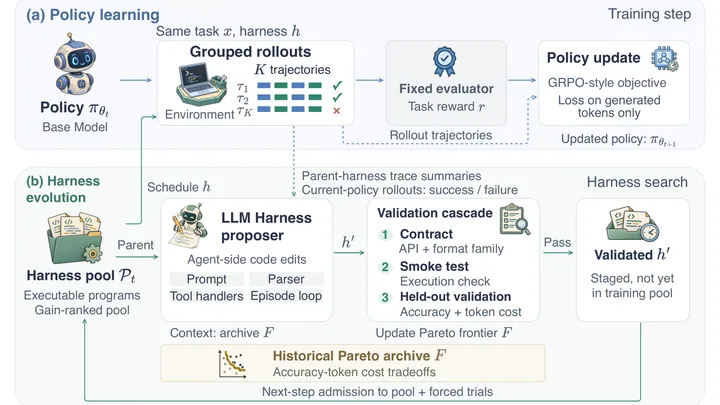
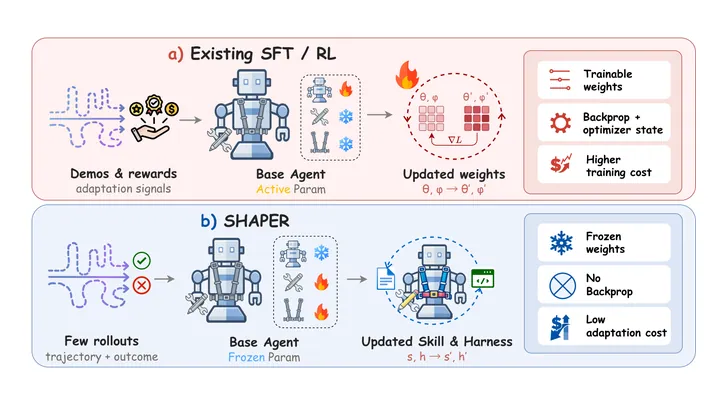
The loop: An agent reads its own execution traces to rewrite its tools, hooks, skills, and prompts. It proves the changes with a live probe and adopts them to improve performance on future tasks.

An open-source harness enables bounded recursive self-improvement by allowing an agent to rewrite its own tools and skills based on execution traces.

loop fit 8/10Yuhua Jiang, Chang Xu, Feifei Gao et al.via arXiv
e13ven-arch/reharness
PaperarXiv·24 Oct 2026·Self-modifying agents

7-e1even/Cognitive-Enzyme-oss

The loop: An AI agent captures its own experience and refines its memory layer through feedback. This refined memory injects more relevant lessons into the agent's context, improving its execution of future tasks.

A self-evolving memory layer captures agent experience and refines it through feedback to improve future task execution.

loop fit 7/10Yue Huang, Yanbo Wang, Lichi Li et al.via arXiv
7-e1even/Cognitive-Enzyme-oss
PaperarXiv·27 Oct 2026·Tools and harness

Discovering and exploiting vulnerabilities in critical, real-world software with Claude

The loop: Claude identifies critical vulnerabilities in widely used operating systems and browsers. Developers patch these flaws, securing the infrastructure that Claude itself relies on to operate.

An internal research model successfully identifies and exploits critical zero-day vulnerabilities in major browsers and operating systems.

loop fit 7/10Jianwen Chen, Peng Xia, Kaide Zeng et al.via arXiv
Discovering and exploiting vulnerabilities in critical, real-world software with Claude
PaperarXiv·26 Oct 2026·Interpretability and oversight

Brute-Force Progress on AlgZoo's 432-param Interpretability Challenge

The loop: An estimator model is trained to predict the accuracy of small RNNs from their weights. This provides a mechanistic interpretability signal that researchers use to evaluate and understand model performance.

A researcher trains an estimator to predict the accuracy of small neural networks, offering a brute-force approach to mechanistic interpretability.

loop fit 6/10Shuo Han, Zhilin Wang, Peng Ling, Wenjia Gong, Yang Liu, Guanjun Jiang, Yukun...via arXiv
Brute-Force Progress on AlgZoo's 432-param Interpretability Challenge
ProjectGitHub·22 Sep 2026·Tools and harness

e13ven-arch/reharness

The loop: The reharness agent reads its own execution traces to rewrite its tools and skills, improving its performance on subsequent requests.

Self-improving LLM agent harness, bounded recursive self-improvement: a Revision Session reads the agent's own returned run, rewrites its tools, hooks, skills and prompts, and proves the change with a Live Probe on the same request....

loop fit 8/10e13ven-archvia GitHub
e13ven-arch/reharness

← 27 Oct 2026 Latest