Alphabell.
Daily edition

Radar, 26 Oct 2026

Today's edition highlights systems that optimize their own training and execution environments, from evolving optimizer agents to unsupervised vetting of scientific discoveries.

PaperarXiv·23 Oct 2026·Architecture and optimizer search

RSI-Opt: Recursive Self-Improvement Optimizer Agents For Model Training

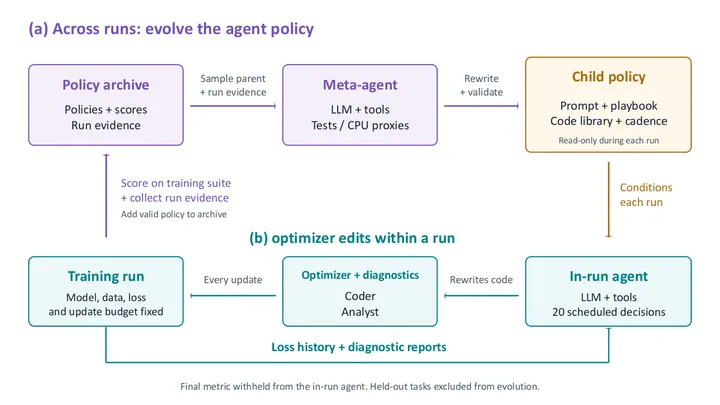
The loop: A meta-agent rewrites the policy and code library of an optimizer agent based on evidence from earlier training runs. The improved optimizer agent then manages subsequent model training tasks more effectively.

A meta-agent recursively improves the prompts, procedures, and code library of an optimizer agent that monitors and adjusts neural network training dynamics.
loop fit 10/10Binghang Lu, Yige Sun, Guang Linvia arXiv
RSI-Opt: Recursive Self-Improvement Optimizer Agents For Model Training
PaperarXiv·23 Oct 2026·Research automation

Minimum Description Length Unsupervisedly Separates Law-Grade from Statistical-Grade Knowledge in a Self-Improving Science Agent - and Reveals 86% of Its Own Discoveries Are Statistical

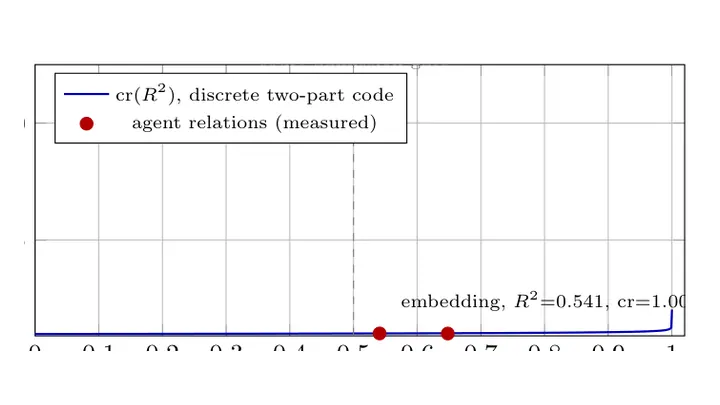
The loop: A self-improving science agent uses a Minimum Description Length compression ratio to unsupervisedly vet its generated scientific relations. This filters the agent's discovery ledger to retain true laws, which guides its future research.

A deployed science agent uses compression ratios to automatically distinguish fundamental physical laws from statistical regularities among its own discoveries.

loop fit 9/10Wenbin Mao, Pei Zouvia arXiv
Minimum Description Length Unsupervisedly Separates Law-Grade from Statistical-Grade Knowledge in a Self-Improving Science Agent - and Reveals 86% of Its Own Discoveries Are Statistical
PaperarXiv·26 Oct 2026·Inference efficiency

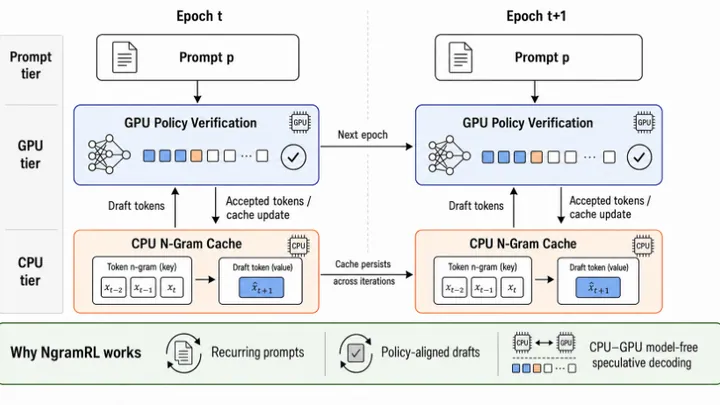
NgramRL: Accelerating RL Post-Training for Structured Generation via Rollout-Aware N-gram Speculative Decoding

The loop: A model undergoing reinforcement learning post-training uses its own recent rollout history to construct an n-gram drafter. This drafter accelerates the autoregressive generation bottleneck, speeding up the model's own post-training process.

NgramRL accelerates reinforcement learning post-training by using the model's own recent rollouts to build a memory-efficient speculative decoding drafter.

loop fit 9/10Nilesh Prasad Pandey, Jangseon Park, Jason Kong, Onat Gungor, Tajana Rosingvia arXiv
NgramRL: Accelerating RL Post-Training for Structured Generation via Rollout-Aware N-gram Speculative Decoding
PaperarXiv·26 Oct 2026·Self-modifying agents

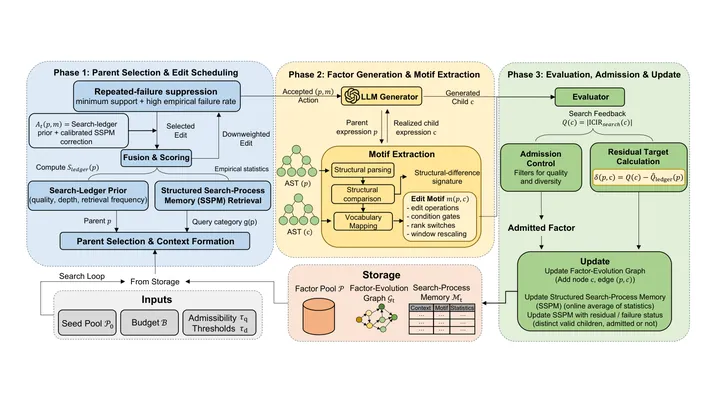
AlphaMemo: Structured Search-Process Memory for Self-Evolving Alpha Mining Agents

The loop: A self-evolving alpha mining agent records reusable evidence of successful and failed edit motifs in a structured memory. The agent then uses this memory to suppress failure patterns and improve its own future discovery efficiency.

AlphaMemo improves financial alpha mining by recording successful and failed edit motifs in a structured memory to guide its future searches.

loop fit 9/10Hang Yu, Zifan Zheng, Chun Gan, Jeff Z. Pan, Tongliang Liu, Zhiyong Wang,...via arXiv
AlphaMemo: Structured Search-Process Memory for Self-Evolving Alpha Mining Agents
Forum postLessWrong·25 Oct 2026·Interpretability and oversight

Is GPT 2XL already clean?

The loop: Opus 5.5 acts as an automated interpretability researcher to analyze and identify the function of neurons in GPT-2-XL. These insights into model internals provide a pathway for researchers to better align and develop future models.

A researcher uses Opus 5.5 to automatically interpret the activations of GPT-2-XL neurons, achieving a significant improvement over previous models.

loop fit 7/10Jasper Blankvia LessWrong
Is GPT 2XL already clean?

← 25 Oct 2026 Latest