Alphabell.
Daily edition

Radar, 25 Oct 2026

Today's edition highlights several closed loop systems where models actively shape their own training data and inference mechanisms.

PaperarXiv·23 Oct 2026·Self-modifying agents

Agentic Knowledge-Model Co-Evolution via Consistency Regularization

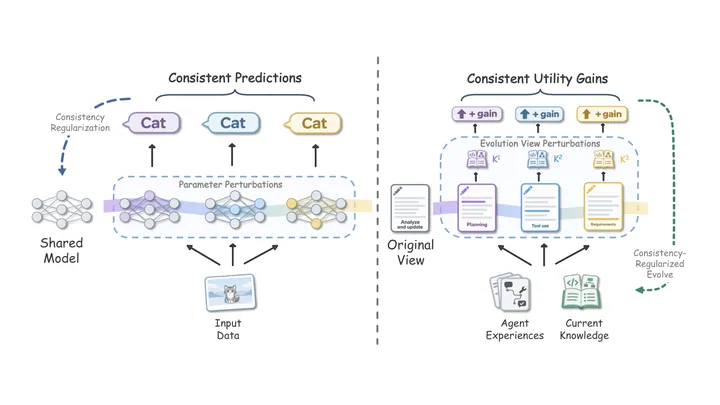
The loop: The SPLICE framework analyzes agent experience to produce knowledge candidates, which improves the internal model through self-distillation. This makes the agent better at analyzing future experiences and solving tasks.

A framework that identifies consistent utility gains across different ways of analyzing experience to guide the co-evolution of an agent's external knowledge and internal model.
loop fit 9/10Sirui Chen, Zhining Liu, Chao Zhang, Jingrui He, Zheng Livia arXiv
Agentic Knowledge-Model Co-Evolution via Consistency Regularization
PaperarXiv·22 Oct 2026·Training data

TeachBack: Learning to Teach via Bidirectional Preference Optimization for On-Policy Self-Distillation

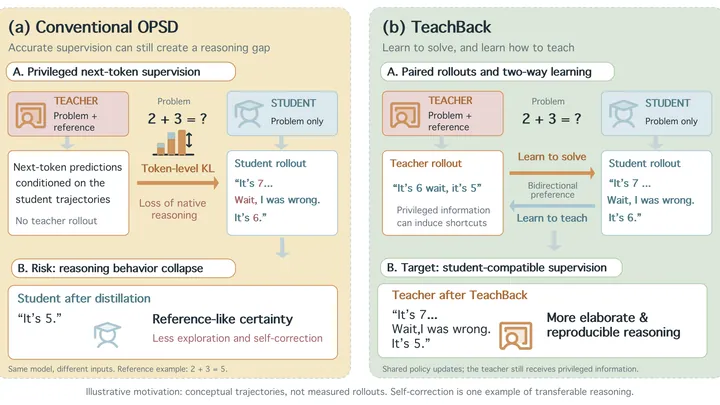
The loop: A Teacher model generates reasoning trajectories for a Student model, while using the Student's learning progress to optimize how the Teacher generates that data. This bidirectional optimization improves the quality of the training data and the resulting Student model.

A bidirectional preference learning framework where a teacher model learns to adjust its prompt style and reasoning length based on how well the student model learns from its output.

loop fit 9/10Linfei Ji (Huazhong University of Science and Technology), Jiayun Li (Tsinghua...via arXiv
TeachBack: Learning to Teach via Bidirectional Preference Optimization for On-Policy Self-Distillation
PaperarXiv·22 Oct 2026·Inference efficiency

RCSD: Reinforcement and Continual Learning for Domain-Specific Speculative Decoding

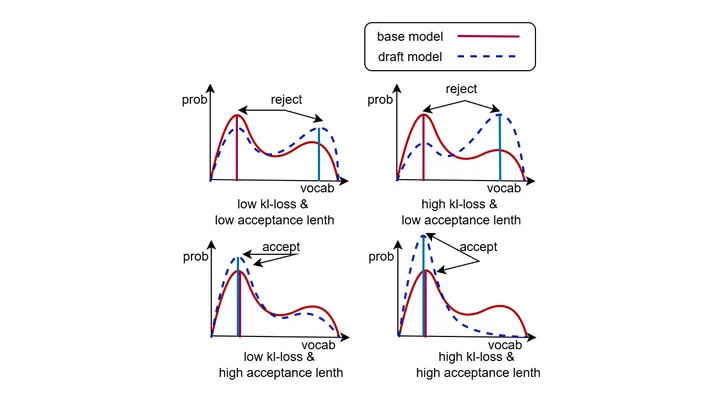
The loop: A speculative decoding system uses sequences generated during inference to construct preference pairs that train the draft model. This alignment improves the draft model's acceptance length, making the overall inference system faster.

A training framework that optimizes a speculative decoding draft model by using naturally occurring accepted and rejected sequences during inference as implicit preference pairs.

loop fit 9/10Mingkang Liu, Weiming Meng, Peipei Jiao, Jiawei Zhang, Tianyuan Liu, Junyan...via arXiv
RCSD: Reinforcement and Continual Learning for Domain-Specific Speculative Decoding
PaperarXiv·21 Oct 2026·Tools and harness

HGM-Dual: Lineage-Aware Guided Agent Harness Optimization for Long-Horizon Planning

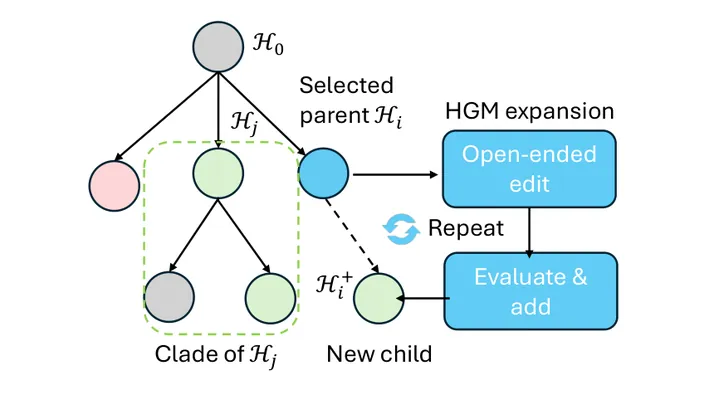
The loop: The HGM-Dual framework uses lineage-aware context to optimize an agent's harness, which improves the agent's planning performance. This improved performance provides better edit outcome attribution for the next round of harness optimization.

A diagnostic-guided framework for budget-efficient harness evolution that records what each ancestor changed to give the editor explicit edit outcome attribution.

loop fit 9/10Sudipta Paul, Pengrui Quan, Aounon Kumar et al.via arXiv
HGM-Dual: Lineage-Aware Guided Agent Harness Optimization for Long-Horizon Planning
PaperarXiv·Self-reward and self-play

Self-Play Pretraining with Zero Data

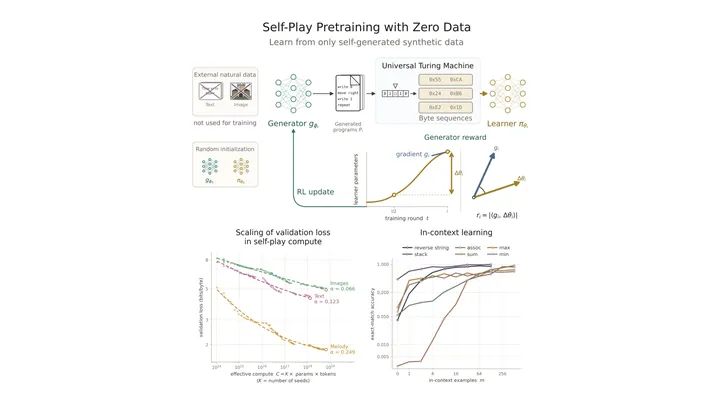
The loop: The model engages in self-play to generate its own training data. This data improves the model's weights, making the model better at future self-play and task performance.

A method where a model engages in self-play to generate training data from scratch.

loop fit 8/10via Awesome-AI4AI
Self-Play Pretraining with Zero Data
ProjectGitHub·8 Aug 2026·Self-modifying agents

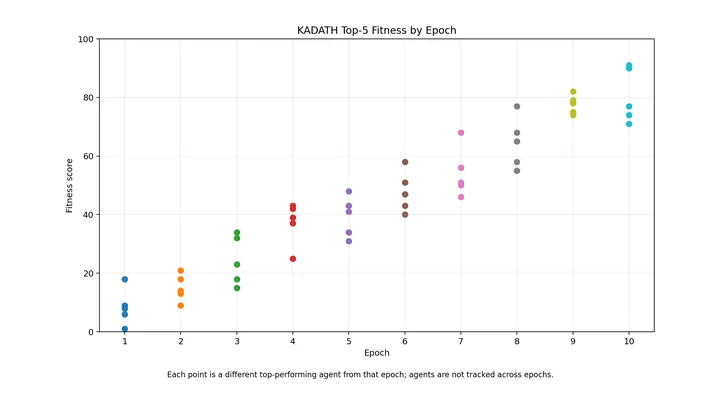
i3T4AN/KADATH

The loop: An evolutionary runtime breeds and evaluates autonomous agents, which improves their goal optimization performance. This makes the successor agents better at the same task in subsequent epochs.

An evolutionary multi-agent runtime that breeds, evaluates, and improves autonomous agents across reproducible epochs.

loop fit 7/10i3T4ANvia GitHub
i3T4AN/KADATH

← 24 Oct 2026 Latest