Alphabell.
Daily edition

Radar, 7 Oct 2026

Today's edition highlights several approaches to recursive self-improvement, from agent harnesses and formal verification workflows to vision-language models and architecture search.

PaperarXiv·6 Oct 2026·Tools and harness

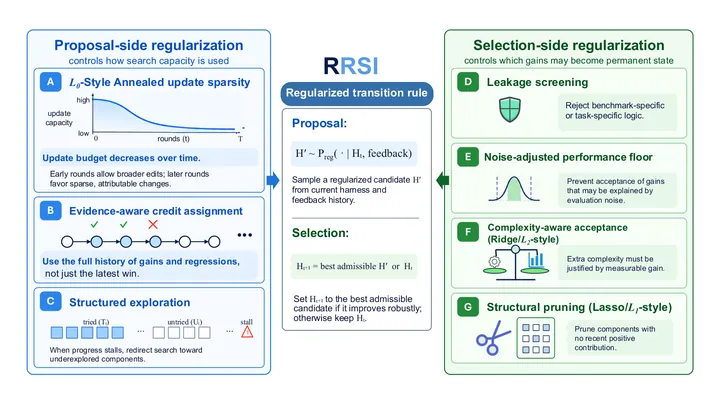
RRSI: Regularized Recursive Self-Improvement of Agent Harnesses

The loop: An LLM agent system iteratively proposes and selects edits to its own harness using a regularized proposer and critic. The resulting improved harness directly upgrades the agent's operating environment, making it better at solving tasks and further improving its harness.

An agent system iteratively improves its own harness by proposing and selecting edits under regularization constraints to prevent overfitting.
loop fit 9/10Peng Xia, Rujun Han, Zifeng Wang, Yanfei Chen, Yufan Zhuang, Yoonho Lee,...via arXiv
RRSI: Regularized Recursive Self-Improvement of Agent Harnesses
PaperarXiv·5 Oct 2026·Tools and harness

Second-Order Problem Solving for Recursive Self-Improvement in Formal Verification

The loop: An agent framework monitors its own execution traces to diagnose structural failures and systematically edit its workflow. These edits improve the agent's workflow for formal verification, making it more effective in subsequent rounds of recursive self-improvement.

An agent framework improves its own workflow by diagnosing structural failures in its execution traces and making systematic edits rather than surface-level parameter patches.

loop fit 9/10Yuxuan Jiang, Aditya Vempaty, Ashish Jagmohanvia arXiv
Second-Order Problem Solving for Recursive Self-Improvement in Formal Verification
PaperarXiv·3 Oct 2026·Architecture and optimizer search

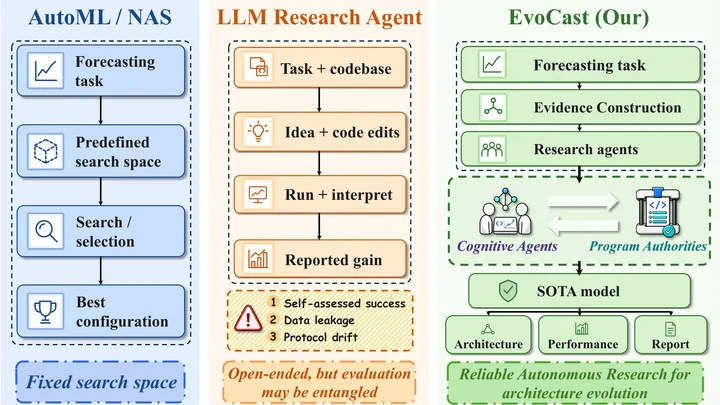
EvoCast: Reliable Autonomous Research Agents for Iterative Forecasting Architecture Evolution

The loop: An autonomous research agent iteratively designs and evaluates time-series forecasting architectures. The experimental outcomes from these evaluations are accumulated as evidence to guide and improve the agent's subsequent architecture search rounds.

An autonomous research agent iteratively designs and evaluates time-series forecasting architectures, using past experimental outcomes to guide future hypotheses.

loop fit 9/10Kaipeng Xu, Xianli Yan, Yan Wang et al.via arXiv
EvoCast: Reliable Autonomous Research Agents for Iterative Forecasting Architecture Evolution
PaperarXiv·5 Oct 2026·Training data

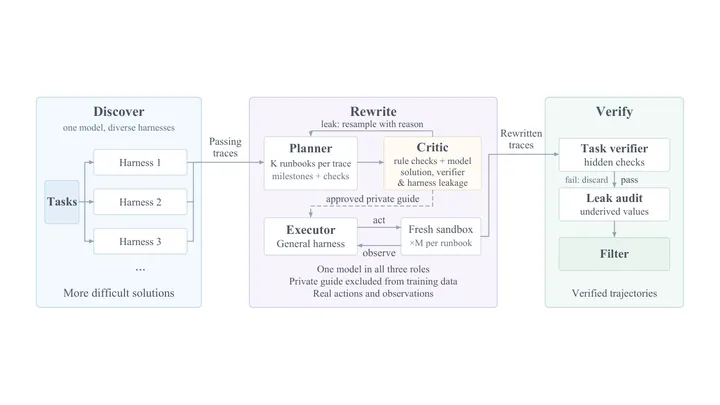
Scaling Trajectories for Complex Tasks through Recursive Self-Rewrite

The loop: A base model discovers successful solutions under diverse harnesses and rewrites them into training trajectories. These trajectories are then used for supervised finetuning, which directly improves the base model's performance on complex tasks.

A framework uses a base model to rewrite successful trajectories from diverse harnesses into training data that improves the model itself.

loop fit 9/10Zongxia Li, Yucheng Shi, Zhongzhi Li, Junyao Yang, Ruhan Wang, Chengsong...via arXiv
Scaling Trajectories for Complex Tasks through Recursive Self-Rewrite
PaperarXiv·3 Oct 2026·Training data

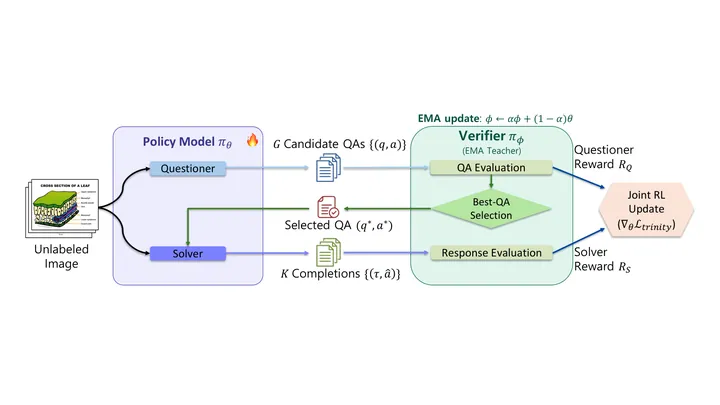
Trinity: Self-Evolving Vision-Language Models with a Self-Verifier

The loop: A vision-language model acts as a Questioner, Solver, and Verifier to generate and screen its own training data. This verified data is then used to train the model's successor, improving its reasoning capabilities without external labels.

A vision-language model generates and self-verifies its own training data to improve its reasoning capabilities in an unsupervised manner.

loop fit 9/10Youngwan Lee, Yong-Ju Lee, Sung Ju Hwangvia arXiv
Trinity: Self-Evolving Vision-Language Models with a Self-Verifier

← 6 Oct 2026 Latest