SplatLab
SplatLab: Autonomous Scientific Discovery for 3DGS ResearchAn autonomous research system that reproduces published 3D Gaussian Splatting baselines, proposes extensions, and writes manuscripts while binding every reported number to a logged training run.
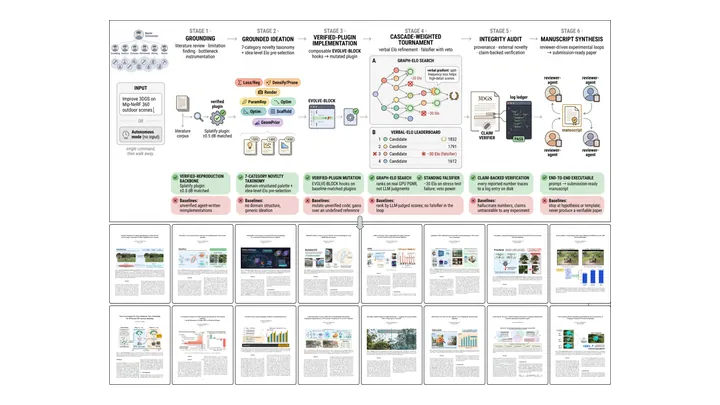
SplatLab autonomously reproduces baselines and proposes extensions for 3D Gaussian Splatting. It then uses an internal Elo tournament to score candidates on measured GPU PSNR, feeding verbal gradient feedback back into its own generation process to refine its research outputs.
- SplatLab reproduces 3DGS baselines
- proposes and codes extensions
- scores candidates via Elo tournament
- uses feedback to refine research outputs
- SplatLab reproduces 3DGS baselines
- proposes and codes extensions
- scores candidates via Elo tournament
- uses feedback to refine research outputs
Why it is a road to recursion
By closing the loop on hypothesis generation, execution, and self-evaluation in a live computer vision subfield, it provides a blueprint for autonomous systems that can iteratively advance their own underlying architectures.
Evidence
SplatLab autonomously trains and ablates across Mip-NeRF 360 and LLFF, scoring candidates on measured GPU PSNR with a standing falsifier that subtracts Elo on failure.
Related loops
More research automation →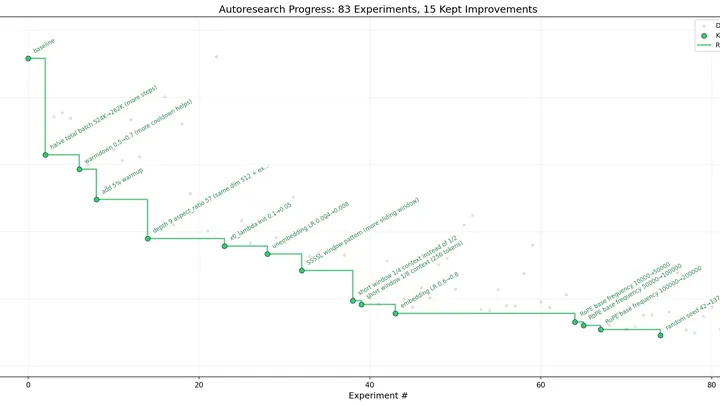
- Coding agent edits LLM training script
- Runs a 5-minute training job
- Keeps change if validation improves
- Changes transferred to larger models
- repeat
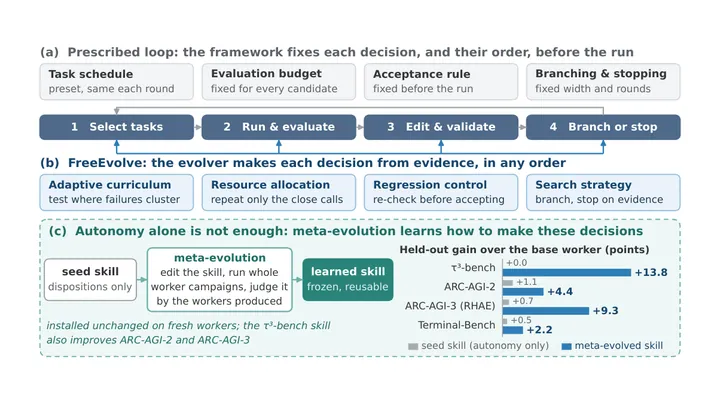
- Agent evolver automates workflow design
- Scores candidate skills on target agents
- Improves its own evolution skill
- Produces better target agents
- repeat
- Qwen3-14B edits GPT training script
- Edit is trained and scored
- Score rewards Qwen3-14B weights update
- Trained checkpoint re-run in autoresearch loop
- repeat