Project · Self-modifying agents
Recursive Self-Improvement through Collective Intelligence
A shared model acts as a team of subagents to solve open-ended research tasks, then trains on its own best executions to improve its performance.
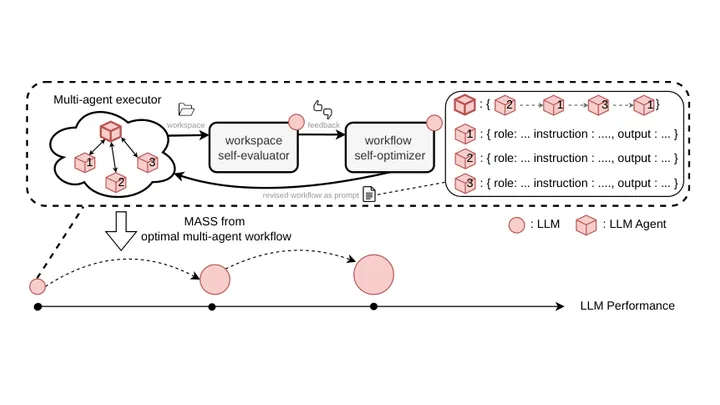
The loop
A shared model searches for better multi-agent workflows and selects the best executions. These executions are then used to train the model, improving its base capabilities.
- Model searches for multi-agent workflows
- Model selects the best executions
- Model trains on selected executions
- Model improves its base capabilities
- Model searches for multi-agent workflows
- Model selects the best executions
- Model trains on selected executions
- Model improves its base capabilities
↻ The improved system does the next round, and the loop turns again.
Why it is a road to recursion
It demonstrates that a model can overcome the supervision bottleneck in open-ended research by distilling the collective intelligence of its own simulated team.
Evidence
Over two cycles with Qwen3.6-27B, the model achieves 1.2 to 1.6 times higher performance.
multi-agentself-supervisionopen-ended research
Related loops
More self-modifying agents →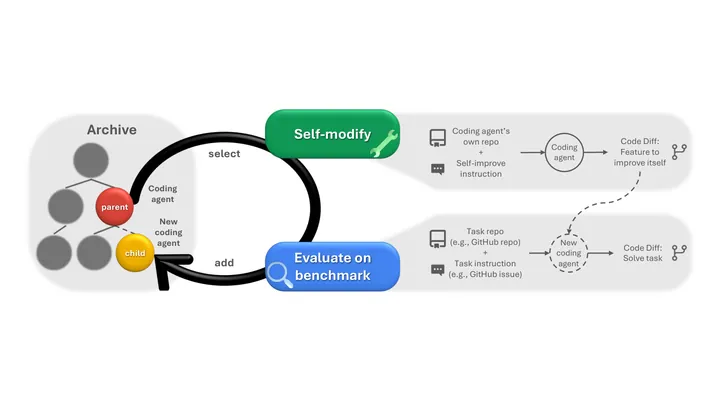
Darwin Gödel Machine
- Coding agent edits its own code
- Scored child agents enter the archive
- Archived agents make later self modifications
- repeat
Self-modifying agentsUBC, Vector Institute, Sakana AI · 2025
Claude Code
- Claude Code writes its own code changes
- Changes become next Claude Code versions
- Release becomes harness for next development round
- repeat
Self-modifying agentsAnthropic · 2025
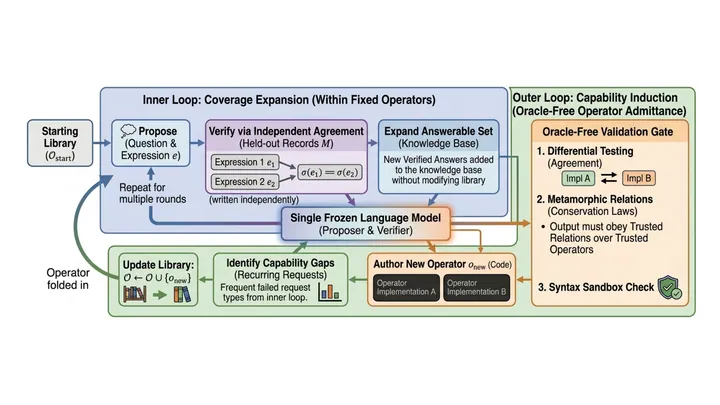
A Self-Improving Agent that Grows its Own DSL: Oracle-Free Operator Induction for Exact Question Answering
- Frozen model attempts exact QA tasks
- Model authors new DSL operators
- Independent implementations verify operators via consensus
- Verified operators expand model's executable library
- repeat
Self-modifying agentsChuang et al. · 2026