Alphabell.
Daily edition

Radar, 24 Nov 2026

Today's edition highlights a milestone in self-modification, alongside new tools for evolving agent harnesses and retrospection skills.

PaperarXiv·22 Nov 2026·Self-modifying agents

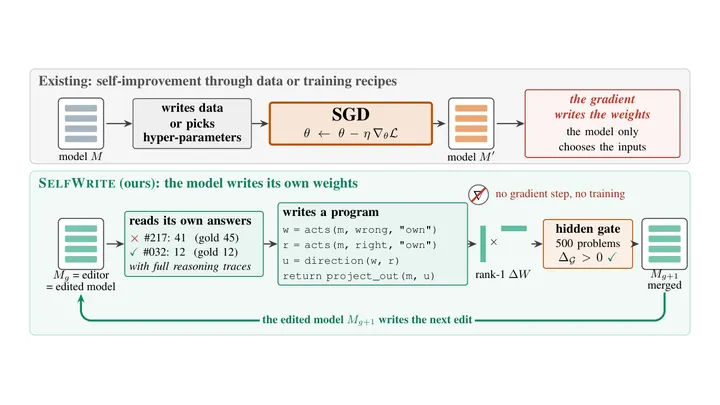
Recursive Self-Editing: LLMs Program Their Own Weight Edits for Self-Improvement

The loop: The SELFWRITE model inspects its own weights and activations to write Python programs that construct low-rank weight edits for itself. The best edits are merged into the model's weights, resulting in a successor that is better at solving math problems and writing subsequent edits.

A language model improves itself by inspecting its own weights and writing Python programs to construct low-rank weight edits without gradient descent.
loop fit 10/10Linghua Zhang, Yunhe Livia arXiv
Recursive Self-Editing: LLMs Program Their Own Weight Edits for Self-Improvement
PaperarXiv·20 Nov 2026·Tools and harness

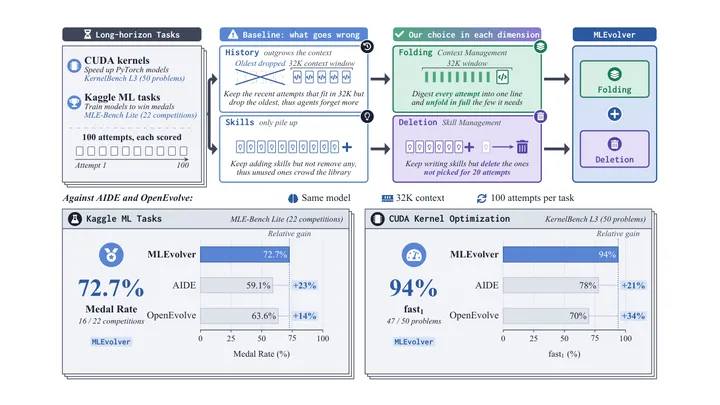
Demystifying the Autoresearch Harness: How Context and Skills Shape Self-Evolving Agents

The loop: Autoresearch agents systematically design and refine their own harness components for context and skill management. These improved harnesses are then used by the agents, increasing their performance on AI research benchmarks like MLE-Bench and KernelBench.

A systematic study of how autoresearch agents can evolve their own context and skill management harnesses to improve performance on long-horizon AI research tasks.

loop fit 9/10Kelvin Kiu-Wai Tam, Newt Hue-Nam K. Nguyen, Tianshi Zheng et al.via arXiv
Demystifying the Autoresearch Harness: How Context and Skills Shape Self-Evolving Agents
PaperarXiv·23 Nov 2026·Tools and harness

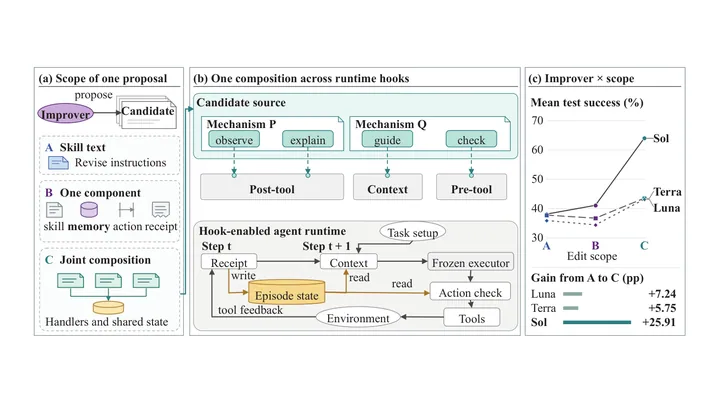
HookEvo: A Framework for Coordinated Plugin Evolution on Hook-Enabled Agent Runtimes

The loop: An improver model diagnoses execution failures and proposes edits to task-specific hooks in an agent runtime. The retained harness improvements are then used by the agent executor, making it better at completing tasks in subsequent rounds.

A framework that uses an improver model to diagnose failures and evolve task-specific plugins and hooks for an agent runtime.

loop fit 9/10Shengze Huang, Yanyu Mao, Xiaofei Yu, Baoshen Guo, Xiaorui Wang, Zhiwen Wu,...via arXiv
HookEvo: A Framework for Coordinated Plugin Evolution on Hook-Enabled Agent Runtimes
PaperarXiv·23 Nov 2026·Self-reward and self-play

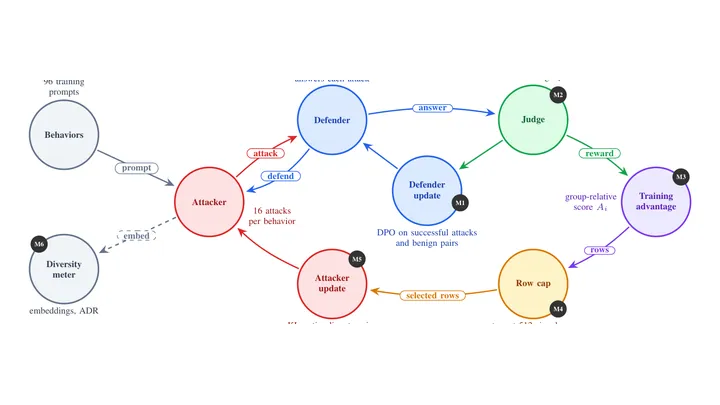
Tracing Attacker Diversity Reduction in Adaptive LLM Red Teaming

The loop: Automated red teaming agents attack a defender model and use reinforcement learning on the success feedback to update their strategy. This improves the attacker's ability to find vulnerabilities, though it also narrows the diversity of the generated attacks.

An analysis of how reinforcement learning narrows the diversity of attack vectors when automated red teaming agents adapt their strategies against a defender model.

loop fit 9/10Chris Tavavia arXiv
Tracing Attacker Diversity Reduction in Adaptive LLM Red Teaming
PaperarXiv·Self-reward and self-play

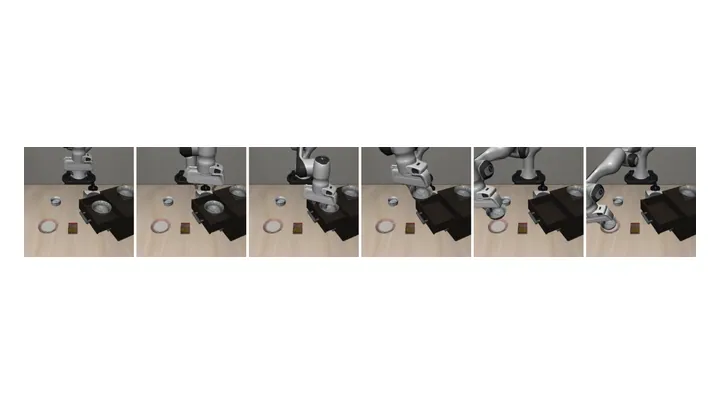
Stochastic Self-Distillation for Flow-Based Vision-Language-Action Models

The loop: A vision-language-action model performs stochastic self-distillation on its own generated outputs. This process updates the model's weights, making it better at executing future actions.

A vision-language-action model improves its action generation capabilities by performing stochastic self-distillation on its own outputs.

loop fit 9/10via Awesome-AI4AI
Stochastic Self-Distillation for Flow-Based Vision-Language-Action Models
ProjectGitHub·22 Jul 2026·Tools and harness

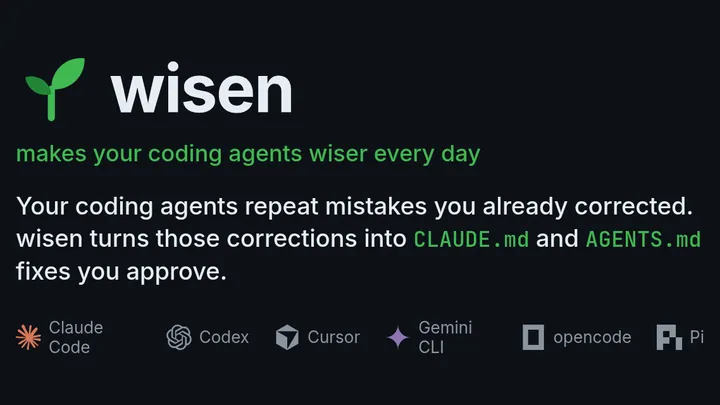
wisen

The loop: The wisen tool reads the session logs of coding agents and writes daily reflections to identify recurring mistakes. It then turns these corrections into persistent fixes in the agent's context files, making the coding agent better at avoiding those errors in future sessions.

A tool that reads coding agent sessions and generates persistent context fixes to prevent recurring mistakes.

loop fit 8/10Vela3202019via GitHub
wisen
ProjectGitHub·12 May 2026·Tools and harness

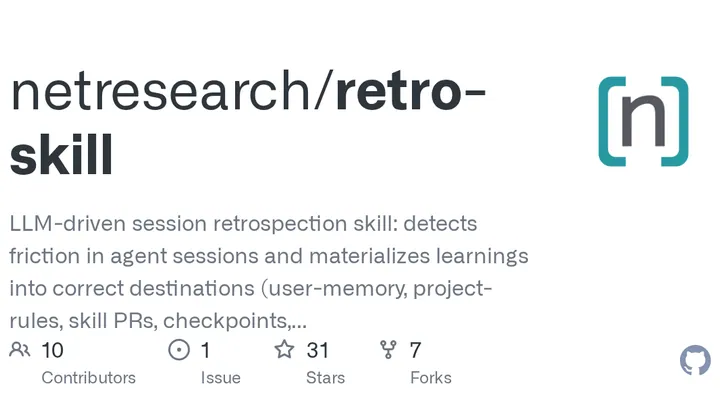
retro-skill

The loop: An LLM-driven retrospection skill detects friction in agent sessions and materializes the learnings into correct destinations like project rules and harness artifacts. This updates the agent's context and harness, making it more effective in future tasks.

An LLM-driven skill that detects friction in agent sessions and materializes learnings into harness artifacts and project rules.

loop fit 8/10netresearchvia GitHub
retro-skill
ModelHugging Face·23 Nov 2026·AI R&D evals

How to build and maintain an agentic evaluation

The loop: Agentic evaluation frameworks measure the performance of AI agents on complex tasks. The results from these evaluations provide the necessary feedback to improve the models and harnesses that power the agents.

A guide on constructing and maintaining evaluations for AI agents to measure and drive their improvement.

loop fit 8/10via Hugging Face
How to build and maintain an agentic evaluation

← 23 Nov 2026 Latest