Alphabell.
Daily edition

Radar, 21 Nov 2026

Today's radar highlights a shift toward internalizing improvements, with models writing harness gains directly into their own weights and recursing on their own outputs to build emergent depth.

PaperarXiv·19 Nov 2026·Training data

Piccolo: Co-Evolving Decision Models and Data through Recursive Self-Improvement

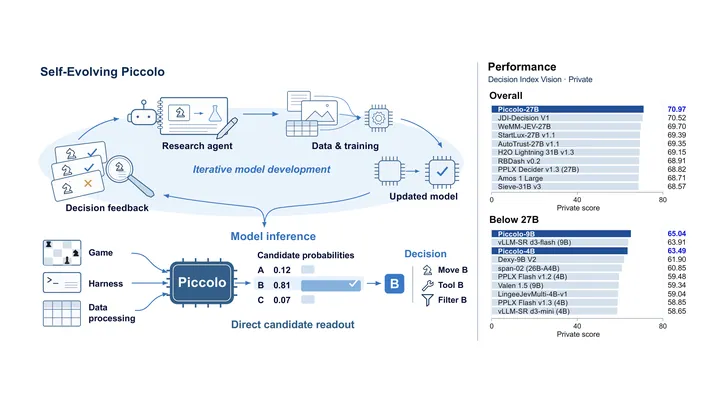
The loop: Piccolo research agents analyze model behavior, conduct experiments, and construct training data. This data improves the Piccolo model family, which in turn makes the agents better at data engineering and recursive self-improvement.

A family of multimodal decision models co-evolves its capabilities and training data through agentic data engineering and recursive self-improvement.

loop fit 9/10Zhenqing Ling, Qirui Jiao, Daoyuan Chen, Cheng Chen, Xinji Mai, Haowen Gao,...via arXiv
Piccolo: Co-Evolving Decision Models and Data through Recursive Self-Improvement
PaperarXiv·19 Nov 2026·Self-modifying agents

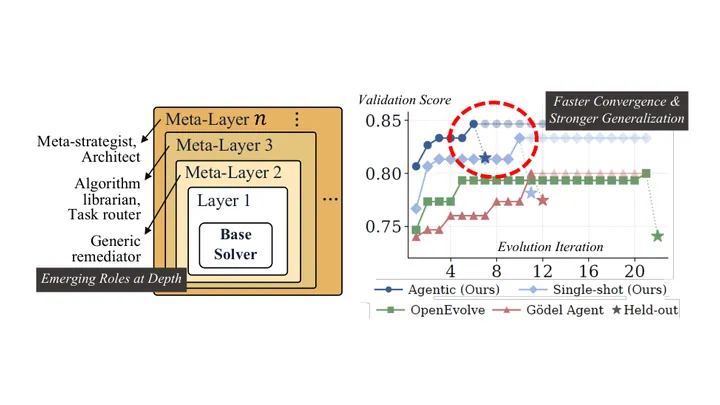
Meta^n: Recursive Self-Improvement through Emergent Depth

The loop: The Meta^n system repeatedly applies a fixed meta-operation to its own products and code. This improves its strategic pre-process and helper library, allowing the system to reason from a higher vantage point on subsequent layers.

A self-improving agent architecture recurses on its own input rather than its meta-operation, building an emergent depth of strategic pre-processes and helper libraries.

loop fit 9/10Zae Myung Kim, Young-Jun Lee, Seungyeon Jwa, Dongyeop Kangvia arXiv
Meta^n: Recursive Self-Improvement through Emergent Depth
PaperarXiv·19 Nov 2026·Tools and harness

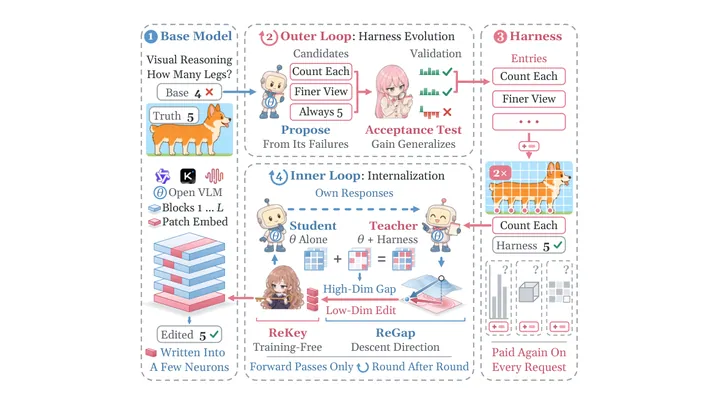
BaseRSI: Recursive Self-Improvement of a Base Vision-Language Model via Training-Free Harness Internalization

The loop: The BaseRSI model improves its own harness and then writes what the harness adds into its own weights through training-free edits. This improves the base model, making it better at further rounds of harness internalization.

A vision-language model recursively improves by internalizing the gains from its own harness directly into its weights using training-free edits.

loop fit 9/10Mingda Zhang, Yuanhao Dong, Qiang Huang, Rui Qian, Yanjin Li, Zhenyu Liu, Xiao...via arXiv
BaseRSI: Recursive Self-Improvement of a Base Vision-Language Model via Training-Free Harness Internalization
ProjectGitHub·18 Nov 2026·AI R&D evals

ZJUSCL/TwinLab-Bench

The loop: AI scientists are evaluated in agentic twins of real laboratories. This benchmark measures their ability to automate research, providing the signal needed to develop better AI research agents.

A benchmark evaluates AI scientists in simulated twins of real laboratories to measure and improve research automation capabilities.

loop fit 9/10ZJUSCLvia GitHub
ZJUSCL/TwinLab-Bench
Blog postMETR·20 Nov 2026·AI R&D evals

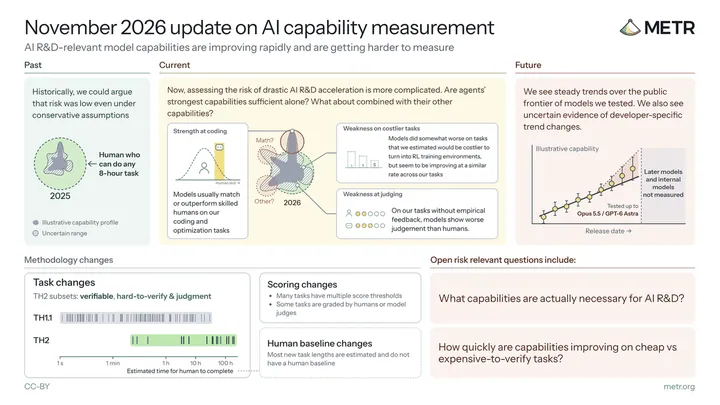
AI R&D-relevant model capabilities are improving rapidly and are getting harder to measure

The loop: Frontier models are evaluated on tasks relevant to AI R&D acceleration. These evaluations measure their ability to automate AI research, providing the signal needed to develop models that are even better at AI R&D.

METR presents an update on capability evaluations of public models relevant to accelerating AI research and development.

loop fit 9/10via METR
AI R&D-relevant model capabilities are improving rapidly and are getting harder to measure
PaperarXiv·18 Nov 2026·Architecture and optimizer search

An Open-Source Training Dataset for Foundation Models for Hyperparameter Optimization

The loop: Foundation models for hyperparameter optimization are trained on a large dataset of optimization trajectories. These models learn optimization principles that can be used to improve the training of future AI systems.

BBO-Pile is a large-scale, open-source dataset of optimization trajectories designed to train foundation models for hyperparameter optimization.

loop fit 9/10Aaron Klein, Herilalaina Rakotoarison, Luca Thale-Bombien, David Salinasvia arXiv
An Open-Source Training Dataset for Foundation Models for Hyperparameter Optimization
Forum postLessWrong·20 Nov 2026·Interpretability and oversight

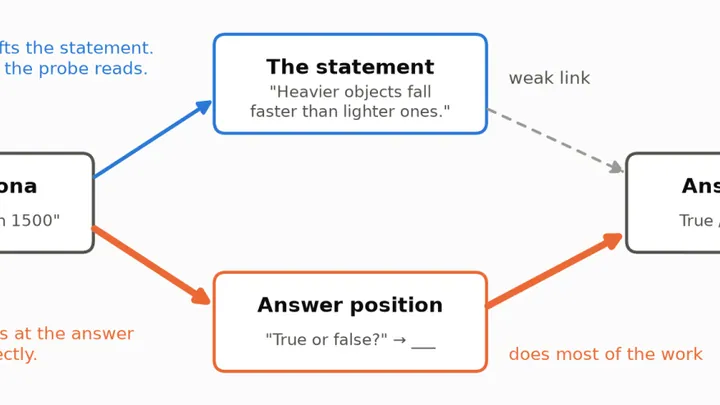
Truth probes follow the persona, but the answer doesn't go through them

The loop: Linear truth probes identify how models represent personas versus truth. This automated interpretability provides oversight that can be used to improve the training of successor models.

An analysis of linear truth probes reveals that they shift based on the model's persona, complicating their use for automated lie detection.

loop fit 8/10Aniket Ghoshvia LessWrong
Truth probes follow the persona, but the answer doesn't go through them

← 20 Nov 2026 Latest 22 Nov 2026 →